Menorah Meaning in the Bible: Light of God’s Presence
The menorah in the Bible, a central fixture described in Exodus, symbolizes divine enlightenment and spiritual guidance. Crafted from pure gold with seven branches, its intricate design reflects divine origin and sacred sanctification.
Positioned in the Tabernacle and later in the Temple, it represents God’s eternal presence, aligning with prophetic Scripture and foreshadowing messianic themes. The seven lamps denote completeness and God’s perfect wisdom.
Beyond its liturgical function, the menorah holds deep metaphysical significance, embodying light over darkness and eternal divine truth. This multifaceted symbol continues to illuminate understanding of biblical themes and Jewish spiritual identity.

Key Takeaways
- Represents divine light, presence, and guidance among the Israelites, symbolizing spiritual enlightenment and wisdom.
- Crafted from pure gold with seven branches, symbolizing completeness and perfection of divine knowledge.
- Central to Tabernacle and Temple worship, embodying God’s eternal covenant and spiritual illumination.
- Commemorates Hanukkah, celebrating the miracle of the oil and the triumph of light over darkness.
Origin of the Menorah
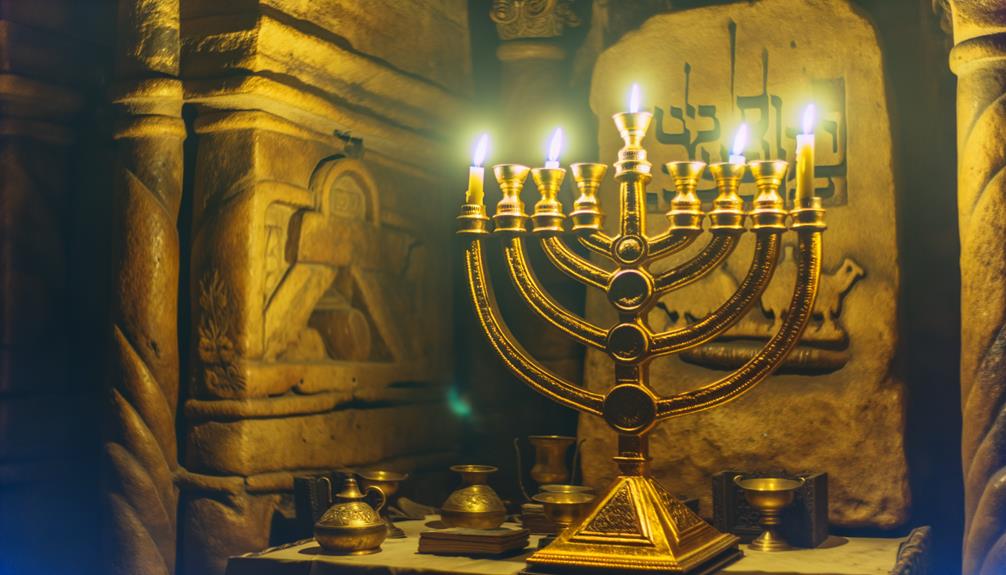
The origin of the menorah can be traced back to the instructions given by God to Moses in the Book of Exodus, where it was described as a central element of the Tabernacle.
This sacred candelabrum, comprising seven branches, was intended to symbolize divine light and presence among the Israelites. Its establishment within the holy context of the Tabernacle underscores its theological significance, representing a perpetual light that guides and sanctifies.
The menorah’s presence in Israelite worship practices reflects its integral role in their spiritual identity and covenantal relationship with God. By embedding it within the sacred structure, the menorah not only served a liturgical function but also embodied deeper metaphysical and eschatological meanings that resonate through Jewish tradition.
Design and Construction
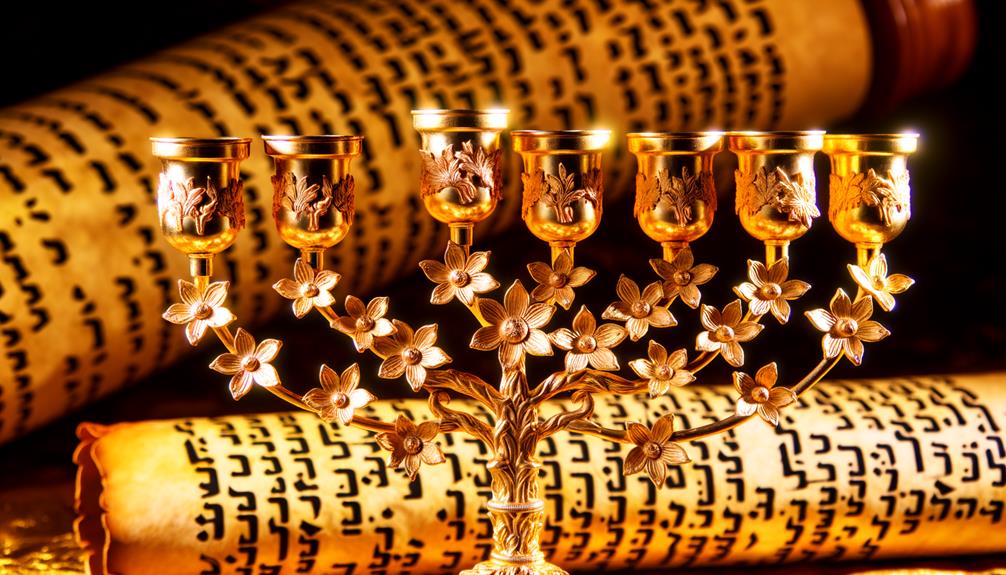
Crafted with meticulous precision according to divine instructions, the menorah’s design and construction hold profound symbolic and ritualistic significance within the biblical narrative. Detailed in Exodus 25:31-40, the menorah was made of pure gold, hammered into shape, and featured a central shaft with six branches. Each branch held a lamp, totaling seven lamps. The intricate design included almond blossoms, buds, and flowers, symbolizing life and growth.
| Component | Description |
|---|---|
| Material | Pure Gold |
| Structure | Central shaft with six branches |
| Decorations | Almond blossoms, buds, and flowers |
| Number of Lamps | Seven |
This meticulous craftsmanship reflects the importance of the menorah in the sanctification of sacred space, underscoring its divine origin and purpose.
Symbolism in Exodus

In the Book of Exodus, the menorah’s symbolism extends beyond its physical structure, representing divine enlightenment, spiritual guidance, and the enduring presence of God among the Israelites.
Crafted according to God’s precise instructions (Exodus 25:31-40), the menorah’s seven branches and perpetual light signify the completeness and perfection of divine knowledge.
The light emanating from the menorah serves as a metaphor for the Torah, illuminating the path of righteousness.
Additionally, the menorah’s central position within the Tabernacle underscores its role as a constant reminder of God’s covenant and providence.
This sacred candelabrum therefore functions as both a practical object and a profound theological symbol, encapsulating the connection between the divine and the chosen people in their journey through the wilderness.
Menorah in the Temple

Within the sacred confines of the Temple, the menorah assumed a central liturgical role, symbolizing both divine presence and the illumination of spiritual wisdom.
Positioned in the Holy Place, the seven-branched menorah was meticulously crafted from pure gold, as detailed in Exodus 25:31-40. Its perpetual light, maintained by the priests, signified unbroken vigilance and a covenantal relationship with God.
The menorah’s design, featuring almond blossoms and ornate cups, evoked the Tree of Life, thereby reinforcing themes of creation and divine sustenance.
Archaeological evidence and historical texts, such as the writings of Flavius Josephus, underscore its prominence, highlighting how the menorah served as a focal point in daily worship and Temple rituals.
Spiritual Significance
The menorah’s spiritual significance extends beyond its physical presence in the Temple, embodying profound theological themes that permeate biblical literature. It symbolizes divine light, guidance, and wisdom, representing God’s eternal presence among His people. The seven branches often correspond to the sevenfold Spirit of God mentioned in Isaiah 11:2, which includes wisdom, understanding, counsel, might, knowledge, fear of the Lord, and delight in the fear of the Lord.
| Aspect | Symbolism | Scripture Reference |
|---|---|---|
| Divine Light | God’s eternal presence | Exodus 27:20-21 |
| Sevenfold Spirit | Completeness, Perfection | Isaiah 11:2 |
| Guidance and Wisdom | Spiritual Illumination | Psalm 119:105 |
This multifaceted symbolism underscores the menorah’s central role in conveying spiritual truths fundamental to biblical theology.
Prophetic References

Within the biblical canon, the menorah emerges not only as a symbol of divine illumination but also as a prophetic instrument foreshadowing Christ and His teachings.
Its intricate design and perpetual light are echoed in John’s apocalyptic vision in Revelation, cementing its eschatological significance.
This interplay between symbol and prophecy underscores the menorah’s enduring theological relevance.
Symbol of Divine Light
In prophetic scripture, the menorah is frequently depicted as a symbol of divine illumination, representing God’s eternal presence and guidance.
The seven-branched lampstand, detailed in Exodus 25:31-40, serves not only as a physical source of light but also as a metaphorical beacon in the tabernacle.
This imagery is echoed in Zechariah 4:2-6, where the vision of a golden menorah signifies the Spirit of the Lord empowering Zerubbabel.
The menorah’s perpetual light underscores the unending nature of divine wisdom and revelation.
Through its continual flame, the menorah illuminates the path of righteousness, symbolizing the way in which God’s presence enlightens and directs His people.
Consequently, it stands as an enduring emblem of divine truth and spiritual clarity.
Foreshadowing of Christ
Building upon the menorah’s symbolism of divine illumination, its presence in biblical prophecy can also be interpreted as a foreshadowing of Christ, reflecting the anticipated arrival of the Messiah as a guiding light for humanity.
The menorah’s seven lamps, often associated with spiritual completeness, may symbolize the perfect and all-encompassing nature of Christ’s light. Isaiah 9:2 speaks of a great light shining on those in darkness, which is often interpreted in Christian theology as a messianic prophecy fulfilled in Christ.
Furthermore, John 8:12, where Jesus declares Himself the ‘light of the world,’ further aligns Christ with the menorah’s enduring symbolism. Consequently, the menorah not only represents divine presence but prophetically prefigures the Messiah’s redemptive mission.
Vision in Revelation
The Book of Revelation, with its vivid imagery and prophetic visions, prominently features the menorah as a symbol of God’s presence and the illumination of divine truth in the eschatological narrative. Within this apocalyptic text, the menorah often appears in contexts emphasizing divine revelation and judgment. This symbolic representation connects the menorah to the seven churches of Asia, each lampstand embodying a church’s spiritual state and role.
| Symbol | Interpretation |
|---|---|
| Menorah | Divine presence, illumination |
| Seven Lampstands | Seven churches of Asia |
| Light | Truth, guidance |
| Seven Spirits | Complete manifestation of the Holy Spirit |
| Golden | Purity, holiness |
Such imagery underscores the menorah’s role as a conduit for divine enlightenment and prophetic insight, essential for understanding the broader theological themes in Revelation.
Modern-Day Relevance
Today, the menorah continues to hold profound significance, symbolizing the enduring faith and cultural heritage of the Jewish people.
In modern contexts, the menorah is prominently displayed during Hanukkah, commemorating the rededication of the Second Temple and the miracle of the oil.
Beyond its ritualistic role, the menorah has also become a symbol of enlightenment, knowledge, and resilience.
In the State of Israel, the menorah is featured on the national emblem, embodying the country’s historical continuity and spiritual aspirations.
Additionally, its presence in various educational and cultural institutions underscores its role as a bridge between ancient traditions and contemporary Jewish identity.
Consequently, the menorah remains an essential link to the past while guiding present and future generations.
Conclusion
The menorah, an ancient symbol originating from biblical texts, encapsulates profound religious and spiritual significance.
Its intricate design and construction, as detailed in Exodus, reflect divine instructions and symbolism.
Serving as a beacon in the Temple, the menorah’s light continues to illuminate Jewish faith through time.
Prophetic references and its enduring presence underscore its perpetual relevance.
Much like a revered relic in a modern museum, the menorah remains a symbol of enduring faith and tradition.