
Seethe Meaning in the Bible: Anger and Emotion
In the Bible, the term ‘seethe‘ refers to boiling, often in the context of food preparation and ritualistic practices. Rooted in Old English and Proto-Germanic origins, its usage reflects the intricate dietary and sacrificial laws of ancient Israel as seen in passages like Exodus 23:19.
These practices emphasized purity, ritual precision, and obedience to divine commandments, symbolizing deeper spiritual principles. Theological implications include separation from pagan customs and the refining of the faithful.
Scriptural instances also imbue ‘seethe’ with connotations of intense emotional and divine states, revealing layers of cultural and spiritual meaning. Discover more by examining these contexts.

Key Takeaways
- ‘Seethe’ in the Bible refers to boiling, particularly in food preparation and sacrificial contexts, emphasizing ritual purity and obedience.
- The term ‘seethe’ underscores strict dietary laws in ancient Israel, highlighting cultural norms and religious observance.
- Seething meat in sacrificial practices symbolizes purification and dedication, ensuring adherence to divine commandments.
- The emotional connotation of ‘seethe’ signifies intense states like divine anger and human fervor, reflecting themes of judgment and renewal.
Historical Context

Examining the historical context of the term ‘seethe’ in the Bible requires an understanding of its usage within ancient Hebrew culture and scriptural language.
In biblical texts, ‘seethe’ often refers to the act of boiling, particularly in the context of food preparation and ritualistic practices. Ancient Hebrew society adhered strictly to dietary laws, which included specific instructions on how food should be prepared.
For instance, Exodus 23:19 prohibits boiling a young goat in its mother’s milk, reflecting broader cultural and religious norms. These instructions were not merely culinary but carried theological implications, emphasizing purity, sanctity, and obedience to divine commandments.
Consequently, examining the term ‘seethe’ sheds light on the intricate relationship between daily life and religious observance in ancient Israel.
Etymology of Seethe

The etymology of ‘seethe’ traces back to the Old English word ‘seothan,’ meaning to boil or cook, which itself is derived from the Proto-Germanic ‘*seuthan,’ indicating the term’s deep linguistic roots and historical evolution.
This term vividly captures a process of transformation and agitation, resonating with biblical themes of purification and refinement.
In theological discourse, ‘seethe’ metaphorically represents the divine process of purging impurities, akin to how metal is refined through intense heat.
Understanding this etymology enhances scriptural analysis by providing richer insights into passages where boiling or cooking is mentioned.
It underscores the symbolic significance of heat and transformation in God’s dealings with humanity, offering a profound layer of meaning to biblical texts.
Seethe in the Old Testament

In the Old Scriptures, ‘seethe‘ frequently appears in contexts that highlight ritualistic practices and divine commandments, elucidating its theological and symbolic importance.
For instance, in Exodus 23:19, the command, ‘Thou shalt not seethe a kid in his mother’s milk,’ is a directive with significant ritual purity implications. This prohibition underscores the separation of life and death, an essential principle in Jewish dietary laws and ethical conduct.
Additionally, in the narrative of Jacob and Esau, ‘seethe’ is used to describe the preparation of a meal, reflecting societal norms and familial relationships of the time.
Consequently, ‘seethe’ in the Old Testament is not merely a culinary term but a word laden with religious and moral connotations, shaping ancient Israelite identity and practice.
Culinary References

How does the term ‘seethe’ in biblical texts deepen our understanding of ancient culinary practices and their intertwining with religious observances?
The word ‘seethe,’ often translated as ‘boil’ or ‘cook,’ provides insight into the dietary laws and daily life of the Israelites.
In the context of biblical culinary practices, ‘seethe’ illustrates:
- The preparation of meat: As seen in Exodus 23:19, where it prohibits boiling a young goat in its mother’s milk.
- Ritual purity: Certain cooking methods were prescribed to maintain ceremonial cleanliness.
- Community meals: Often prepared by seething meat in large communal pots, fostering fellowship.
These culinary references reveal a profound connection between food, faith, and community in ancient Israel.
Seethe and Sacrificial Practices
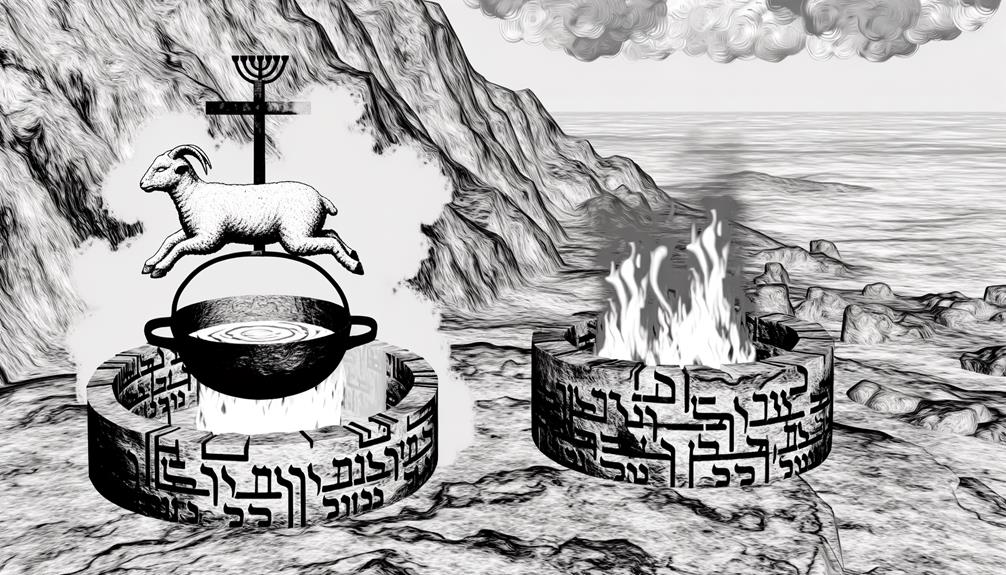
In examining the term ‘seethe‘ within the Bible, it is essential to understand its definition in the context of sacrificial practices, particularly as outlined in ancient Israelite rituals.
Historically, sacrificial offerings frequently involved specific cooking methods, including boiling or seething, as seen in various scriptural passages such as Exodus 23:19.
Analyzing these practices sheds light on the theological significance and the meticulous regulations governing ritualistic sacrifices.
Biblical Seething Definition
Seething, as referenced in biblical texts, denotes the act of boiling, particularly in the context of ancient sacrificial practices where boiling meat was a common method of preparing offerings to God. This practice is mentioned in several scriptural passages, reflecting its theological and ritual significance.
- Exodus 23:19: Prohibits boiling a young goat in its mother’s milk, highlighting ethical boundaries.
- 1 Samuel 2:13-14: Describes priests using a three-pronged fork to retrieve boiled meat from a pot, emphasizing proper ritual conduct.
- Leviticus 6:28: Specifies that if a sacrificial offering is boiled in a bronze pot, the pot must be scoured and rinsed.
These references underscore the importance of seething in biblical sacrificial rites.
Historical Sacrificial Context
Ancient Israel’s sacrificial practices, deeply rooted in ritualistic precision, prominently featured the act of seething as a means of preparing offerings that were both symbolically and ceremonially significant.
Within the broader Levitical system, seething, or boiling, was employed to process certain portions of sacrificial animals. These actions were meticulously outlined in texts such as Leviticus and Deuteronomy, where seething symbolized purification and dedication to God.
The boiling process guaranteed that the offerings were rendered in a manner that adhered to divine prescriptions, reinforcing a covenantal relationship between Israel and Yahweh.
Scriptural references, including Exodus 23:19, further emphasize the importance of adhering to these methods, underscoring the theological significance behind sacrificial preparations and their alignment with divine commands.
Ritualistic Cooking Methods
Frequently, the ritualistic cooking methods detailed in biblical texts, including seething, play a pivotal role in understanding the theological and ceremonial dimensions of ancient Israelite sacrificial practices.
These methods were not merely culinary; they embodied profound religious significance, reflecting obedience to divine commandments and facilitating communal worship.
In scriptural analysis, several key aspects emerge:
- Exodus 23:19: Prohibits boiling a young goat in its mother’s milk.
- Leviticus 7:15: Details specific cooking instructions for peace offerings.
- 1 Samuel 2:13-14: Describes the priests’ practice of taking portions from seething pots.
These cooking rituals underscore the intersection of daily life and sacred observance, enriching our historical and theological comprehension.
Emotional Connotations

In biblical scripture, the term ‘seethe’ carries profound emotional connotations that resonate deeply within the context of divine anger and human fervor. Throughout the Old Covenant, ‘seethe’ signifies intense emotional states, often associated with God’s righteous wrath or the fervent zeal of His followers. This term encapsulates the boiling intensity of emotions that can lead to transformative spiritual experiences or divine judgment.
| Emotion | Scriptural Reference | Implication |
|---|---|---|
| Divine Anger | Exodus 32:10 | God’s wrath toward idolatry |
| Human Zeal | 2 Kings 10:16 | Jehu’s fervor for the Lord |
| Spiritual Agitation | Job 30:27 | Job’s inner turmoil |
Understanding these emotional layers enriches one’s comprehension of biblical narratives and the profound spiritual lessons they convey.
Seethe in Prophetic Texts

The term ‘seethe’ in prophetic texts often carries profound symbolic and interpretive weight, reflecting intense divine displeasure or judgment.
Understanding its usage requires examining the contextual framework of prophecy, where seething emotions and actions frequently underscore messages of impending upheaval or transformation.
Historically and culturally, such language resonated deeply with ancient audiences, providing vivid imagery that reinforced the gravity of prophetic declarations.
Symbolism and Interpretation
Examining the term ‘seethe’ within prophetic texts reveals a rich tapestry of symbolic meaning that often underscores divine judgment and purification processes. This terminology encapsulates the intense, transformative experiences that prophets convey to their audiences.
Through a theological lens, ‘seethe’ can be interpreted as:
- Divine Wrath: The boiling point of God’s anger against sin, leading to purification.
- Refinement: Similar to metal being purified in a furnace, seething represents the refining of the faithful.
- Judgment: The intense, seething heat signifies the impending judgment upon nations or individuals.
These interpretations highlight the multifaceted symbolism of ‘seethe’ and its fundamental role in prophetic literature.
Context in Prophecy
Prophetic texts frequently employ the term ‘seethe’ to illustrate moments of divine intervention and the consequential purification they bring. This term is used to convey a process of intense emotional or spiritual upheaval, often serving as a precursor to transformation.
For instance, in Ezekiel 24:5, the seething pot symbolizes Jerusalem’s impending judgment and cleansing. The prophetic use of ‘seethe’ therefore underscores a dynamic interplay between divine wrath and mercy, aiming for ultimate restoration.
Historical and Cultural Significance
How does the term ‘seethe’ reflect the historical and cultural context of ancient Israelite society within prophetic texts? The term ‘seethe’ in prophetic literature often symbolizes intense emotional and spiritual upheaval, mirroring the social and political turmoil of ancient Israel. It evokes imagery of boiling cauldrons or fermenting anger, emphasizing the urgent need for repentance and divine intervention. Theologically, ‘seethe’ underscores God’s righteous indignation and the fervent call for justice.
Symbol of Divine Anger: Prophets used ‘seethe’ to convey God’s displeasure with Israel’s disobedience.
Social and Political Turmoil: Reflects the chaos and instability of the period.
Call for Repentance: Urgency in turning back to God.
Imagery of Purification: Seething as a metaphor for purging impurities.
Comparative Translations

Different translations of the Bible offer varying interpretations of the term ‘seethe,’ reflecting both linguistic evolution and theological nuances.
The King James Version (KJV) frequently employs ‘seethe’ in the context of cooking, as seen in Exodus 23:19, where it admonishes not to ‘seethe a kid in his mother’s milk.’
Modern translations like the New International Version (NIV) replace ‘seethe’ with ‘cook,’ reflecting contemporary language usage.
Theological implications also vary; while ‘seethe’ in older texts may carry connotations of ritualistic or cultural significance, newer translations aim for clarity and accessibility.
This divergence underscores the importance of examining multiple translations to fully grasp the scriptural intent and its resonance across different historical and cultural landscapes.
Seethe in Modern Interpretations

In modern biblical scholarship, the term ‘seethe’ is often reinterpreted through linguistic, cultural, and theological lenses to enhance the understanding of its original scriptural context and relevance. Scholars explore ancient Hebrew and Greek texts to discern nuances that might be lost in modern translations. The cultural practices of ancient societies are also examined to provide a backdrop for the term’s usage.
- Linguistic Analysis: Examining root words and their evolution.
- Cultural Context: Understanding ancient culinary practices and their symbolic meanings.
- Theological Significance: Exploring how the term reflects divine commandments and human conduct.
Such multifaceted approaches guarantee a richer, more accurate interpretation of ‘seethe’ in biblical exegesis.
Spiritual Implications

The spiritual implications of the term ‘seethe’ in biblical texts reveal profound insights into the nature of divine instructions and human obedience. In scripture, ‘seethe’ often pertains to dietary laws and ritual purity, underscoring the importance of adhering to God’s commands. The Hebrew term for ‘seethe,’ בָּשַׁל (bashal), extends beyond mere cooking to symbolize purification and transformation processes.
| Aspect | Biblical Significance |
|---|---|
| Dietary Laws | Emphasizes separation from pagan practices |
| Ritual Purity | Guarantees holiness and sanctification |
| Divine Obedience | Reflects submission to God’s will |
| Transformation | Represents spiritual refinement |
| Symbolism of Seething | Highlights moral and spiritual cleansing |
Understanding these facets encourages deeper reflection on how ancient practices inform contemporary spiritual life.
Conclusion
In the biblical context, the term ‘seethe’ encompasses historical, culinary, and sacrificial dimensions, reflecting the multifaceted nature of ancient practices and beliefs.
Through an etymological lens and comparative translations, the word’s usage in prophetic texts underscores deeper spiritual implications.
As the saying goes, ‘still waters run deep,’ indicating that beneath the surface of seemingly mundane terms lies profound theological significance.
Understanding ‘seethe’ enriches comprehension of scriptural narratives and their enduring moral and spiritual lessons.