Enthroned Meaning in the Bible: God’s Sovereignty
In the Bible, ‘enthroned‘ denotes the supreme authority and sovereignty of God, vividly represented through throne imagery. Scriptural instances such as Isaiah 6:1 and Revelation 4:2 highlight God’s divine governance and moral order.
The Old Covenant underscores God’s kingship in creation (Genesis 1:1) and His established throne (Psalm 103:19). Historical contexts include the anointing of David and Solomon, symbolizing divinely sanctioned leadership.
Prophetic texts like Isaiah 9:6-7 and Daniel 7:13-14 envision an eternal, righteous reign. Throne imagery in Revelation emphasizes judgment and worship (Revelation 20:11).
Understanding these elements reveals deeper theological insights.

Key Takeaways
- Symbolizes Divine Authority: Being enthroned in the Bible symbolizes God’s ultimate authority and governance over all creation (Psalm 103:19).
- Representation of Kingship: Enthronement signifies God’s kingship and everlasting reign, illustrated in passages like Revelation 11:15.
- Divine Judgment and Moral Order: It denotes God’s role in judgment and maintaining moral order, as seen in Isaiah 6:1 and Revelation 20:11.
- Messianic Fulfillment: Enthronement imagery aligns with messianic expectations, pointing to a future ruler of justice and peace (Isaiah 9:6-7).
Divine Thrones in Scripture
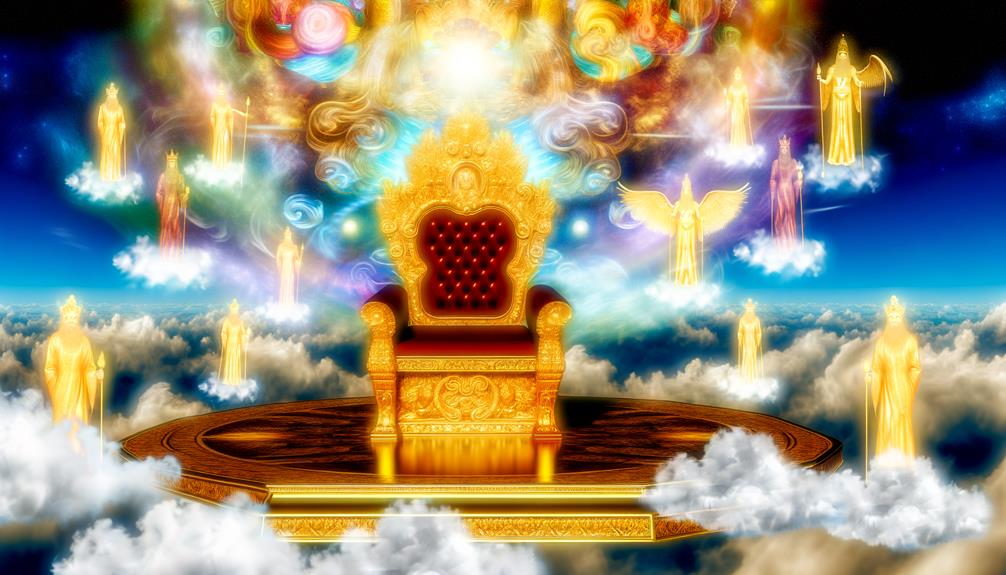
The concept of divine thrones in Scripture is deeply rooted in the theological portrayal of God’s sovereignty and kingship, as illustrated in numerous biblical passages such as Isaiah 6:1 and Revelation 4:2.
These visions depict God seated on a throne, emphasizing His supreme authority and majestic rule over creation. Historically, thrones were symbols of power and judgment in ancient Near Eastern cultures, aligning with the biblical imagery used to convey God’s dominion.
Isaiah’s vision of the Lord ‘high and exalted, seated on a throne’ (Isaiah 6:1) and John’s revelation of a ‘throne in heaven with someone sitting on it’ (Revelation 4:2) underscore the central theme of divine governance and the ultimate source of moral and cosmic order in Christian theology.
God’s Sovereignty and Authority

God’s sovereignty and authority are evident throughout Scripture, exemplified by His divine rule over creation as seen in Genesis 1:1, where He speaks the universe into existence.
This supreme power is further manifested in passages like Psalm 103:19, where His throne is established in the heavens, affirming His control over all.
Historically, the eternal kingship of God is consistently reinforced through biblical narratives, such as in Revelation 11:15, where His reign is proclaimed as everlasting.
Divine Rule Over Creation
Exhibiting unparalleled sovereignty, biblical texts consistently depict God as the supreme ruler over all creation, as illustrated in passages like Psalm 103:19. The divine rule is emphasized through numerous scriptural references, underscoring God’s ultimate authority over the cosmos and human history. This theological notion is vividly portrayed in the Old Covenant, where God’s agreement with Israel signifies His dominion. Additionally, the New Testament affirms this through Christ’s role in creation, as seen in Colossians 1:16.
| Scripture | Concept of Divine Rule |
|---|---|
| Psalm 103:19 | God’s throne established in the heavens |
| Genesis 1:1-31 | God as Creator and Sustainer |
| Exodus 20:2-3 | God’s command for exclusive worship |
| Colossians 1:16 | Christ’s involvement in creation |
This framework establishes the foundational understanding of God’s sovereignty.
Supreme Power Manifested
In numerous biblical narratives, divine sovereignty is vividly demonstrated through acts of judgment, deliverance, and the establishment of covenants, all of which underscore God’s supreme authority over both the natural and spiritual domains.
For instance, in the Exodus account, God’s deliverance of Israel from Egyptian bondage (Exodus 12-14) reveals His unparalleled power over nations and nature.
Similarly, the covenant with Abraham (Genesis 17) highlights God’s sovereign choice and unfolding plan for humanity.
The prophetic literature, such as Isaiah 45:7, affirms God’s control over both calamity and blessing.
These scriptural references, set against the historical context of ancient Near Eastern thought, emphasize a God whose authority transcends human limitations, solidifying His position as the ultimate sovereign ruler.
Eternal Kingship Affirmed
Building upon the demonstration of divine sovereignty through historical acts, the biblical affirmation of God’s eternal kingship is profoundly illustrated in passages that declare His unending dominion and authority, such as Psalm 93:1-2 and Revelation 11:15.
Psalm 93 proclaims, ‘The Lord reigns; he is robed in majesty… Your throne is established from of old; you are from everlasting.’
Similarly, Revelation 11:15 heralds, ‘The kingdom of the world has become the kingdom of our Lord and of His Christ, and He shall reign forever and ever.’
These scriptures underscore a continuous, unbroken reign, portraying God’s authority as timeless and unassailable.
Historically, these declarations provided assurance to believers, affirming God’s ultimate control over all creation and history.
David’s Anointing and Reign
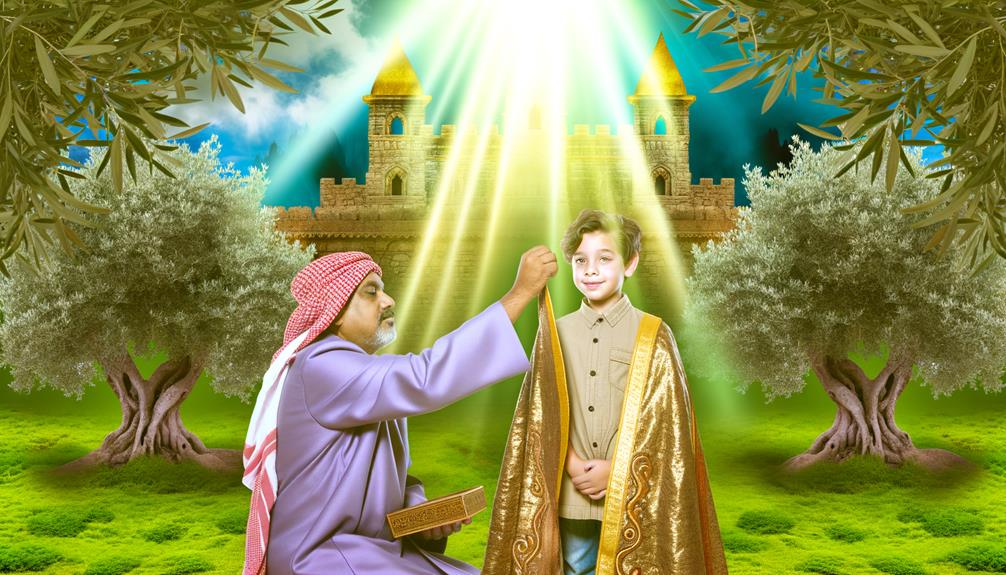
David’s anointing by the prophet Samuel, as recounted in 1 Samuel 16:13, marks a pivotal moment in biblical history, signifying God’s selection of a king ‘after His own heart.’
David’s ascent to power, highlighted through his military victories and leadership, underscores the divine favor and providence central to his reign.
Establishing Jerusalem as the capital (2 Samuel 5:6-9) further cements his legacy, intertwining the spiritual and political dimensions of kingship in Israel.
Samuel’s Anointing Ceremony
Samuel’s anointing ceremony of David, as detailed in 1 Samuel 16:1-13, marks a pivotal moment in biblical history, signifying the divine selection and legitimization of David’s future reign over Israel.
In this passage, the prophet Samuel, acting under God’s command, bypasses David’s elder brothers, emphasizing God’s preference for the heart over outward appearances (1 Sam. 16:7).
The anointing by Samuel with oil symbolizes the Holy Spirit’s empowerment, establishing David as God’s chosen leader amidst Israel’s spiritual and political turbulence.
This act not only foreshadows David’s eventual kingship but also serves as a theological affirmation of God’s sovereign will and intimate involvement in the leadership of His people.
David’s Rise to Power
In examining the narrative of 1 Samuel 16-2 Samuel 5, the account of David’s ascendancy to the throne reveals a complex interplay of divine providence, personal valor, and political maneuvering.
David’s rise involves several significant moments:
- Divine Selection: David’s anointing by Samuel (1 Samuel 16:12-13) signifies a divine choice, highlighting God’s preference for inner character over outward appearance.
- Military Exploits: His victory over Goliath (1 Samuel 17) and subsequent military triumphs solidify his reputation and rally popular support.
- Political Strategy: David’s strategic alliances and marriages (2 Samuel 3:2-5) demonstrate his acumen in consolidating power amidst the turbulent shift from Saul’s reign.
These elements underscore the theological theme of God’s sovereignty intertwined with human agency in the establishment of David’s kingship.
Establishing Jerusalem Capital
As David’s consolidation of power progressed, the establishment of Jerusalem as the political and spiritual capital marked a pivotal moment in his reign, as chronicled in 2 Samuel 5:6-10.
Historically, Jerusalem’s capture symbolized the unification of the Israelite tribes under David’s monarchy.
Theologically, this act signified divine favor and the fulfillment of God’s covenantal promises.
David’s anointing, earlier noted in 1 Samuel 16:13, found its consummation in his reign from Jerusalem, a city that would become central to Israel’s religious identity.
Solomon’s Coronation

The coronation of Solomon, detailed in 1 Kings 1:28-40, marks a pivotal moment in biblical history, symbolizing the divine appointment and continuation of Davidic kingship. This significant event can be understood through various dimensions:
- Divine Legitimacy: Solomon’s anointing by Zadok the priest and Nathan the prophet underscores the divine sanctioning of his kingship (1 Kings 1:39).
- Dynastic Continuity: As David’s chosen successor, Solomon’s enthronement guarantees the preservation of the Davidic covenant, affirming God’s promise to David (2 Samuel 7:12-16).
- National Stability: Solomon’s ascension brings unity and stability to Israel, countering the rebellion of Adonijah and consolidating national governance (1 Kings 1:49-53).
These elements highlight the theological and historical significance of Solomon’s coronation in biblical narrative.
Symbolism of Thrones
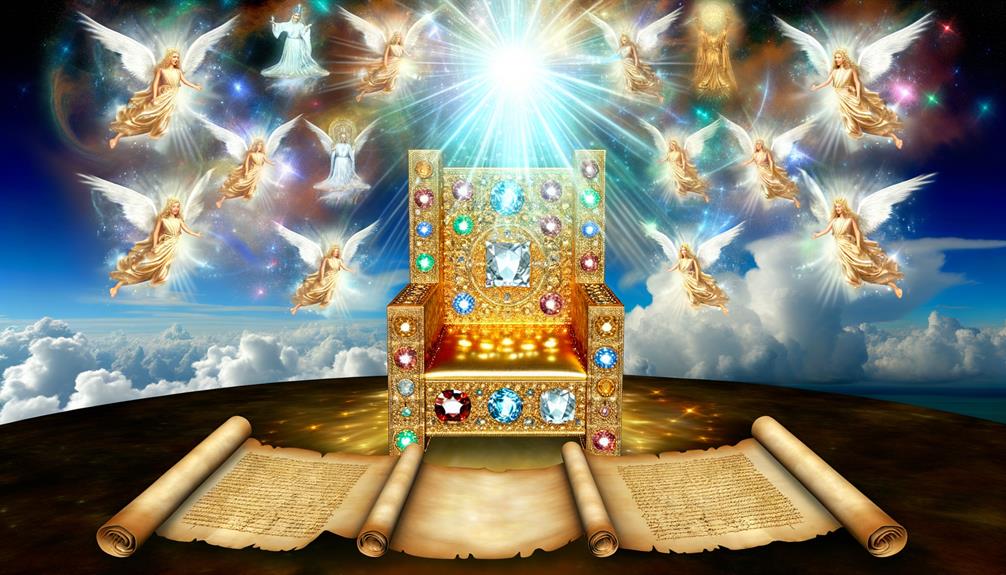
Solomon’s coronation not only signifies the establishment of his rule but also introduces the broader biblical theme of thrones as symbols of divine authority and kingship. Thrones in the Bible are more than mere seats of power; they represent God’s sovereignty and the legitimacy of earthly rulers. Scriptural references such as Isaiah 6:1 and Revelation 4:2 underscore the throne as a locus of divine majesty and judgment. Historically, thrones have been central to the portrayal of kingship in ancient Near Eastern cultures, reflecting a divine mandate.
| Scripture | Theme | Context |
|---|---|---|
| Isaiah 6:1 | Divine Majesty | Vision of Isaiah |
| Revelation 4:2 | Heavenly Authority | John’s Revelation |
| 1 Kings 10:18-20 | Solomonic Splendor | Solomon’s Throne |
| Daniel 7:9 | Divine Judgment | Vision of the Ancients |
Prophecies of the Messiah’s Reign
Biblical prophecies concerning the Messiah’s reign consistently emphasize the establishment of an eternal kingdom characterized by justice, peace, and divine authority.
Scriptural analysis reveals key aspects of this prophetic vision:
- Isaiah 9:6-7: Foretells a ruler with titles such as ‘Wonderful Counselor’ and ‘Prince of Peace,’ governing with justice and righteousness.
- Daniel 7:13-14: Describes the ‘Son of Man’ receiving everlasting dominion, glory, and a kingdom where all nations serve Him.
- Psalm 2:6-9: Proclaims the Messiah’s authority to rule with an iron scepter, emphasizing divine decree and sovereignty.
Historically, these prophecies have been pivotal in shaping eschatological expectations, reinforcing the anticipation of a messianic reign grounded in divine promise and scriptural affirmation.
Throne Imagery in Revelation

Revelation employs throne imagery extensively to symbolize divine authority, judgment, and the ultimate sovereignty of God and the Lamb over creation.
Central to this imagery is Revelation 4:2-3, where John describes a throne set in heaven, with One seated on it, radiating with the brilliance of precious stones. This throne signifies God’s supreme authority and His role as the righteous judge.
Revelation 5 introduces the Lamb, symbolizing Christ, who shares in this authority, being worthy to open the scroll.
The imagery extends through Revelation 20:11, where a great white throne represents the final judgment.
Historically, apocalyptic literature used such imagery to communicate enduring divine power amidst persecution, affirming the eschatological hope of God’s ultimate victory.
Worship and Enthronement

In the context of biblical theology, worship and enthronement are intricately linked, as demonstrated by the myriad of scriptural passages that depict divine kingship through the act of worship. This relationship is evident in several key aspects:
Old Covenant Examples: Psalms 22:3 states, ‘Yet you are enthroned as the Holy One; you are the one Israel praises.’ Worship here is a recognition of God’s sovereign rule.
New Covenant Revelation: Revelation 4:10-11 depicts elders casting crowns before God’s throne, signifying submission and adoration.
Historical Context: Ancient Near Eastern ceremonies often included enthronement rituals, paralleling biblical depictions where worship acknowledges divine authority.
Through these examples, one sees how worship functions as an acknowledgment of God’s enthronement, intertwining devotion with divine sovereignty.
Spiritual Implications for Believers
Understanding the spiritual implications of God’s enthronement for believers involves recognizing the transformative power of divine sovereignty in their daily lives.
Scripturally, passages like Psalm 99:1 declare, ‘The Lord reigns, let the nations tremble.’ This asserts God’s supreme authority, urging believers to trust in His ultimate control over worldly affairs.
Historically, the enthronement motif has provided solace and strength during periods of persecution, as seen in early Christian communities under Roman rule.
For contemporary believers, acknowledging God’s enthronement fosters a profound sense of peace and purpose, aligning their lives with divine will.
This theological perspective underscores that God’s reign is not merely a future hope but a present reality, shaping ethical conduct and spiritual resilience.
Conclusion
The concept of enthronement in the Bible encapsulates divine authority, sovereign rule, and prophetic fulfillment.
For instance, the Book of Revelation references the term ‘throne’ over 40 times, symbolizing God’s ultimate dominion and the eschatological hope of believers.
Historical context, such as David’s anointing and Solomon’s coronation, provides a rich tapestry for understanding biblical kingship.
This theological analysis underscores the enduring significance of thrones in conveying spiritual truths and divine governance throughout Scripture.