
Genealogy Meaning in the Bible: Lineage and Legacy
In the Bible, genealogies serve as essential theological and historical matrices that document the ancestries of seminal figures such as Adam, Noah, Abraham, David, and Jesus Christ. These records underscore God’s covenantal promises, evidencing divine faithfulness and providence through successive generations.
They not only situate biblical narratives within precise historical contexts but also reinforce themes of divine judgment, mercy, and the inclusivity of God’s salvific plan. These genealogical lists highlight the interconnectedness of humanity and God’s redemptive work, bridging Old and New covenant prophecies.
Exploring these records reveals profound spiritual insights and theological consistency within the biblical text.

Key Takeaways
- Genealogies in the Bible document the ancestry of pivotal figures like Adam, Noah, Abraham, David, and Jesus Christ.
- They affirm God’s covenantal faithfulness, highlighting divine providence and election across generations.
- Genealogical records serve as chronological anchors, situating biblical narratives within historical contexts.
- They illuminate the inclusivity of God’s plan, showcasing the participation of Gentiles in the messianic lineage.
Importance of Biblical Genealogies

Biblical genealogies hold significant theological and historical importance, serving as essential frameworks for understanding the lineage of key figures and the fulfillment of divine promises throughout scripture.
These genealogical records meticulously document the ancestry of pivotal individuals such as Adam, Noah, Abraham, David, and ultimately Jesus Christ.
By providing a continuous lineage, they affirm God’s covenantal faithfulness across generations, underscoring themes of divine providence and election.
Additionally, genealogies serve as chronological anchors, situating biblical narratives within historical contexts and connecting disparate scriptural events.
They also illuminate the inclusivity of God’s plan, highlighting Gentile participants in the messianic line.
Consequently, biblical genealogies are indispensable for theological reflection and historical analysis, offering profound insights into God’s redemptive work.
Genealogies in Genesis

The genealogies presented in the Book of Genesis form the foundational genealogical records that trace the origins of humanity and the lineage of key figures central to the unfolding biblical narrative.
These genealogies serve not only as historical records but also as theological frameworks that connect humanity to divine purpose.
The genealogies in Genesis, such as those found in chapters 5 and 11, meticulously trace the descent from Adam through successive generations.
They illustrate God’s ongoing relationship with humanity, highlighting themes of covenant, blessing, and divine promise.
Additionally, these genealogies establish a continuity that underscores the interconnectedness of biblical history, providing a structured context for understanding God’s redemptive plan as it unfolds through subsequent narratives.
Lineage of Noah

The lineage of Noah holds profound theological significance, encapsulating the narratives of his sons—Shem, Ham, and Japheth—and the subsequent tribes that originated from them.
The cataclysmic flood marked a divine reset, profoundly impacting human lineage and shaping the postdiluvian world.
Additionally, the covenant established with Noah reiterates God’s ongoing relationship with humanity and His promises for future generations.
Noah’s Sons and Tribes
Examining the lineage of Noah’s sons—Shem, Ham, and Japheth—reveals essential insights into the genealogical foundations and tribal divisions that shape much of the biblical narrative.
The descendants of Shem, often referred to as Semites, are traditionally linked to the Hebrew people and many Middle Eastern nations.
Ham’s lineage is said to include the Canaanites and various African tribes, reflecting a diverse and widespread heritage.
Japheth’s descendants are generally associated with Indo-European populations, encompassing a broad geographic expanse.
This tripartite division underscores theological themes of unity and diversity within humanity, emphasizing a common origin while acknowledging the distinct paths taken by different peoples.
Such genealogical records are pivotal in understanding biblical context and God’s unfolding plan throughout history.
Flood’s Impact on Lineage
Understanding the Flood’s transformative impact on human lineage necessitates a theological examination of how Noah’s descendants repopulated and diversified the earth, embodying both continuity and renewal in God’s covenantal history.
Post-Flood, Noah’s sons—Shem, Ham, and Japheth—became progenitors of distinct ethnic groups, symbolizing a new genesis of humanity.
This repopulation underscores themes of divine judgment and mercy, highlighting God’s sovereignty in purging wickedness while preserving a righteous remnant.
The genealogical records in Genesis 10, often referred to as the Table of Nations, trace the dispersion of Noah’s lineage, signifying the reestablishment of human society.
Consequently, the Flood marks a pivotal juncture in biblical history, where lineage serves as an indication of God’s enduring plan for humanity’s restoration and growth.
Covenant With Noah
Central to the post-diluvian narrative, the divine covenant with Noah establishes a theological framework for understanding God’s promises and expectations regarding human lineage. This covenant, found in Genesis 9, is pivotal in the biblical genealogy, as it reassures humanity of God’s enduring commitment.
Key elements of this covenant include:
- Divine Promise: God vows never to destroy the earth with a flood again, symbolized by the rainbow.
- Human Responsibilities: Noah and his descendants are instructed to multiply and fill the earth, emphasizing the importance of lineage.
This covenant underscores the interplay between divine grace and human responsibility, shaping biblical genealogy’s theological contours.
Abraham’s Descendants
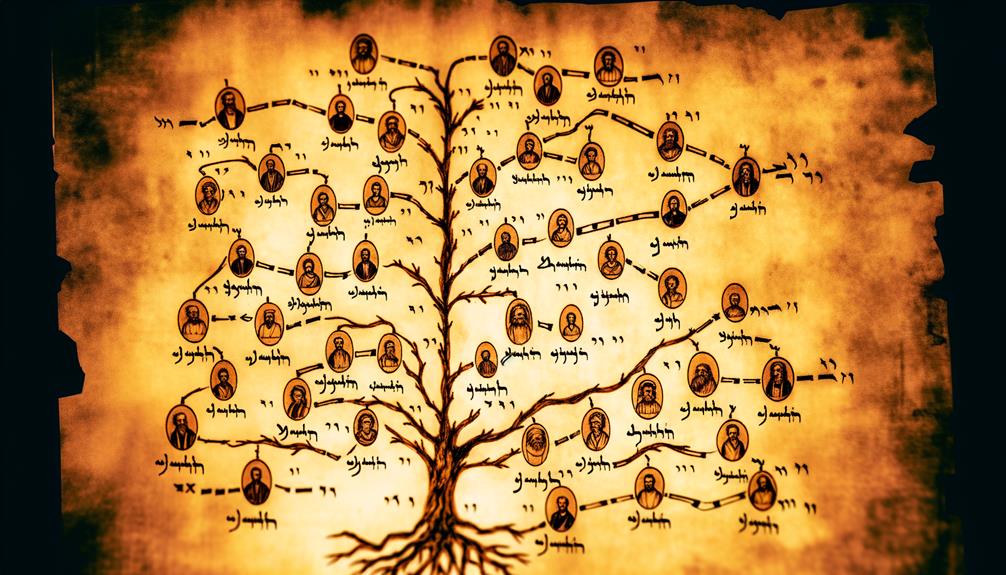
Abraham’s descendants occupy a pivotal role in biblical genealogy, underscored by God’s covenantal promise to make Abraham the father of a great nation.
This divine assurance not only establishes the foundational lineage of the patriarchs—Isaac, Jacob, and the twelve tribes of Israel—but also imbues their genealogical records with theological significance.
Understanding this lineage is essential for comprehending the broader narrative of God’s ongoing relationship with His chosen people throughout the Scriptures.
God’s Promise to Abraham
The biblical narrative of God’s promise to Abraham serves as a foundational moment in the theological understanding of lineage and divine covenant, underpinning the significance of Abraham’s descendants throughout the Scriptures. This covenant is multifaceted, encompassing promises of land, nationhood, and blessings to all peoples through his lineage.
Land: God promises Abraham a specific geographical inheritance, symbolizing divine provision and stability.
Nationhood: Abraham’s descendants are to become a great nation, reflecting God’s plan for a chosen people.
Universal Blessing: Through Abraham’s seed, all families of the earth would be blessed, indicating a broader salvific purpose.
This triadic promise not only shapes Israel’s identity but also establishes a theological framework for understanding God’s unfolding plan in biblical history.
Lineage of the Patriarchs
Frequently, the lineage of the patriarchs serves as an essential thread in the biblical narrative, illustrating the continuity of God’s covenantal promises through successive generations.
Abraham’s descendants, especially Isaac, Jacob, and the twelve tribes of Israel, embody the unfolding of divine promises. The genealogical records meticulously trace this lineage, emphasizing both biological and spiritual heritage.
Contextually, these genealogies underscore the fulfillment of God’s promises to Abraham, as seen in Genesis 17:5, where he is named ‘father of many nations.’
Theologically, they signify the perpetuation of God’s plan for redemption, culminating in the Messiah, Jesus Christ, as delineated in the New Covenant.
Therefore, the lineage of the patriarchs is indispensable for understanding the cohesive, redemptive arc of Scripture.
Genealogy of David
Tracing the lineage of King David reveals a rich tapestry of theological significance, underscoring the fulfillment of divine promises throughout biblical history. David’s genealogy, meticulously documented in the Old Scripture, not only establishes his rightful place as Israel’s revered monarch but also prefigures the messianic lineage culminating in Jesus Christ.
This genealogical record serves several pivotal purposes:
- Covenantal Fulfillment: It underscores God’s promise to Abraham and his descendants, ensuring the continuity of the chosen lineage.
- Legitimacy and Authority: It legitimizes David’s kingship and his descendants’ claims to the throne.
This intricate lineage consequently amplifies biblical narratives of covenant, kingship, and prophecy.
Exile and Return

Exile and Return narratives in the Bible encapsulate profound themes of judgment, repentance, and divine restoration, serving as critical junctures in the unfolding of Israel’s theological journey. These narratives are not merely historical accounts but are laden with theological significance. The exile serves as a divine judgment for Israel’s unfaithfulness, while the return signifies God’s unwavering commitment to restore His chosen people. This cyclical pattern emphasizes the covenantal relationship and the necessity of repentance.
| Event | Theological Theme | Scriptural Reference |
|---|---|---|
| Exile to Babylon | Judgment | 2 Kings 24:10-16 |
| Return to Judah | Restoration | Ezra 1:1-4 |
| Babylonian Captivity | Repentance | Daniel 9:1-19 |
| Rebuilding Temple | Renewal | Haggai 1:7-11 |
| Covenant Renewal | Divine Faithfulness | Nehemiah 9:32-38 |
These themes collectively underscore the dynamic interplay between divine justice and mercy.
Prophetic Fulfillment
Building upon the themes of judgment and restoration, prophetic fulfillment serves as the divine affirmation of God’s promises, manifesting through events and figures foretold by biblical prophets. This theological concept underscores the reliability of divine revelation and the unfolding of God’s redemptive plan.
Prophetic fulfillment can be observed through:
- Historical events: Significant occurrences that align with prophetic declarations, such as the return from Babylonian exile.
- Messianic prophecies: Predictions concerning the coming of a savior, which are central to understanding biblical genealogy.
Analyzing these fulfillments within their historical and theological context enriches our comprehension of biblical genealogy.
Lineage of Jesus

The lineage of Jesus, meticulously chronicled in the Gospels of Matthew and Luke, serves as a theological bridge connecting Old Covenant prophecies with their New Covenant fulfillment.
Matthew’s genealogy traces Jesus’ descent from Abraham through David, emphasizing His legal right to the throne of Israel and fulfilling Jewish Messianic expectations.
Conversely, Luke’s account extends back to Adam, presenting Jesus as the universal Savior for all humanity.
These genealogies, while differing in emphasis and lineage details, collectively underscore Jesus’ dual nature as both the promised Jewish Messiah and the Savior of the world.
Such detailed ancestral records provide a framework for understanding the continuity of God’s redemptive plan throughout biblical history, solidifying Jesus’ identity and mission within the divine narrative.
Theological Significance

Understanding the theological significance of biblical genealogies requires an examination of their role in illustrating God’s sovereign orchestration of history and covenantal promises. These genealogies serve multiple theological purposes:
- Divine Faithfulness: They demonstrate God’s unwavering commitment to His promises, tracing His fidelity across generations.
- Human Agency and Divine Will: They highlight the interplay between human actions and divine sovereignty, where individuals fulfill God’s larger plan.
Connecting Old and New Testaments
The genealogies in the Bible serve to bridge the Old and New Scriptures by highlighting the fulfillment of prophecies, particularly through the lineages of Jesus Christ.
They illustrate the continuity of God’s covenants and promises, demonstrating a divine plan that spans both scriptures.
This connection underscores the theological consistency and redemptive narrative integral to the biblical canon.
Prophecies and Fulfillments
By examining the genealogical records within the Bible, one can trace the fulfillment of messianic prophecies from the Old Covenant to their realization in the New Covenant, thereby highlighting the continuity and divine orchestration of biblical history.
The genealogies serve as theological bridges that connect:
- Prophetic Promises: Foretellings in the Old Scriptures, such as the Davidic Covenant, which assured a lasting dynasty.
- Historical Validations: Authenticating the lineage of key figures like Jesus, underscoring divine fidelity.
Thus, biblical genealogies not only chronicle familial lines but also affirm the reliability and coherence of God’s redemptive plan.
Lineages of Jesus
Genealogical records of Jesus in the Gospels of Matthew and Luke not only affirm His rightful place in the lineage of David but also elucidate the theological connections between the Old and New Covenants.
Matthew traces Jesus’ lineage through Joseph, establishing legal rights to David’s throne, thereby fulfilling Jewish Messianic prophecies.
Conversely, Luke’s genealogy, extending back to Adam, emphasizes Jesus’ universal mission, signifying salvation for all humanity.
The convergence of these genealogies illustrates the continuity of God’s redemptive plan, bridging the promises of the Old Scriptures with their fulfillment in the New Scriptures.
Through this dual lineage, the Gospels reinforce Jesus’ identity as the Messiah, rooted in Jewish tradition yet transcending it to encompass all creation.
Covenants and Promises
Building upon the genealogical affirmations of Jesus’ Messianic identity, the covenants and promises in the Bible underscore the continuity and fulfillment of God’s redemptive plan from the Old Scripture to the New Scripture.
These divine agreements serve as pivotal links between ancient prophecies and their realization in Christ. Theologically, the covenants highlight:
- Abrahamic Covenant: Promising a nation through which all families of the earth would be blessed (Genesis 12:3).
- Davidic Covenant: Ensuring an everlasting kingdom through David’s lineage (2 Samuel 7:16).
Such covenants are integral to understanding the Bible’s unified narrative, bridging scriptures and affirming God’s fidelity.
Spiritual Lessons

The genealogies in the Bible are not merely historical records but are imbued with profound spiritual lessons that reveal God’s sovereignty, faithfulness, and the unfolding plan of redemption.
The structured lineage underscores divine providence, illustrating how God meticulously orchestrates history for His purposes. For instance, the genealogy of Jesus Christ in Matthew 1:1-17 demonstrates the fulfillment of Old Covenant prophecies, bridging the covenants from Abraham to David and ultimately to the Messiah.
Moreover, these genealogies reflect God’s inclusive nature, incorporating individuals of varied backgrounds, thereby emphasizing grace and redemption.
They also serve as a reminder of human frailty and divine intervention, highlighting that it is through God’s steadfast love and promises that salvation history progresses.
Conclusion
The meticulous genealogies within the Bible serve as more than mere historical records; they weave a tapestry that connects the faithful to the divine narrative.
From Genesis to the lineage of Jesus, these genealogies underscore a divine orchestration, linking the Old and New Covenants.
Through these familial lines, one discerns the unfolding of divine providence, offering profound spiritual lessons and a deeper understanding of theological continuity across the sacred texts.