Tempest Meaning in the Bible: Divine Judgment
In the Bible, tempests are rich in theological symbolism, encapsulating God’s divine power, authority, and judgment. Psalm 29:3-4 and Job 37:5 highlight storms as manifestations of God’s omnipotence, reinforcing reverence.
They also signify divine judgment, as seen in Isaiah 29:6 and Jeremiah 23:19, reflecting God’s response to human disobedience. Moreover, tempests represent trials fostering spiritual resilience, as illustrated in Job’s suffering and Paul’s perilous journey in Acts 27.
They reveal faith through narratives like Jesus calming the storm (Mark 4:35-41), symbolizing transformation and renewal, ultimately inviting deeper exploration into divine themes.

Key Takeaways
- Tempests symbolize God’s divine power and authority, showcasing His control over nature and inspiring reverence.
- Tempests often signify divine judgment and wrath in response to human sin and disobedience.
- Tempests represent trials and tribulations, acting as catalysts for spiritual resilience and reliance on God.
- Biblical tempests illustrate lessons of faith, emphasizing reliance on God’s presence during tumultuous times.
Divine Power and Authority

In the Bible, tempests often symbolize the unparalleled divine power and authority of God. This is exemplified in passages such as Psalm 29:3-4, where the voice of the Lord is described as being over the waters, thundering with a power that shakes the wilderness. This imagery underscores God’s supreme control over nature and His ability to command the elements.
Further, in Job 37:5, God’s voice is likened to thunder, illustrating His magnificent and awe-inspiring nature. The tempest, consequently, serves as a vivid manifestation of God’s omnipotence, illustrating His capacity to instill both reverence and awe.
Scriptural narratives often utilize such natural phenomena to convey the might and sovereignty of the divine, emphasizing His ultimate dominion over the created order.
Symbol of Judgment

Tempests in biblical texts frequently serve as a harbinger of divine judgment, signifying God’s response to human sin and disobedience through powerful, natural upheavals.
In the prophetic literature, storms often symbolize the impending wrath of God. For instance, in Isaiah 29:6, the Lord’s judgment is depicted through ‘thunder, earthquake, and great noise, storm and tempest.’ Similarly, in Jeremiah 23:19, a ‘whirlwind of the Lord’ indicates divine anger.
These vivid descriptions underscore the tempest as not merely a meteorological phenomenon but as a theological signifier of God’s righteous indignation. By employing such imagery, the Bible emphasizes the seriousness of divine justice, calling its audience to repentance and reverence in the face of God’s sovereign authority.
Trials and Tribulations

Beyond symbolizing divine judgment, tempests in the Bible also serve as metaphors for the trials and tribulations faced by individuals and communities. They illustrate the testing of faith and the refining of character through adversity.
In the Book of Job, the whirlwind signifies Job’s intense suffering and his subsequent spiritual growth (Job 38:1). Similarly, the apostle Paul’s perilous sea journey (Acts 27:13-44) represents the manifold challenges Christians endure, emphasizing reliance on divine providence.
These scriptural accounts portray tempests not merely as destructive forces, but as catalysts for spiritual resilience and deeper reliance on God. Such biblical narratives underscore the transformative potential inherent in life’s storms, offering a profound theological framework for understanding suffering and perseverance.
Lessons of Faith
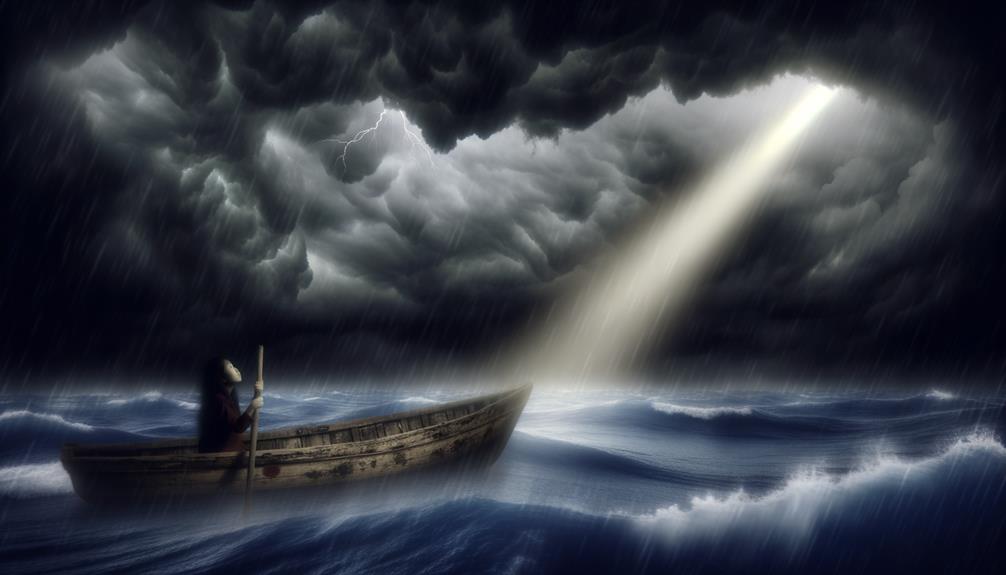
Through the lens of biblical tempests, profound lessons of faith emerge, illustrating how reliance on God during tumultuous times fortifies spiritual resilience and trust.
The story of Jesus calming the storm (Mark 4:35-41) exemplifies this, where His disciples’ fear is met with a divine display of authority over nature.
In the Old Scriptures, Job’s sufferings and eventual restoration (Job 38-42) highlight unwavering faith amidst overwhelming adversity.
These narratives underscore that faith is not the absence of storms, but the assurance of God’s presence and sovereignty within them.
Transformation and Renewal

Amidst the biblical tempests, the themes of transformation and renewal emerge powerfully, as God’s interventions often lead to profound spiritual growth and revitalization. Instances such as Jonah’s ordeal in the belly of the fish (Jonah 2:1-10) and the calming of the storm by Jesus (Mark 4:35-41) illustrate the divine capacity to transform chaos into peace and despair into hope. These events are not mere historical records but serve as metaphors for personal and communal renewal.
| Event | Transformation | Scripture |
|---|---|---|
| Jonah’s Ordeal | Repentance and Deliverance | Jonah 2:1-10 |
| Jesus Calms Storm | Faith and Peace | Mark 4:35-41 |
| Noah’s Flood | Judgment and Covenant | Genesis 6-9 |
| Job’s Suffering | Restoration and Blessing | Job 42:10-17 |
| Paul’s Conversion | Radical Change and Mission | Acts 9:1-19 |
These narratives underscore the transformative power of divine intervention during life’s tempests.
Conclusion
In biblical literature, the tempest is not merely a natural phenomenon but a profound symbol of divine power and authority.
It serves as a dramatic manifestation of judgment, a crucible for human trials and tribulations, and a catalyst for profound lessons of faith.
Through the tempest, scripture reveals the awe-inspiring capacity for transformation and renewal, underscoring the omnipotence of the divine and the enduring resilience of the faithful.
This potent imagery remains an indelible proof to the theological depth and spiritual gravity of biblical teachings.