
Virtuous Woman Meaning in the Bible: Proverbs 31 Explained
The concept of a virtuous woman in the Bible, primarily illustrated in Proverbs 31, characterizes domestic proficiency, economic skill, and moral integrity. She embodies the fear of the Lord, displaying wisdom, kindness, and commitment to divine principles.
Historically, these virtues highlight important societal roles assigned to women in ancient Israel. The text underscores her strength and dignity (Proverbs 31:25) and wise, kind speech (Proverbs 31:26).
Her efficient household and resource management further exemplify divine stewardship. The virtuous woman’s qualities and dedication serve as timeless principles for personal and societal excellence, with further exploration offering deeper theological insights.

Key Takeaways
- The virtuous woman embodies moral integrity, economic acumen, and domestic proficiency, as described in Proverbs 31.
- She exhibits strength and dignity, reflecting unwavering faith and spiritual resilience.
- Wisdom and kindness guide her interactions, promoting family and community well-being.
- Efficient in household management, she ensures prudent resource allocation and financial stewardship.
Proverbs 31 Overview

Proverbs 31, often referred to as the chapter depicting the ‘Virtuous Woman,’ provides a thorough portrayal of an ideal woman in ancient Israelite society, blending theological insight with practical virtues.
This chapter, attributed to King Lemuel’s mother, offers a composite sketch of a woman whose worth is far above rubies. Her attributes encompass domestic proficiency, economic acumen, and moral integrity.
Scripturally, she epitomizes the fear of the Lord, embodying wisdom and virtue.
Historically, this passage reflects societal values where women’s roles were both supportive and pivotal within the household and community.
Theologically, Proverbs 31 serves as a didactic text, urging readers to appreciate and emulate these timeless virtues, thereby bridging the ancient with the contemporary.
Strength and Dignity

In Proverbs 31:25, the attributes of strength and dignity are ascribed to the virtuous woman, underscoring her inner resilience and noble character.
Historically, these qualities were esteemed in the ancient Near Eastern culture, where women often faced societal challenges.
Scripturally, these traits signify not just physical fortitude but a profound spiritual and moral steadfastness, embodying the essence of godly wisdom and integrity.
Inner Resilience Defined
Drawing from the rich tapestry of biblical wisdom, the concept of inner resilience in a virtuous woman is intricately tied to the virtues of strength and dignity, which are deeply rooted in scriptural teachings.
Proverbs 31:25 proclaims, ‘She is clothed with strength and dignity; she can laugh at the days to come.’ This passage underscores the historical context where resilience was essential for women facing societal and familial challenges.
Theologically, strength signifies not just physical prowess but moral fortitude, while dignity reflects a sense of self-worth bestowed by divine creation.
Inner resilience, therefore, emerges as a harmonious blend of these virtues, enabling a woman to navigate life’s trials with unwavering faith and integrity.
Noble Character Traits
Strength and dignity, as foundational traits of a virtuous woman, are profoundly illustrated in her ability to maintain moral fortitude and self-respect amidst life’s adversities.
Scripturally rooted in Proverbs 31:25, ‘She is clothed with strength and dignity; she can laugh at the days to come,’ these attributes signify an inner resilience and unwavering faith.
Historically, this depiction aligns with the societal roles of women in biblical times, where fortitude and honor were paramount.
Theologically, strength denotes not only physical endurance but also spiritual steadfastness, while dignity reflects an inherent self-worth bestowed by God.
Together, these traits empower a woman to navigate challenges with grace and confidence, embodying the essence of divine wisdom and virtue.
Wisdom and Kindness

A virtuous woman in the Bible is often depicted as embodying wisdom and kindness, reflecting the divine attributes emphasized in scriptural passages such as Proverbs 31. This chapter paints a vivid portrait of her qualities:
- Wisdom: Proverbs 31:26 states, ‘She opens her mouth with wisdom,’ underscoring her discerning speech.
- Kindness: The same verse continues, ‘and the teaching of kindness is on her tongue,’ highlighting her nurturing nature.
- Grace: Her wisdom and kindness are not isolated traits but intertwined, demonstrating a holistic approach to living a life of virtue.
Historically, these characteristics were esteemed in ancient Israelite society, where wisdom and kindness were seen as divine attributes that aligned one’s life with God’s will, enriching both family and community life.
Household Management
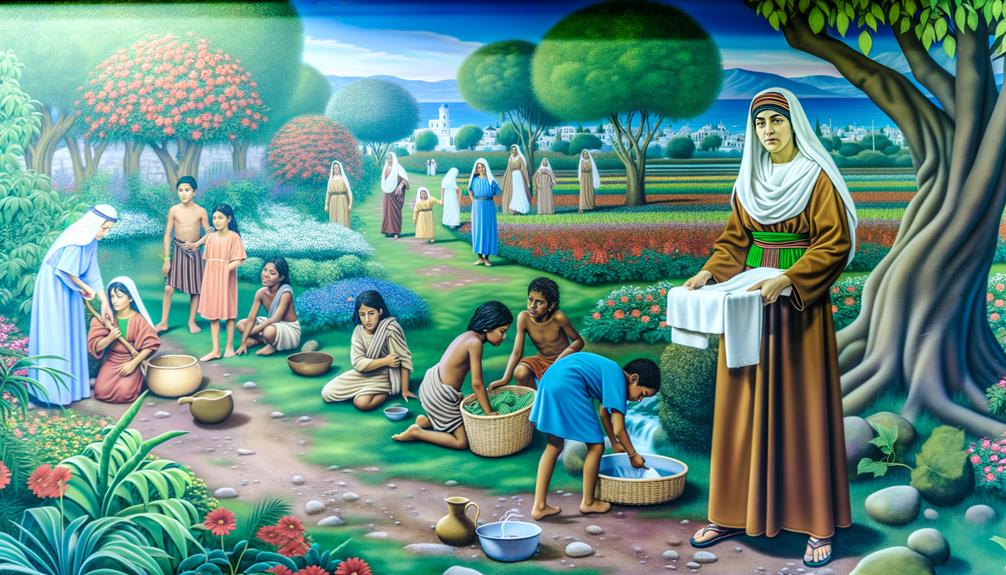
In the biblical context, the virtuous woman’s role in household management is underscored by her efficient resource allocation, ensuring that the needs of her family are met with prudence and foresight.
Proverbs 31:27 highlights her vigilance over household affairs, reflecting a deep commitment to family well-being and financial stewardship practices.
This scriptural portrayal not only emphasizes her organizational skills but also her unwavering dedication to maintaining a harmonious and prosperous home.
Efficient Resource Allocation
Through the lens of biblical teachings, the virtuous woman exemplifies efficient resource allocation by meticulously managing household affairs, thereby ensuring the well-being and prosperity of her family.
Scripture provides a vivid image of her resourcefulness:
- Proverbs 31:13 – She seeks wool and flax and works with willing hands, indicating her diligence in sourcing and preparing materials.
- Proverbs 31:16 – She considers a field and buys it, showcasing her prudent investment and planning skills.
- Proverbs 31:27 – She looks well to the ways of her household and does not eat the bread of idleness, underscoring her commitment to active stewardship.
Family Well-being Prioritized
Building upon her resourcefulness, the virtuous woman prioritizes the well-being of her family through diligent household management, reflecting a deep commitment to nurturing and sustaining her loved ones as illustrated in Proverbs 31.
Scripturally, Proverbs 31:27 states, ‘She watches over the affairs of her household and does not eat the bread of idleness.’ This verse underscores her proactive role in ensuring her family’s physical, emotional, and spiritual needs are met.
Historically, her role was pivotal in maintaining the social fabric of her community.
Theologically, her dedication is emblematic of divine stewardship, reflecting God’s care for His people.
Therefore, her household management transcends mere chores, embodying a holistic approach to familial well-being.
Financial Stewardship Practices
A key aspect of the virtuous woman’s household management is her diligent financial stewardship, which is illustrated in Proverbs 31:16, where she ‘considers a field and buys it; out of her earnings she plants a vineyard.’ This passage reveals her strategic and thoughtful approach to finances, reflecting:
- Investment Wisdom: She evaluates opportunities and makes informed decisions.
- Economic Productivity: Her actions generate additional income, ensuring the household’s sustainability.
- Resource Management: She efficiently allocates resources, enhancing the family’s prosperity.
Historically, this scripture underscores the significant role women played in managing and growing household wealth.
Theologically, it highlights virtues of prudence and industriousness, aligning with broader biblical principles of stewardship.
Such financial acumen is instrumental in fostering a stable, thriving household.
Community Contributions
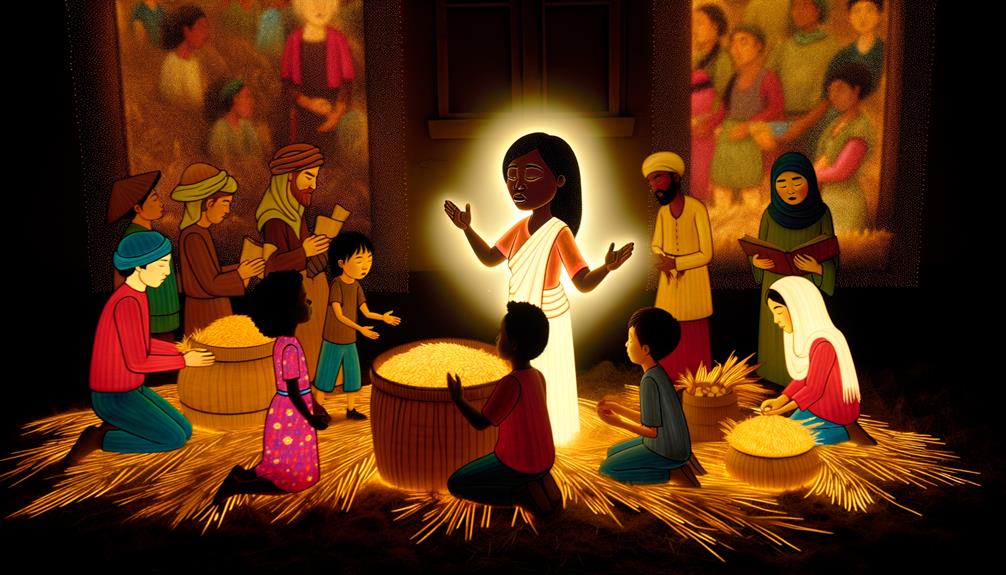
The virtuous woman in the Bible is often depicted as a crucial figure whose contributions considerably impact the moral and social fabric of her community. Proverbs 31:20 extols her generosity, stating, ‘She opens her arms to the poor and extends her hands to the needy.’ This scriptural affirmation highlights her role as a benefactor and moral beacon.
Historically, such women were essential in fostering communal solidarity and ethical conduct. Theologically, her actions reflect divine compassion and stewardship, serving as a model for righteous living.
Her community contributions extend beyond mere charity; they encompass nurturing relationships, promoting justice, and embodying integrity. Through these acts, the virtuous woman reinforces the communal values rooted in biblical teachings.
Faith and Devotion

Beyond her impactful contributions to the community, the virtuous woman’s life is deeply rooted in unwavering faith and devotion, as evidenced by her constant reliance on divine guidance and commitment to spiritual principles.
Scripturally, her faith is manifest in several ways:
- Prayerfulness: Regularly seeking divine wisdom through fervent prayer (Proverbs 31:30).
- Scriptural Adherence: Living a life aligned with biblical teachings, reflecting God’s commandments in her daily actions.
- Steadfast Trust: Demonstrating unwavering trust in God during adversities, embodying the Psalmist’s declaration, ‘The Lord is my shepherd; I shall not want’ (Psalm 23:1).
Historically, this unwavering devotion is seen as the bedrock of her strength and moral integrity, illustrating a life led by faith.
Modern Relevance

In contemporary society, the virtues outlined in the biblical portrayal of a virtuous woman serve as timeless principles that continue to inspire and guide individuals towards leading a life of integrity and purpose.
Proverbs 31, often cited for its depiction, emphasizes qualities such as diligence, wisdom, and compassion—attributes that transcend historical and cultural boundaries. These virtues, while rooted in ancient scriptural context, resonate with modern ideals of ethical living and community service.
Theological insights reveal that embodying these principles is not confined to gender but reflects a universal call to embody Godly characteristics. Consequently, the virtuous woman’s model remains relevant, offering a framework for personal growth and societal contribution in today’s complex and evolving world.
Conclusion
The virtuous woman of Proverbs 31 emerges as a paragon of strength and dignity, her wisdom and kindness like a well-lit lantern in the night.
Her adept management of household affairs and active community involvement paint a vivid tapestry of industrious devotion.
Through faith, she anchors her life, offering a timeless model of grace.
This scriptural archetype continues to resonate, beckoning modern readers to emulate her exemplary virtues amidst contemporary challenges.