
Meaning of Mason in the Bible: Builder’s Symbolism
In the Bible, the term ‘mason’ designates a skilled craftsman in stone construction, essential for creating sacred structures such as altars and the Temple of Solomon. Masons are repeatedly acknowledged for their technical expertise and spiritual devotion, symbolizing divine craftsmanship (1 Kings 5:18).
Their work reflects broader theological themes, with stonework representing permanence and strength in God’s covenant (Genesis 28:18, Ephesians 2:20). Stones also carry deep symbolic meanings, with Christ being referred to as the cornerstone, underscoring the mason’s labor as foundational to faith and community.
By exploring further, you will uncover the rich historical and spiritual dimensions of masons in scripture.

Key Takeaways
- Originates from Old French ‘maçon’ meaning ‘stone worker’ or ‘builder,’ highlighting skilled labor essential for sacred structures.
- Masons were crucial in constructing religious edifices like Solomon’s Temple, symbolizing God’s covenant.
- Stonework represented permanence and strength, reflecting spiritual and communal life.
- Metaphorically, Jesus is the ‘cornerstone,’ indicating His foundational role in the Church.
Etymology of Mason

The term ‘Mason‘ derives from the Old French word ‘maçon,’ which means ‘stone worker’ or ‘builder,’ and its etymological roots trace back to the Latin word ‘machio’ or ‘matio.’
In theological discourse, the mason symbolizes the divine craftsmanship evident in Biblical narratives. Scriptural references to builders, such as in 1 Kings 5:18, highlight the skilled labor essential for constructing sacred spaces like Solomon’s Temple.
This craftsmanship is emblematic of God’s orderly creation, reflecting His wisdom and precision. Historically, masons were venerated for their ability to transform raw materials into structures of spiritual significance.
Understanding the term’s etymology enriches our comprehension of its profound theological and historical implications within the Biblical context.
Mason in Historical Context
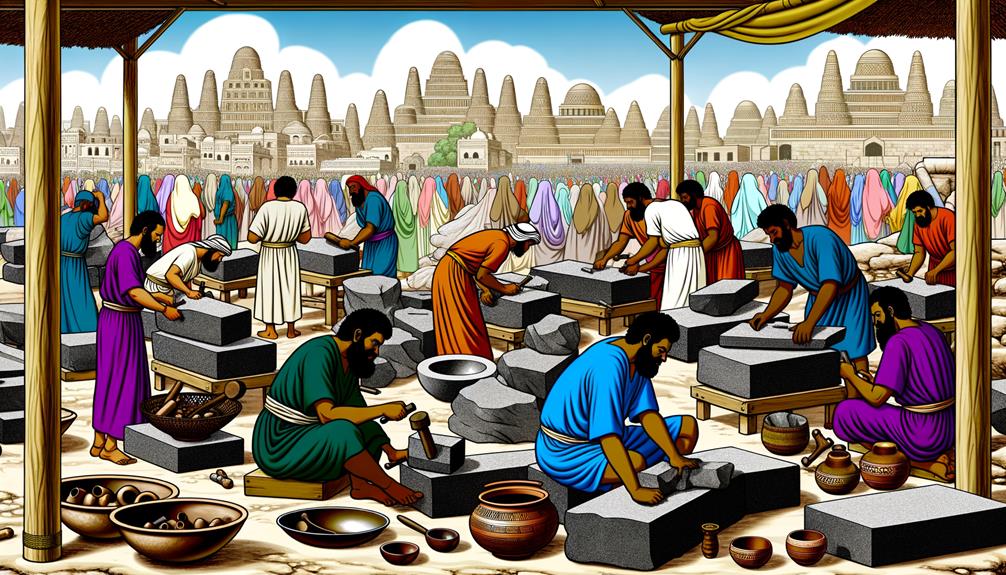
Building on the etymological significance of ‘Mason,’ the historical context illuminates how these skilled artisans were fundamental to the construction of monumental religious edifices in ancient Israel, exemplifying their revered status in Biblical times.
Masons were entrusted with building the Temple of Solomon, a crucial structure that represented God’s covenant with Israel (1 Kings 6). This sacred task underscored their essential role in manifesting divine plans through architectural prowess.
Their expertise in stone-cutting and construction was not merely technical but also spiritual, as their labor facilitated the worship and community life centered around these holy sites.
Consequently, masons were seen as fundamental contributors to the fabric of Biblical society, intertwining their craftsmanship with sacred duties.
Stonework in Biblical Times
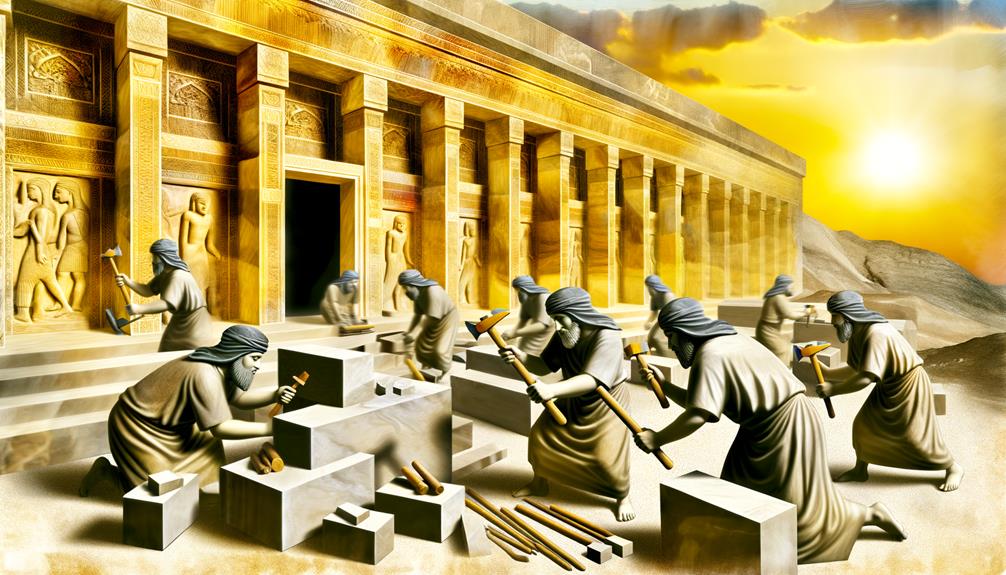
In Biblical times, stonework was an essential aspect of construction, intricately tied to the spiritual and communal life of ancient Israel. The craftsmanship of masons was evident in the construction of city walls, dwellings, and public buildings.
Stone, a durable and abundant material, symbolized permanence and strength. Scriptural references, such as in 1 Kings 5:17, highlight the importance of skilled labor in quarrying and shaping large stones for Solomon’s Temple.
Historical records and archaeological findings corroborate the use of various techniques, including chiseling and carving, to create functional and aesthetic structures.
Stonework not only facilitated everyday life but also held symbolic significance, reflecting divine order and the covenantal relationship between God and His people.
Altars and Temples

Among the most profound applications of stonework in Biblical times was the construction of altars and temples, which served as central places for worship and sacrifice, embodying the sacred covenant between God and His people. These structures were meticulously crafted, reflecting divine instructions and symbolizing divine presence.
- Altars of Sacrifice: Examples include Noah’s altar (Genesis 8:20) and Abraham’s altar (Genesis 22:9).
- Solomon’s Temple: A monumental edifice detailed in 1 Kings 6, exemplifying the pinnacle of sacred architecture.
- Portable Tabernacle: Made during the Exodus, described in Exodus 25-31, it was a precursor to permanent temples.
These structures underscored the community’s devotion and obedience to God’s commandments.
Symbolism of Stones

The symbolism of stones in the Bible carries profound theological and historical significance, representing both physical and metaphorical foundations.
Scripturally, stones are often depicted as symbols of strength, permanence, and divine intervention, as seen in the construction of altars and memorials.
Additionally, metaphorical references, such as Jesus being described as the ‘cornerstone,’ highlight their role in embodying spiritual truths and foundational beliefs within the Christian faith.
Biblical Stone Significance
Throughout the Bible, stones often serve as potent symbols of strength, permanence, and divine revelation, reflecting their essential role in both physical construction and spiritual metaphor.
These elements are woven into the fabric of biblical narrative, marking significant events and covenants. The theological implications of stones are profound, underscoring God’s enduring presence and covenantal faithfulness.
- Jacob’s Pillar at Bethel: Symbolizing divine encounter and revelation (Genesis 28:18).
- Stones of the Law: Representing the permanence of God’s commandments (Exodus 24:12).
- Foundation Stone of the Temple: Signifying the centrality of worship (1 Kings 5:17).
These instances collectively underscore the multifaceted significance of stones in biblical theology.
Metaphorical Stone References
In biblical literature, stones are frequently employed as metaphors to convey deeper spiritual truths and divine messages.
One profound example is Christ being referred to as the ‘cornerstone‘ in Ephesians 2:20, indicating His foundational role in the faith.
Similarly, in 1 Peter 2:5, believers are described as ‘living stones,’ signifying their integral part in constructing a spiritual house.
Historically, stones also symbolize permanence and strength, as seen in the memorial stones set by Joshua (Joshua 4:20-24) to remind Israel of God’s faithfulness.
The metaphor of the ‘stone’ consequently encapsulates themes of strength, foundational truth, and divine remembrance, illustrating the enduring and unchanging nature of God’s promises and the believer’s role within the divine narrative.
Christ as the Cornerstone

In the biblical narrative, the cornerstone holds paramount importance, symbolizing strength and stability in architectural terms.
Scriptural references, such as Psalm 118:22 and Ephesians 2:20, elevate Jesus as the foundational cornerstone, signifying His pivotal role in the faith and unity of the Church.
Historically, this metaphor underscores the centrality of Christ in the Christian doctrine, where He is not just a structural necessity but the essential basis for all spiritual growth and cohesion.
Biblical Cornerstone Significance
The metaphor of Christ as the cornerstone encapsulates both theological profundity and historical significance within Christian doctrine. The cornerstone, essential in ancient construction, is the stone that sets the foundation and alignment for the entire structure.
Scripturally, this metaphor emphasizes Christ’s foundational role in the faith and the unity of believers.
- Isaiah 28:16: God declares a tested stone, a precious cornerstone.
- Psalm 118:22: The stone the builders rejected has become the cornerstone.
- Ephesians 2:20: Christ Jesus himself as the chief cornerstone.
Thus, Christ as the cornerstone is pivotal in understanding both the spiritual and communal aspects of the Christian faith.
Jesus as Foundation
Recognizing Christ as the cornerstone underscores His integral role in the spiritual edifice of Christianity, anchoring the faith and unity of believers in a steadfast foundation.
Scripturally, Ephesians 2:20 proclaims Jesus as the cornerstone, a critical element in the apostles’ and prophets’ teachings, uniting the entire structure.
Historically, the cornerstone in ancient construction was essential, setting the alignment and integrity of the entire building. Therefore, Christ’s role as the cornerstone signifies His preeminence and the essential stability He provides to the Church.
Isaiah 28:16 and 1 Peter 2:6 reiterate this symbolism, portraying Jesus as the chosen and precious cornerstone, ensuring that those who trust in Him will never be put to shame. This imagery affirms Christ’s foundational importance.
Builders in the Old Testament
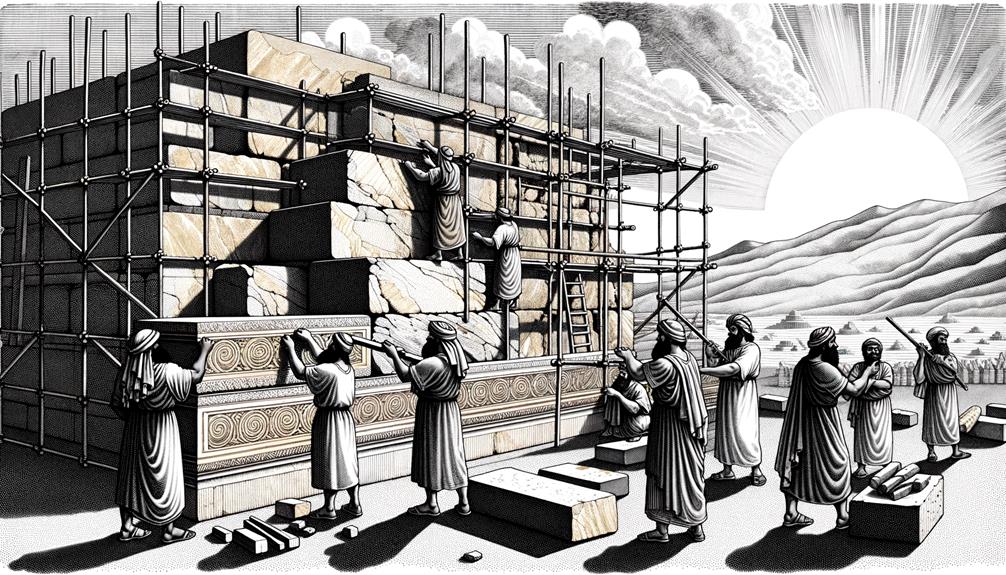
Biblical narratives vividly illustrate the critical role of builders in the Old Scriptures, underscoring their contributions to the construction of sacred spaces and communal structures.
From the skilled artisans who built the Tabernacle to the laborers under King Solomon’s reign who erected the magnificent Temple, builders were instrumental in manifesting divine instructions into tangible forms.
These artisans were often divinely inspired, and their craftsmanship was a direct service to God, reflecting deep theological significance.
- Exodus 31:1-11: Bezalel and Oholiab, endowed with divine wisdom, crafted the Tabernacle.
- 1 Kings 6: Solomon’s Temple, a monumental project, symbolized God’s dwelling.
- Nehemiah 4:6: Rebuilding Jerusalem’s walls under Nehemiah’s leadership.
New Testament References
In the New Scripture, the term ‘mason‘ bears significance through Paul’s references to his fellow workers in Christ, highlighting the communal and cooperative spirit of the early Christian community.
The apostle Paul often employed the metaphor of building to describe the construction of the church, emphasizing the importance of each individual’s role.
Additionally, the name Mason itself, though not explicitly mentioned, symbolizes the foundational work of spreading the gospel and establishing the church in its nascent stages.
Paul’s Fellow Worker
Throughout his epistles, Paul frequently acknowledges his fellow workers, underscoring the communal and collaborative nature of early Christian ministry. These individuals played crucial roles in the growth and sustenance of the nascent church, aiding Paul in his mission to spread the Gospel.
Notable figures include:
- Timothy: Often referred to as Paul’s ‘true child in the faith’ (1 Timothy 1:2), Timothy was a key companion and co-author of several epistles.
- Priscilla and Aquila: This couple provided essential support and instruction in the faith, as seen in Acts 18:26.
- Titus: Another trusted colleague, instrumental in organizing and strengthening church communities (Titus 1:5).
These collaborators exemplify the interconnected efforts foundational to early Christianity.
Early Christian Community
Emerging from the teachings of Jesus and the apostles, the early Christian community is depicted in the New Scripture as a vibrant and dynamic network of believers who shared resources, worshipped together, and upheld a communal ethos.
Acts 2:44-47 illustrates this vividly: ‘And all who believed were together and had all things in common.’ This community model was characterized by mutual support and devotion to the apostles’ teaching, breaking of bread, and prayers.
The historical context of Roman occupation and diverse cultural influences further underscores the remarkable unity and resilience of this nascent movement.
Theological insights from passages such as Galatians 3:28 emphasize the inclusivity of this community, transcending social and ethnic boundaries to form a singular body in Christ.
Biblical Name Significance
Biblical names within the New Covenant carry profound theological significance, often reflecting the character, mission, or divine calling of the individuals they denote. These names not only identify but also convey deeper meanings and divine purposes.
- Jesus (Yeshua): Meaning ‘The Lord is Salvation,’ emphasizing His role as the Savior.
- Peter (Petros): Signifying ‘rock,’ representing his foundational role in the Church.
- Paul (Paulos): Denoting ‘small’ or ‘humble,’ reflecting his transformation and mission.
Understanding these names enhances our comprehension of God’s redemptive plan, as each name encapsulates a facet of divine revelation and human destiny in the New Scripture narrative.
Metaphorical Builders
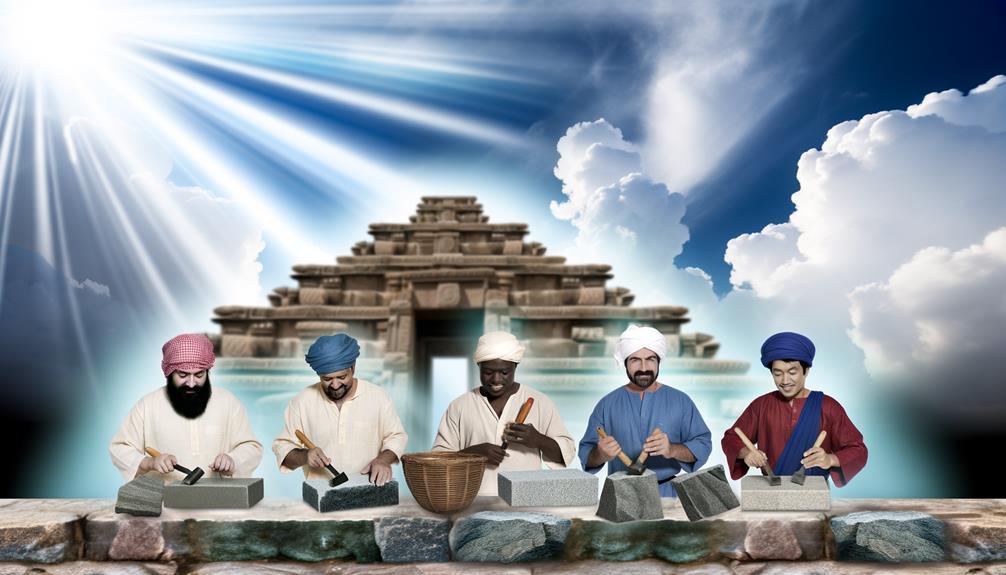
The concept of metaphorical builders in the Bible often symbolizes spiritual growth and the cultivation of faith within the community of believers.
Scriptural references, such as Ephesians 2:20-22, depict believers as ‘built on the foundation of the apostles and prophets, with Christ Jesus himself as the chief cornerstone.’ This imagery underscores the importance of personal and communal spiritual development.
Historically, the early church viewed each believer’s role as contributing to the edifice of faith. First Corinthians 3:9-11 further illustrates this, where Paul describes believers as ‘God’s fellow workers‘ and ‘God’s building.’
The metaphor of building highlights the collaborative effort required to establish a strong, enduring faith community, rooted in biblical teachings and divine guidance.
Divine Architecture

Divine architecture in the Bible serves as a profound metaphor for God’s intricate and purposeful design for both individual lives and the collective faith community. Scriptural narratives often depict God as a master builder, emphasizing the intentionality behind His creations.
This concept is vividly illustrated in:
- Solomon’s Temple: A symbol of divine presence and order (1 Kings 6).
- The Tabernacle: Reflecting God’s dwelling among His people (Exodus 25-27).
- New Jerusalem: The ultimate expression of divine architecture (Revelation 21).
Understanding these illustrations provides a deeper appreciation of how biblical texts reveal God’s sovereign blueprint, guiding humanity towards a divine purpose and communal harmony.
Spiritual Implications

Through examining the role of a mason in biblical narratives, one uncovers profound spiritual implications that extend beyond physical construction to the shaping of moral and communal foundations. In the Bible, the mason’s work symbolizes the creation of spiritual edifices, where each stone represents virtues, faith, and obedience to God. This metaphor underscores the importance of diligent craftsmanship in spiritual growth and community cohesion.
| Biblical Reference | Mason’s Role | Spiritual Implication |
|---|---|---|
| 1 Kings 6:7 | Building Solomon’s Temple | Sanctity and dedication |
| Isaiah 28:16 | Laying a cornerstone | Faith in Christ |
| Ephesians 2:20 | Foundation of apostles | Unity in the church |
| 1 Peter 2:5 | Living stones | Spiritual house, holy priesthood |
| Revelation 21:19 | Adorning New Jerusalem | Eternal beauty and perfection |
These insights illustrate how biblical masons contribute to spiritual edifices, fostering faith and unity.
Conclusion
The term ‘mason’ in the biblical context encompasses not only the literal craftsmanship of stonework but also profound theological and symbolic meanings.
From constructing altars and temples to metaphorical references as builders in the New Covenant, masons symbolize divine architecture and spiritual edification.
For instance, the construction of Solomon’s Temple, involving skilled masons and intricate stonework, epitomizes the confluence of human artistry and divine guidance, underscoring the sacredness embedded in both physical and spiritual edifices.