
Philemon Meaning In The Bible: Message of Reconciliation
The Book of Philemon, a succinct yet theologically rich epistle in the New Covenant, addresses issues of forgiveness and social equity through the lens of Christian brotherhood. Authored by the Apostle Paul during his imprisonment around 60-62 AD, the letter urges Philemon to reintegrate Onesimus, a runaway slave, as a beloved brother in Christ.
This radical appeal challenges Greco-Roman social norms and redefines relationships within the early Christian community. Paul’s intercession exemplifies the transformative power of divine love and forgiveness, suggesting profound implications for early and contemporary Christian practice.
Explore deeper, and the intricate dynamics of these themes will unfold further.
Key Takeaways
- Forgiveness and Reconciliation: Philemon emphasizes the transformative power of forgiveness and reconciliation within the Christian community.
- Christian Brotherhood: The letter urges believers to view each other as brothers and sisters in Christ, transcending social hierarchies.
- Social Hierarchies: Philemon challenges the norms of first-century slavery, promoting equality and mutual respect among believers.
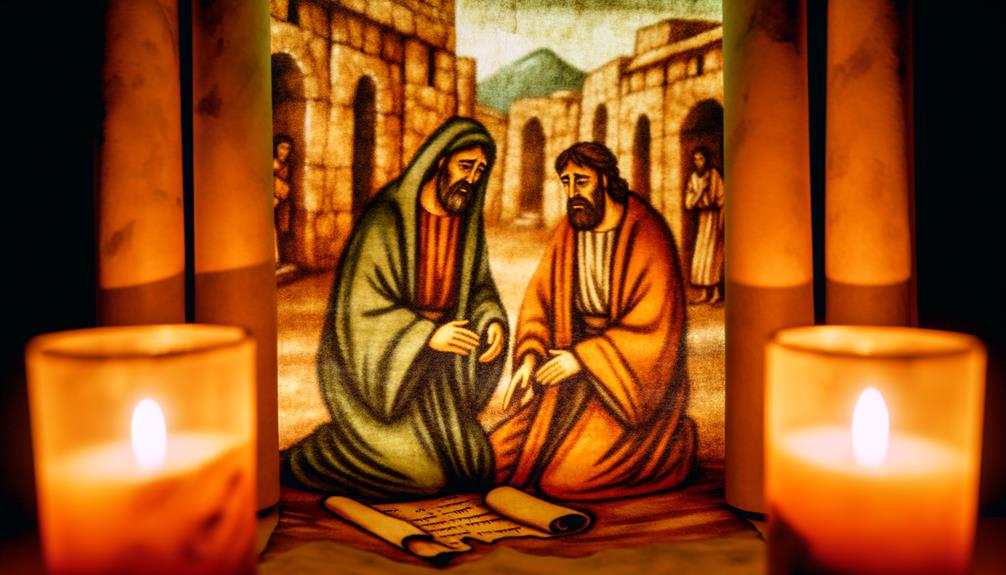
- Paul’s Advocacy: Paul intercedes for Onesimus, a runaway slave, highlighting the importance of mediation and reconciliation in Christian relationships.
Historical Background of Philemon

In order to fully understand the historical background of Philemon, it is essential to recognize its context within the early Christian movement and the socio-cultural dynamics of the first-century Roman Empire.
The Epistle to Philemon, a brief yet profound New Scripture letter, reflects the intricate interplay between faith and societal norms.
Written in an era where slavery was a pervasive institution, the letter addresses issues of forgiveness, reconciliation, and Christian brotherhood.
Philemon, a Christian convert and slave owner, is urged to receive Onesimus, his runaway slave, not merely as property but as a beloved brother in Christ.
This appeal underscores the nascent Christian ethic that sought to transform personal relationships and challenge prevailing social hierarchies, presenting a radical redefinition of community and kinship.
Authorship and Date

The authorship and date of the Epistle to Philemon hold critical significance for biblical scholarship, as they underscore the apostolic authority and historical context within which the letter was composed.
Traditionally attributed to the Apostle Paul, this letter is believed to have been written during his imprisonment, around 60-62 AD.
Establishing these parameters not only affirms the epistle’s authenticity but also enhances our understanding of its theological and socio-cultural implications.
Authorship Context and Significance
Authorship of the Epistle to Philemon is traditionally attributed to the Apostle Paul, with historical and textual evidence underscoring its Pauline origin and situating its composition around A.D. 60-62 during Paul’s first Roman imprisonment.
This epistle is distinguished by its personal tone and theological depth, emphasizing themes such as forgiveness, reconciliation, and the transformative power of Christian love.
The letter is addressed to Philemon, a leader within the Colossian church, and it advocates for the humane treatment of the runaway slave Onesimus.
Paul’s intercession on behalf of Onesimus not only reveals the apostle’s pastoral concern but also highlights the early Christian community’s ethical and social imperatives.
The epistle’s brevity belies its profound ecclesiastical and doctrinal significance.
Historical Dating Analysis
An examination of the historical dating of the Epistle to Philemon necessitates a thorough understanding of Paul’s circumstances during his first Roman imprisonment, approximately between A.D. 60-62. This period is corroborated by internal evidence within the text, referencing Paul’s status as a prisoner (Phm 1:1, 9).
The letter’s personal tone, addressing Philemon regarding his runaway slave Onesimus, aligns with the apostolic practice of fostering early Christian communities through direct and relational correspondence.
The epistle’s authentic Pauline authorship is widely affirmed by scholars, supported by stylistic and theological consistencies with Paul’s undisputed letters.
Consequently, the historical context situates the letter within a critical phase of early Christian expansion under Roman dominion.
Key Themes and Messages

The Epistle to Philemon encapsulates profound theological themes, primarily underscoring the transformative power of forgiveness and reconciliation within the Christian community.
It calls for a re-examination of relationships through the lens of Christian brotherhood, urging believers to transcend social hierarchies and embrace unity in Christ.
This apostolic letter serves as a witness to the radical implications of grace and equality in the early Church.
Forgiveness and Reconciliation
Central to the epistle of Philemon is the profound exploration of forgiveness and reconciliation, as exemplified through the apostle Paul’s plea for Onesimus’s acceptance and restoration. Paul’s intercession for Onesimus, a former slave who had wronged his master, underscores the transformative power of Christian forgiveness. By advocating for Onesimus’s reintegration, Paul not only seeks to mend broken relationships but also to embody the Christian ideal of grace.
| Theme | Description | Biblical Reference |
|---|---|---|
| Forgiveness | Paul’s request for Philemon to forgive Onesimus | Philemon 1:10-12 |
| Reconciliation | Appeal for restored relationships | Philemon 1:15-16 |
| Intercession | Paul’s role as mediator | Philemon 1:17-19 |
This theological narrative elucidates the ethos of mercy and unity within the Christian community.
Christian Brotherhood Emphasized
Forgiveness and reconciliation, as epitomized in Paul’s appeal, naturally extend to the broader theme of Christian brotherhood, where mutual love and equality within the faith community are paramount.
In the Epistle to Philemon, Paul underscores the transformative power of Christ’s love in dissolving social hierarchies, urging Philemon to receive Onesimus not as a slave, but as a beloved brother.
This theological assertion propounds that in Christ, distinctions of status and rank are subsumed under the unifying banner of Christian fellowship.
Paul’s entreaty elucidates the radical nature of Christian kinship, advocating an egalitarian ethos whereby every believer is equally valued.
Consequently, the letter becomes a profound evidence of the inclusivity and unity integral to Christian discipleship.
Paul’s Relationship With Philemon

Although many facets of early Christian relationships remain shrouded in antiquity, Paul’s epistle to Philemon provides a rare and insightful glimpse into the personal and spiritual bond between the Apostle and his fellow believer.
Paul addresses Philemon with a tone of deep affection and respect, indicating a profound mutual esteem rooted in their shared faith. The letter reflects Paul’s diplomatic yet earnest appeal, emphasizing themes of love, fellowship, and Christian duty.
Significantly, Paul’s language reveals an intimate rapport, calling Philemon a ‘dear friend’ and ‘fellow worker’ (Philemon 1:1). This epistolary interaction underscores the significant role of personal relationships in the early Church, illustrating how spiritual kinship can foster both individual and communal growth within the Christian community.
The Story of Onesimus

In the narrative concerning Onesimus, Paul’s letter to Philemon unfolds a profound theological discourse on reconciliation and transformation within the Christian ethos. Onesimus, a runaway slave, becomes a pivotal figure through whom Paul elucidates the transformative power of Christian conversion. As Paul intercedes on behalf of Onesimus, now a “beloved brother,” he challenges societal norms and advocates for a radical redefinition of relationships in Christ. This epistle encapsulates the journey from servitude to spiritual kinship, underscoring the essence of Christian identity.
| Aspect | Context | Theological Implication |
|---|---|---|
| Onesimus’ Status | Runaway Slave | Transformation through Christ |
| Paul’s Advocacy | Intercession with Philemon | Role of mediation in Christian fellowship |
| Philemon’s Response | Requested reception of Onesimus | Christian duty in redefined relationships |
This table accentuates the multifaceted dimensions of Onesimus’ story within Pauline theology.
Forgiveness and Reconciliation

The epistle to Philemon stands as a profound witness to the theological imperatives of forgiveness and reconciliation, urging believers to embody these virtues as fundamental expressions of their faith in Christ.
Paul’s appeal to Philemon to forgive Onesimus and welcome him as a brother transcends mere social norms, illustrating divine principles at work.
The text elucidates:
- The transformative power of Christ’s love in healing fractured relationships
- The call for mutual forgiveness as a reflection of divine grace
- The practical outworking of theological truths in everyday life
Christian Brotherhood

Central to the epistle to Philemon is the concept of Christian brotherhood, which underscores the intrinsic unity and equality of all believers within the body of Christ. Paul’s appeal to Philemon on behalf of Onesimus, a former slave, is profoundly theological, advocating for a transformative understanding of relationships in light of Christ’s redemptive work. The apostle emphasizes that in Christ, societal distinctions dissolve, rendering all believers as siblings in faith.
| Key Concept | Biblical Reference | Theological Implication |
|---|---|---|
| Unity in Christ | Galatians 3:28 | Equality among believers |
| Brotherhood | Philemon 1:16 | Transformation of relations |
| Spiritual Family | Matthew 12:50 | Redefines kinship |
| Mutual Love | John 13:34 | Ethical conduct |
| Forgiveness | Colossians 3:13 | Essential for unity |
This epistle consequently becomes a paradigm of ecclesial unity and mutual respect.
Social and Cultural Context

Understanding the social and cultural context of the epistle to Philemon necessitates an examination of the first-century Greco-Roman world, particularly its pervasive institution of slavery and hierarchical societal structures.
In this milieu, the letter addresses:
- Slavery: A deeply ingrained economic and social system, where slaves were considered property.
- Patronage: Relationships often dictated by social status, where patrons provided protection and resources in exchange for loyalty.
- Households: Central units of social and economic life, often including extended family and slaves.
This context underscores the complexities and radical nature of Paul’s appeal for Onesimus, a runaway slave, through a lens of Christian brotherhood.
Theological Insights

In the epistle to Philemon, Paul’s theological insights illuminate the transformative power of Christian love and forgiveness within the rigid structures of slavery and societal hierarchy.
Paul subtly yet profoundly subverts the master-slave dynamic by urging Philemon to embrace Onesimus not as a servant but as a beloved brother in Christ. This appeal for reconciliation transcends legalistic constraints, emphasizing the radical equality inherent in the Christian community.
Paul’s intercession for Onesimus exemplifies the redemptive potential of intercessory prayer and the ethical imperative to act justly. By anchoring his plea in the love and grace of Christ, Paul demonstrates how divine principles can reshape human relationships, fostering a community that mirrors the kingdom of God.
Modern-Day Applications

The epistle to Philemon, with its profound themes of reconciliation and equality, offers a timeless paradigm for addressing contemporary issues of social justice and interpersonal relationships. Its principles can be dynamically applied to modern contexts, fostering a more equitable and harmonious society.
Consider these modern-day applications:
- Conflict Resolution: Encouraging forgiveness and mutual understanding in personal and professional conflicts.
- Social Equality: Promoting the inherent dignity and worth of every individual, regardless of status.
- Restorative Justice: Advancing systems that focus on rehabilitation and reconciliation rather than punishment.
Conclusion
The Epistle to Philemon juxtaposes the personal and the communal, juxtaposes the ancient and the contemporary.
Paul’s advocacy for Onesimus transcends mere personal appeal, transforming into a profound theological discourse on Christian brotherhood and reconciliation.
The narrative interweaves the social structures of the Roman world with the nascent principles of Christian egalitarianism.
Consequently, the letter serves as both a historical document and a timeless guide, offering enduring insights into the complexities of faith, forgiveness, and fellowship.