Celestial Meaning in the Bible: Heavenly Realm
In the Bible, celestial bodies like stars, the moon, and the sun hold significant theological symbolism. Stars often symbolize divine messages and eschatological themes, as seen in the Book of Revelation where they represent angels or agents of prophetic events.
The moon illustrates divine intervention and God’s covenant, depicted as a faithful witness in Psalms. The sun, described as the ‘Sun of Righteousness‘ in Malachi, embodies divine light and guidance.
These celestial entities also reflect God’s omnipotence, omnipresence, and creative power, underscoring the heavens’ testimony to God’s glory. Exploring these symbols reveals deeper layers of biblical theology and divine revelation.

Key Takeaways
- Stars symbolize divine messages, significant events, and eschatological themes in Scripture, often representing angels or messengers (Revelation 1:20).
- The moon signifies divine intervention, God’s covenant with humanity, and acts as a faithful witness to God’s promises (Psalms 89:37).
- The sun represents divine light, God’s omnipresence, and the ‘Sun of Righteousness’ bringing healing and direction (Malachi 4:2).
- Celestial imagery in Revelation conveys theological truths and signifies cosmic battles and divine judgment (Revelation 12:4).
Stars in Biblical Prophecy
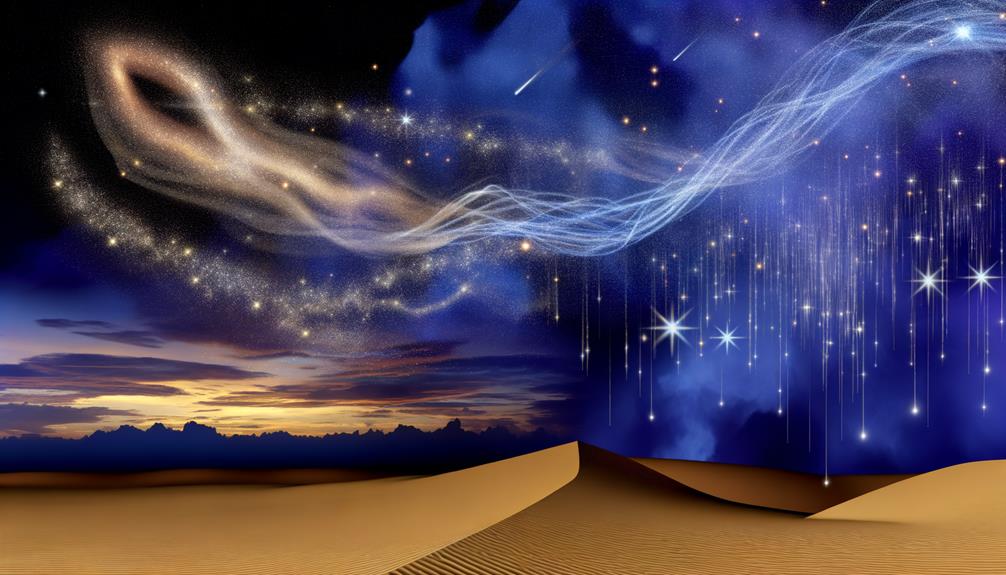
In Biblical prophecy, stars often serve as potent symbols, representing divine messages, significant events, and the unfolding of God’s plan. They are frequently depicted as heavenly bodies that convey God’s omnipotence and omniscience.
For instance, in the Book of Revelation, stars symbolize angels or messengers of the seven churches (Revelation 1:20). The prophetic visions of Isaiah and Daniel also employ stars to signify rulers or nations destined for judgment or glory.
These celestial markers are hence integral to understanding the eschatological themes prevalent in Scripture. By examining their placement and context, scholars can gain deeper insights into the divine narrative and its implications for humanity.
Stars, consequently, act as divine signposts, guiding believers through the mysteries of God’s prophetic revelation.
The Guiding Star of Bethlehem
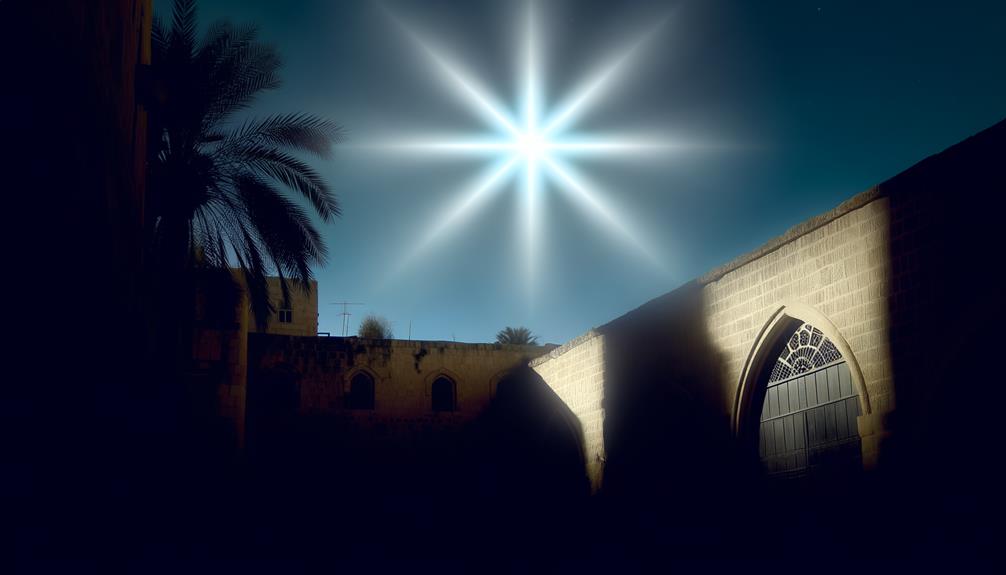
Heralded as a celestial beacon, the Star of Bethlehem is a significant symbol in the Nativity story, guiding the Magi to the birthplace of Jesus and consequently playing an essential role in the divine narrative of the Incarnation.
This luminous phenomenon has been subject to various interpretations, ranging from astronomical events like a supernova or planetary conjunction to miraculous occurrences beyond natural explanation.
Biblically, the Star demonstrates God’s sovereignty over creation, orchestrating cosmic signs to fulfill prophetic scripture.
Theologically, it underscores the universality of Christ’s birth, drawing Gentile Magi to worship Him.
Therefore, the Star of Bethlehem serves not only as a navigational guide but also as a profound witness to God’s revelation and the fulfillment of divine promise.
Sun Symbolism in Scripture

The symbolism of the sun in Scripture often embodies notions of light and guidance, reflecting God’s illuminating presence in the lives of believers.
Additionally, the sun serves as a powerful metaphor for divine presence, underscoring themes of righteousness and eternal life.
Light and Guidance
Scripture frequently employs the symbolism of the sun to represent divine light and guidance, illuminating the path of faith for believers.
In Psalms 119:105, the psalmist declares, ‘Your word is a lamp to my feet and a light to my path,’ metaphorically linking divine instruction to sunlight.
Malachi 4:2 further reinforces this by stating, ‘The Sun of Righteousness shall rise with healing in its wings,’ portraying God’s righteousness as a guiding light.
The sun’s daily rise and set also symbolize constancy and dependability, reflecting God’s unwavering presence and guidance.
Through these passages, the Bible underscores the sun as a powerful emblem of divine direction, illuminating the faithful’s journey with celestial clarity and purpose.
Divine Presence Symbolism
How does the sun serve as an enduring symbol of divine presence in biblical scripture?
The sun, often depicted as a source of light and life, is emblematic of God’s omnipresence and omnipotence.
In Psalms 84:11, the Lord is referred to as ‘a sun and shield,’ highlighting protection and sustenance.
Similarly, Malachi 4:2 speaks of the ‘Sun of Righteousness‘ rising with healing in its wings, signifying divine salvation and justice.
Furthermore, the constant presence of the sun in the sky mirrors God’s unwavering vigilance over creation.
The sun’s daily journey from dawn to dusk can be seen as a metaphor for God’s eternal covenant with humanity, reaffirming His steadfastness and nurturing presence throughout the ages.
Moon as a Divine Sign

Throughout the Bible, the moon frequently serves as a profound symbol of divine intervention and a celestial marker of God’s covenant with humanity.
In Genesis 1:16, the moon is created to govern the night, emphasizing its role in God’s orderly design. The moon’s phases are also used to mark sacred times, such as the Hebrew calendar’s festivals.
In prophetic literature, lunar phenomena often signify divine judgment or impending change, as seen in Joel 2:31 where the moon turns to blood before the ‘great and dreadful day of the Lord.’
Additionally, Psalms 89:37 portrays the moon as a faithful witness in the sky, reinforcing the enduring nature of God’s promises.
Consequently, the moon encapsulates themes of divine orchestration and covenant fidelity.
The Heavens Declare God’s Glory

Building on the symbolic significance of the moon, the broader celestial expanse serves as a proof of the majesty and splendor of God’s creation, as articulated in Psalm 19:1, which proclaims, ‘The heavens declare the glory of God; the skies proclaim the work of His hands.’
This verse encapsulates the theological assertion that the universe is an evident manifestation of divine craftsmanship. The stars, planets, and galaxies signify not only the vastness of God’s creation but also His omnipotence and omnipresence.
Scholarly interpretations often highlight that the observable order and beauty in the cosmos reflect God’s intentional design, inviting humankind to acknowledge His sovereignty.
Consequently, the heavens function as a perpetual testimony to God’s glory and creative power.
Celestial Imagery in Revelation
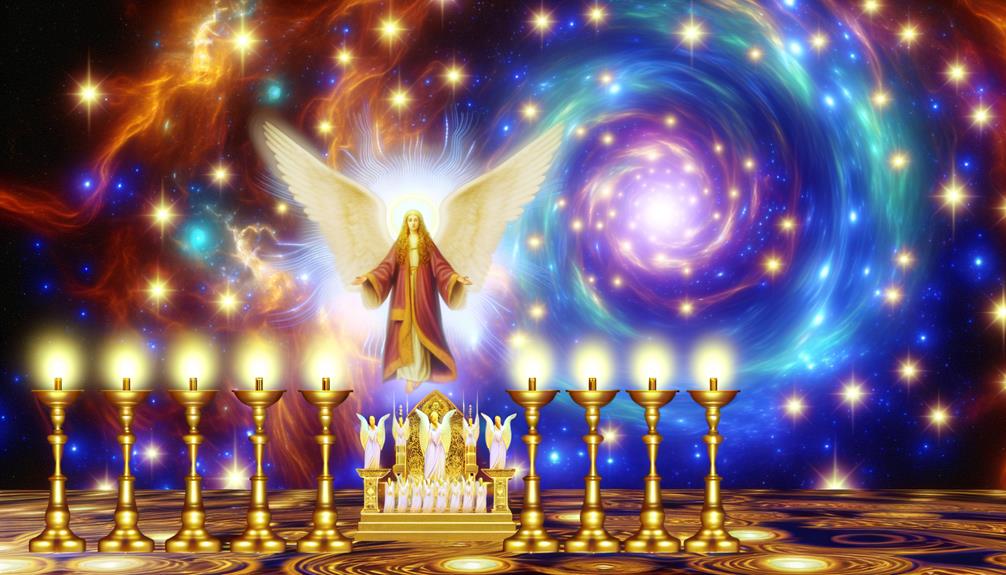
The Book of Revelation employs celestial imagery extensively, using heavenly bodies to convey profound theological and eschatological truths.
The symbolism of stars, the moon, and the sun not only reveals divine judgment and cosmic upheaval but also underscores the ultimate sovereignty of God.
Symbolism of Heavenly Bodies
Revelation employs celestial imagery to convey profound theological truths and eschatological events, encapsulating the divine interplay between the heavens and the earthly domain.
The symbolism of heavenly bodies in this biblical text is both rich and multifaceted. For instance:
- The Sun: Represents Christ’s glory and righteousness, illuminating the path for believers.
- The Moon: Often symbolizes the Church, reflecting the sun’s (Christ’s) light in the world’s darkness.
- Stars: Depict angels or messengers, guiding and protecting the faithful.
This celestial symbolism serves to evoke a sense of awe and divine mystery, reinforcing the sovereignty of God and the ultimate triumph of good over evil.
Understanding these symbols enhances our comprehension of Revelation’s messages, deepening our spiritual insight and faith.
Apocalyptic Star Representations
Among the myriad celestial symbols in Revelation, stars frequently embody apocalyptic elements that signify divine judgment and cosmic upheaval.
The falling star in Revelation 8:10, often interpreted as an angel or a harbinger of destruction, illustrates the profound connection between celestial imagery and divine intervention.
Revelation 12:4 depicts a dragon sweeping a third of the stars from the sky, symbolizing a dramatic cosmic battle. Additionally, Revelation 6:13 portrays stars falling to earth as a prelude to the final judgment.
These instances collectively underscore the stars’ role as potent symbols of God’s sovereign will and the impending transformation of the world order. Such imagery invites believers to reflect on the transcendence and ultimate authority of the divine narrative.
Angelic Hosts and the Heavens
In biblical literature, angelic hosts are frequently depicted as celestial beings who inhabit the heavens and serve as messengers of God’s divine will. These beings are often portrayed in scripture as powerful and awe-inspiring, reflecting the majesty of the divine order.
Angelic hosts fulfill key roles within the heavenly hierarchy, exemplifying divine attributes and executing God’s commands. Their presence evokes a profound sense of reverence and spiritual connection, underscoring the celestial domain’s significance in biblical theology.
Consider the following:
- Guidance: Angels provide divine guidance, appearing to figures like Abraham and Mary.
- Protection: They offer protection, as seen in the story of Daniel in the lion’s den.
- Worship: Angelic beings perpetually worship God, emphasizing the sacred nature of their existence.
The Firmament in Genesis

The concept of the firmament in Genesis is pivotal for understanding the biblical account of creation, particularly the divine separation of waters above and below.
This notion aligns with ancient cosmological views, reflecting the period’s understanding of the universe’s structure.
Beyond its physical description, the firmament also carries profound symbolic significance, representing order and the intentionality of God’s creative act.
Divine Separation of Waters
How does the concept of the firmament in Genesis reflect the divine separation of waters and convey a deeper theological significance within the creation narrative?
The term ‘firmament’ (רָקִיתַ, rāqîa‘) in Genesis 1:6-8 signifies a divinely appointed expanse that separates the ‘waters above’ from the ‘waters below’. This act of separation is symbolic of God’s sovereign order over chaos, emphasizing His omnipotence and intentional design.
The theological implications are profound:
- Divine Authority: It highlights God’s ultimate control over creation.
- Cosmic Harmony: It establishes a framework for balance and order in the universe.
- Spiritual Insight: It invites reflection on God’s purposeful intervention in the natural world.
This separation underscores the structured beauty and intention inherent in God’s creation.
Ancient Cosmological Views
Ancient Near Eastern cosmologies, including the biblical account in Genesis, often depict the firmament as a solid dome or expanse that separates the primordial waters, reflecting a shared understanding of the cosmos’ structure and function.
This firmament, or ‘raqia‘ in Hebrew, is described in Genesis 1:6-8 as a divinely created barrier that divides the ‘waters above’ from the ‘waters below.’
This concept aligns with other ancient beliefs, where the sky was envisioned as a physical partition holding back celestial waters.
Such imagery underscores a theological framework where God establishes order amidst chaos, creating a habitable world.
Ancient texts, consequently, provide an essential backdrop for comprehending how early peoples viewed divine interaction with the physical universe.
Firmament’s Symbolic Significance
In examining the firmament’s symbolic significance within the Genesis narrative, one observes that it functions as a profound theological metaphor for divine order and separation. The firmament, or ‘expanse,’ delineates the heavens from the earth, reflecting God’s intentional design in creation. This act of separation underscores the following:
- Divine Authority: The firmament symbolizes God’s sovereign power to create and organize the cosmos.
- Cosmic Harmony: It signifies the inherent order and balance within God’s creation, eliciting a sense of awe and reverence.
- Human Understanding: By comprehending the firmament, believers gain insight into the structure and purpose of the universe, fostering a deeper connection to the Creator.
Thus, the firmament serves as a crucial element in understanding biblical cosmology.
Astral Worship and Idolatry
Throughout biblical history, numerous accounts reveal the persistent human tendency to elevate celestial bodies to objects of worship, often leading to idolatry condemned by scriptural teachings. This phenomenon is illustrated in the worship of the sun, moon, and stars, which are explicitly prohibited in various passages. The Bible underscores the Creator’s supremacy over creation, admonishing against the veneration of created entities. This idolatry is often linked with divine retribution, emphasizing the importance of monotheism and devotion to God alone.
| Celestial Body | Scripture Reference | Condemnation |
|---|---|---|
| Sun | Deuteronomy 4:19 | Forbidden worship |
| Moon | Jeremiah 8:2 | Associated with disobedience |
| Stars | 2 Kings 23:5 | Linked to false gods |
| Heavenly Hosts | Deuteronomy 17:3 | Punishable by death |
| Planets | Isaiah 47:13 | Denounced as powerless |
Celestial Bodies in Psalms

While the Bible condemns the worship of celestial bodies, the Psalms frequently extol their beauty and purpose as creations that reflect the glory of God. Psalms such as Psalm 19:1 declare, “The heavens declare the glory of God; the skies proclaim the work of his hands.” This poetic imagery invites believers to view the cosmos as a representation of divine craftsmanship. The Psalms often evoke a sense of wonder and reverence.
- Awe: The vastness of the heavens inspires awe, reminding believers of God’s infinite nature.
- Praise: The celestial bodies serve as a call to worship, pointing to God’s majesty.
- Reflection: Contemplating the skies facilitates spiritual introspection and connection with the Creator.
Thus, the Psalms use celestial imagery to deepen faith and understanding.
Apocalyptic Signs in the Sky
Numerous biblical passages depict celestial phenomena as harbingers of apocalyptic events, signifying divine intervention and the unfolding of God’s ultimate plan.
In the prophetic literature, such as the Book of Revelation and the writings of Isaiah and Joel, signs in the sky often precede significant eschatological transformations.
For instance, Joel 2:30-31 describes ‘wonders in the heavens and on the earth, blood and fire and columns of smoke’ followed by the sun turning to darkness and the moon to blood.
These vivid descriptions serve not merely as dramatic imagery but as theological assertions, emphasizing the sovereignty of God over cosmic and historical events.
Accordingly, celestial signs are integral to understanding biblical eschatology and God’s overarching narrative of redemption.
Conclusion
The celestial elements in biblical texts serve as profound symbols, juxtaposing divine guidance and cosmic grandeur against human fallibility and idolatry.
From stars heralding prophetic events to the heavens declaring God’s glory, these motifs underscore a theological narrative that bridges the earthly and the divine.
Such celestial imagery, whether in apocalyptic visions or poetic Psalms, invites a deeper reflection on the omnipotence of the Creator, contrasting celestial order with human spiritual disorder.