
Garrison Meaning in the Bible: Military and Protection
In the Bible, the term ‘garrison’ denotes a fortified military post established for strategic control and defense of specific territories. Such structures were pivotal in various biblical narratives, especially in the Old Covenant, where they feature prominently in conflicts and territorial expansions, like Jonathan’s attack on the Philistine garrison (1 Samuel 13:3).
In the New Covenant, garrisons symbolize Roman authority and control, as seen in the intervention by soldiers in Acts 21:31-32. These fortifications underscore themes of power, dominance, and divine protection, resonating deeply within the cultural and theological context of biblical stories.
Explore further to uncover the multi-faceted dimensions of garrisons in biblical literature.

Key Takeaways
- Garrisons in the Bible refer to military posts or fortifications for protection and control.
- Old Testament garrisons symbolize strategic military strongholds, as seen in Jonathan’s attack on the Philistine garrison (1 Samuel 13:3).
- In the New Testament, garrisons represent Roman occupation and authority, like the soldiers’ intervention in Acts 21:31-32.
- Spiritually, garrisons symbolize divine protection and strength, akin to God being a refuge and fortress (Psalm 91:2).
Definition of Garrison
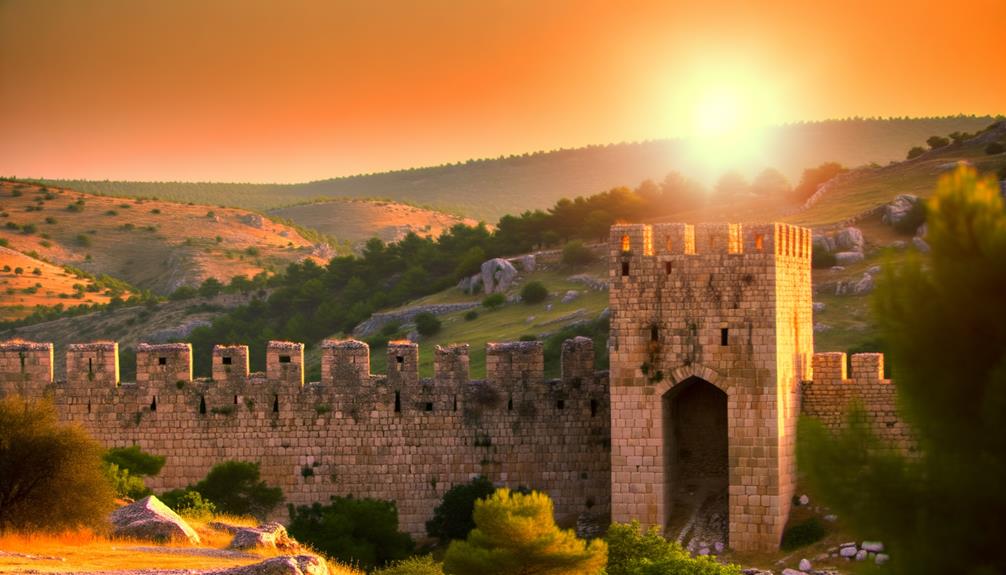
In biblical terms, a ‘garrison’ refers to a military post or fortification established to maintain control over a specific area and to provide protection against potential threats. This concept encompasses both physical structures and the troops stationed within them.
Garrisoned locations served strategic purposes, often situated in contested or vulnerable regions to assert dominance and deter enemy advances. These installations were pivotal in the ancient world for maintaining order and implementing governance.
The term ‘garrison’ also implies a sense of permanency and readiness, reflecting the necessity for continuous vigilance.
Understanding the role and function of garrisons within the biblical narrative provides a deeper insight into the socio-political and military strategies of the time, underscoring their importance in historical and theological contexts.
Old Testament References
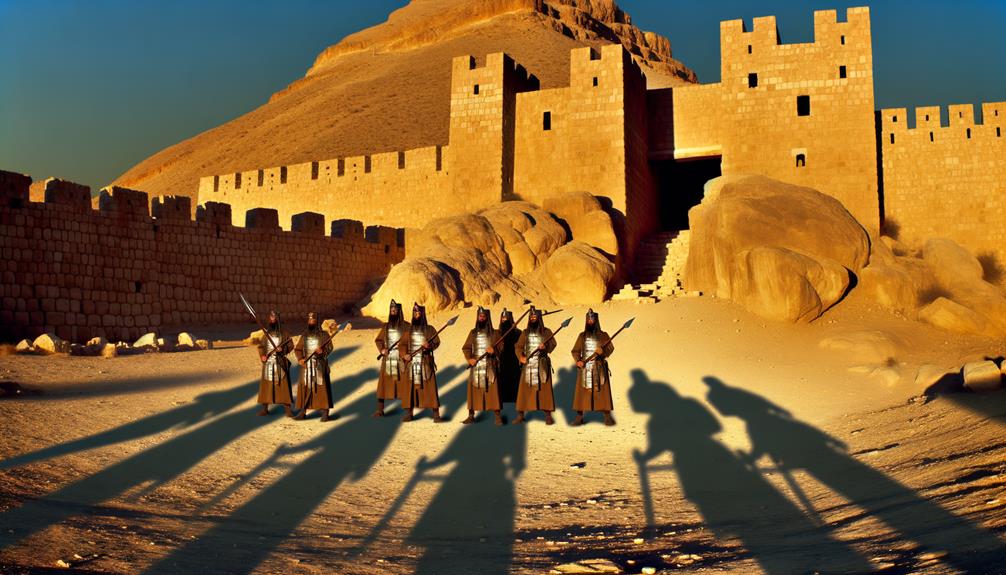
How do Old Covenant references to garrisons illuminate the broader military and political landscape of ancient Israel?
In the Old Scriptures, garrisons are frequently mentioned within the context of Israel’s military campaigns and territorial expansions. For example, 1 Samuel 13:3 describes Jonathan’s attack on the Philistine garrison at Geba, which underscores the volatile nature of Israelite-Philistine relations.
Additionally, 2 Samuel 8:6 highlights King David’s establishment of garrisons in Aram, indicating the consolidation of territorial control and the imposition of political dominance.
These references reveal Israel’s strategic use of fortified positions to secure borders, project power, and maintain dominance over conquered peoples.
Consequently, garrisons served not just as military strongholds but as instruments of broader geopolitical strategy.
New Testament Mentions
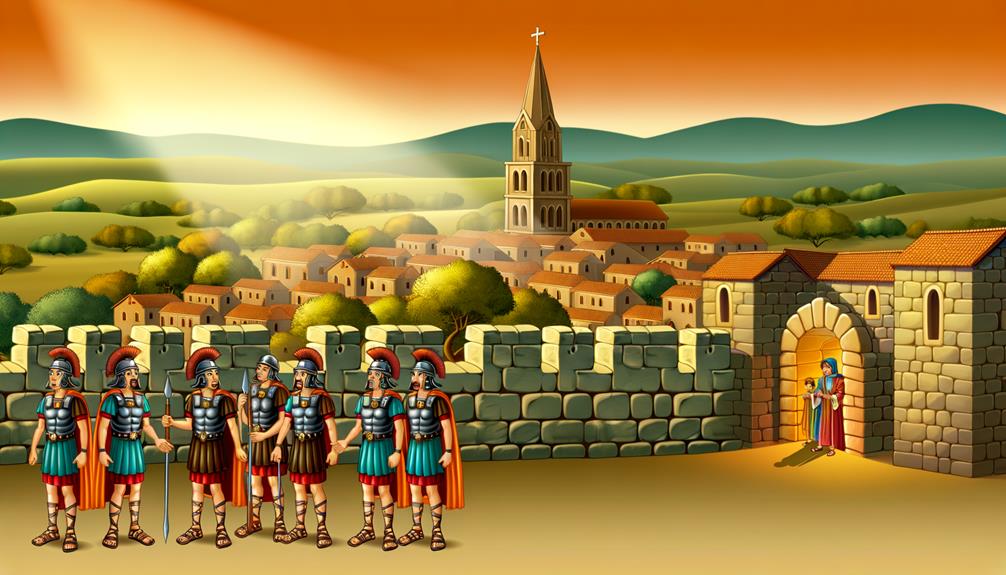
While the Old Scriptures extensively documents the strategic role of garrisons in Israel’s military and political maneuvers, the New Scriptures offers a more nuanced depiction of these structures within the context of Roman occupation and early Christian communities. Garrisons in the New covenant often symbolize Roman authority and control, seen in passages where soldiers are stationed in Jerusalem to maintain order. These references illuminate the socio-political landscape that early Christians navigated, reflecting tensions between emerging Christian groups and established Roman rule.
| Scripture | Mentions of Garrisons |
|---|---|
| Acts 21:31-32 | Roman soldiers intervening in a riot |
| Luke 23:11 | Herod’s soldiers mock and dress Jesus |
| Mark 15:16 | Roman soldiers lead Jesus to the Praetorium |
This scholarly perspective underscores the multifaceted role of garrisons, extending beyond mere military presence to symbols of power and societal dynamics.
Symbolism and Imagery

Garrisons in biblical texts often serve as potent symbols of imperial dominance and the socio-political tension between occupying forces and local populations. These military strongholds epitomize the pervasive control exerted by empires such as Rome and Babylon, often representing the subjugation and marginalization of indigenous communities.
Symbolically, garrisons are not just physical structures but metaphors for the broader themes of power, resistance, and cultural imposition found throughout biblical narratives. The imagery of fortified garrisons underscores the dichotomy between the oppressor and the oppressed, illustrating the pervasive impact of imperialism on societal structures.
This symbolism is essential for understanding the historical context and the profound sense of urgency for deliverance and justice that permeates many biblical passages.
Garrison as Divine Protection

Amidst the backdrop of garrisons symbolizing imperial dominance, biblical texts also portray these strongholds as manifestations of divine protection and sanctuary for the faithful. This dual symbolism underscores a theological paradigm wherein God’s providence is likened to a fortified refuge. The metaphor of God as a garrison is prevalent in Psalms, providing a robust image of divine defense.
- Psalms 46:1-2: Depicts God as a ‘refuge and strength.’
- Psalm 18:2: Describes the Lord as ‘my fortress and deliverer.’
- Proverbs 18:10: States that ‘The name of the Lord is a fortified tower.’
- Nahum 1:7: Asserts ‘The Lord is good, a refuge in times of trouble.’
These verses collectively illustrate a divine garrison that provides spiritual and existential security.
Historical Context
To fully understand the concept of garrisons in the Bible, it is essential to examine the historical and cultural milieu in which these texts were written.
Garrisons, often military outposts or fortresses, played a vital role in the security and administrative control of territories in ancient times. The biblical narrative spans a period marked by frequent conflicts and the rise and fall of empires, such as Assyria, Babylon, and Rome.
During these eras, garrisons were established to protect strategic locations, secure trade routes, and maintain order. The presence of garrisons signified authority and power, often reflecting the political dynamics of the period.
Understanding this context sheds light on the practical and symbolic significance of garrisons in biblical accounts.
Spiritual Significance

The term ‘garrison’ in the biblical context extends beyond its historical role to encapsulate profound spiritual connotations.
It frequently symbolizes divine protection, serving as a fortress against malevolent forces and safeguarding believers.
This duality enriches its theological significance, offering insights into the nature of divine guardianship and the perpetual struggle against evil.
Symbol of Divine Protection
In biblical literature, the term ‘garrison’ often symbolizes divine protection, reflecting God’s safeguarding presence over His people. This metaphorical use underscores the spiritual security provided by God, akin to a military stronghold.
Scriptural references illustrate this:
- Psalm 91:1-2: Depicts God as a refuge and fortress.
- 2 Samuel 22:2-3: David describes the Lord as his stronghold and deliverer.
- Proverbs 18:10: The name of the Lord is likened to a fortified tower.
- Isaiah 26:1-2: Emphasizes the strength and salvation found in God’s protection.
These passages collectively highlight the profound assurance and spiritual defense offered by divine guardianship.
Fortress Against Evil Forces
Against the backdrop of spiritual warfare, the concept of a garrison in biblical texts serves as a symbol of God’s protective strength against evil forces. This imagery signifies a fortified stance, where divine intervention acts as a bulwark against spiritual adversaries.
Scriptural references, such as those found in Psalms and Ephesians, underscore the necessity of divine protection in the believer’s life. The garrison metaphor extends beyond physical defense, encapsulating the spiritual armor that guards the heart and mind.
Theologically, it denotes a sanctuary where God’s omnipotence repels malevolent forces, ensuring spiritual resilience. Such contextual understanding enriches the believer’s grasp of divine fortification, aligning their faith with the enduring promise of God’s unwavering protection.
Lessons From Garrisons

The concept of garrisons in the Bible offers multifaceted insights into strategic military strongholds, revealing how these fortified positions were essential for defense and control.
Symbolically, garrisons represent spiritual fortifications, reflecting the need for vigilance and preparedness in one’s faith journey.
Additionally, the biblical portrayal of garrisons provides profound lessons on spiritual warfare, highlighting the importance of maintaining a stronghold of righteousness against adversarial forces.
Strategic Military Strongholds
Throughout biblical history, garrisons served as strategic military strongholds that not only protected territories but also facilitated control and influence over surrounding regions. These fortified positions were essential in maintaining security and asserting dominance.
Key aspects include:
- Defense: Garrisons acted as the first line of defense against invading forces.
- Surveillance: Elevated positions allowed for effective monitoring of enemy movements.
- Logistics: They served as hubs for the storage and distribution of supplies.
- Communication: Garrisons enabled efficient relay of information across regions.
Examining these elements reveals the multifaceted role of garrisons in biblical narratives, highlighting their significance in historical military strategy and regional governance.
Symbolism in Scripture
While garrisons in the biblical context primarily served military functions, their presence and characteristics also carry profound symbolic meanings that offer deeper insights into spiritual fortitude and divine protection.
In Scripture, garrisons often symbolize the strength and steadfastness required to uphold faith amidst adversity. They represent divine fortification, indicating that just as physical garrisons safeguard against enemies, so too does God’s protection secure believers against spiritual threats.
Additionally, these strongholds echo themes of vigilance and preparedness, urging believers to remain spiritually watchful. The metaphor of a garrison underscores the necessity of a fortified heart and mind, grounded in scriptural truths, to withstand trials and tribulations.
Consequently, garrisons in the Bible are emblematic of both divine guardianship and the resilient spirit of faith.
Spiritual Warfare Insights
Understanding the symbolic significance of garrisons in Scripture provides a foundational perspective for exploring their strategic lessons in spiritual warfare. Garrisons, as fortified strongholds, encapsulate various defensive and offensive strategies applicable to spiritual battles. By examining biblical accounts, one can derive essential principles for maintaining spiritual vigilance and resilience.
- Defense Mechanisms: Like physical garrisons, spiritual defenses must be robust to withstand attacks.
- Strategic Positioning: Spiritual readiness involves positioning oneself advantageously through prayer and scripture.
- Resource Allocation: Properly allocating spiritual resources guarantees preparedness.
- Continuous Vigilance: Just as garrisons require constant watch, believers must remain spiritually alert.
These insights underscore the necessity of strategic spiritual preparedness.
Modern Interpretations

In contemporary biblical scholarship, the term ‘garrison’ is often re-examined through various lenses to uncover its nuanced roles and implications within the scriptural narrative. Scholars analyze ‘garrison’ not merely as a military installation but as a symbol of divine protection, territorial control, and societal structure.
This term’s usage in passages such as 1 Samuel 13:3, where Jonathan attacks a Philistine garrison, invites interpretations that consider the geopolitical and spiritual undertones. Modern interpretations also explore the metaphorical significance of ‘garrison’ in the context of God safeguarding His people, thereby interlinking physical defense with spiritual guardianship.
Consequently, the term transcends its literal meaning, offering deeper insights into ancient Israelite society and their conceptualization of divine intervention and communal safety.
Conclusion
In examining the term ‘garrison’ within the biblical context, it becomes evident that it transcends mere physical fortifications, embodying divine guardianship and spiritual resilience.
Both Old and New scriptures references, enriched by historical and symbolic dimensions, reveal its multifaceted significance.
This exploration underscores the garrison’s role as a metaphor for divine protection and spiritual fortitude.
Contemporary interpretations continue to draw on these ancient lessons, imbuing the concept with enduring theological and existential relevance.