
Meaning Of Daphne In Bible: Victory and Transformation
The name ‘Daphne,’ rooted in the Greek word for ‘laurel,’ encompasses a rich amalgamation of cultural, mythological, and biblical significance. In the Bible, laurel symbolizes victory, honor, and divine favor, appearing in various passages such as Psalm 37:35 and Isaiah 44:14.
The laurel tree’s evergreen nature underscores themes of eternal life and resurrection, offering a profound symbol of triumph and God’s blessings. Early Church Fathers also adapted Daphne’s narrative into allegories of spiritual purity and transformation.
By exploring the name ‘Daphne,’ one encounters a tapestry of historical, religious, and cultural meanings, each layer adding depth to its significance.

Key Takeaways
- Daphne is derived from the Greek word for laurel, symbolizing victory and honor.
- Laurel is mentioned in the Bible, representing triumph and divine favor.
- Biblical texts like Isaiah and Psalms use laurel imagery to convey strength and resilience.
- Early Church Fathers used Daphne’s myth to symbolize the soul’s spiritual journey and transformation.
Origin of the Name Daphne

The name Daphne, frequently encountered in classical literature and mythology, originates from the ancient Greek word ‘δάφνη,’ meaning ‘laurel.’
This etymology reflects the historical and cultural significance of the laurel tree in ancient Greek society, where it symbolized victory, honor, and status.
Laurels were often used to craft crowns for victors in athletic competitions and poetic contests, consequently establishing a deep-rooted association with excellence and nobility.
The name Daphne, therefore, carries connotations of distinction and reverence.
Understanding its origin provides a nuanced perspective on its application in various narratives and contexts, including its later adaptations and influences.
This analysis underscores the importance of etymology in comprehending the layers of meaning embedded in names used throughout history.
Daphne in Greek Mythology

Central to the rich tapestry of Greek mythology, the story of Daphne epitomizes themes of transformation and unrequited love, illustrating the complex interplay between divine intervention and human experience.
Daphne, a naiad nymph, became the object of Apollo’s relentless desire after being struck by Eros’s golden arrow. In her desperate plea for escape, she prayed to her father, the river god Peneus, who transformed her into a laurel tree just as Apollo approached.
This metamorphosis not only saved Daphne but also immortalized her in the form of the laurel, a symbol of victory and eternal honor in Greek culture.
This myth underscores the profound narratives of change and the poignant cost of divine whims in human lives.
Biblical References to Laurel

While Daphne’s transformation into a laurel tree holds substantial significance in Greek mythology, the laurel also bears remarkable mentions within the context of the Bible. Though not as overtly prominent as other symbols, references to the laurel appear in various biblical texts, underscoring its cultural and theological importance. These instances illustrate a multifaceted understanding of the laurel, linking it to themes of victory, honor, and divine favor.
| Bible Verse | Context |
|---|---|
| Psalm 37:35 | Wicked flourishing like a green laurel tree |
| Isaiah 44:14 | Laurel used in crafting idols |
| 1 Kings 6:23-35 | Laurel imagery in Solomon’s Temple decorations |
These references enrich our comprehension of laurel’s biblical connotations.
Symbolism of Laurel in Scripture
In biblical scripture, the laurel serves as a potent symbol of victory, honor, and divine favor, encapsulating a rich tapestry of theological and cultural significance.
Rooted in ancient traditions, the laurel wreath often signifies triumph and achievement, resonating through various biblical narratives. This symbolism extends to divine approval, where the laurel represents God’s blessings upon the righteous.
In prophetic literature, the laurel can also symbolize eternal life and resurrection, as its evergreen nature conveys immortality and enduring faith.
The apostle Paul’s epistles frequently use laurel imagery to illustrate the spiritual victories of believers, emphasizing perseverance and ultimate triumph through faith.
Consequently, the laurel embodies a multifaceted emblem of spiritual excellence and divine endorsement.
Cultural Significance of Daphne

The cultural significance of Daphne extends beyond its biblical mentions, encompassing a rich tapestry of symbolism in ancient texts where it often represents victory and eternal glory.
Botanical references in scriptures further highlight its sacred status, drawing connections between its evergreen nature and divine immortality.
This enduring symbol has profoundly influenced art and literature, inspiring countless works that explore themes of transformation and resilience.
Symbolism in Ancient Texts
Daphne, often depicted as a symbol of purity and transformation in ancient texts, carries significant cultural weight through her association with the laurel tree, a plant revered in various mythologies and religious traditions.
The myth of Daphne, who transformed into a laurel tree to escape Apollo, emphasizes themes of chastity and divine intervention. This narrative illustrates the laurel as a symbol of victory and honor, echoing its use in Greco-Roman ceremonies.
In broader cultural contexts, the laurel tree signifies protection and sacredness, aligning with spiritual pursuits and moral integrity. Such symbolism underscores the deep cultural resonance of Daphne, bridging mythological imagination with enduring human values.
Botanical References in Scriptures
Scriptural references to botanical elements, such as the laurel tree associated with Daphne, reflect profound cultural and theological significances that span across various religious texts. The laurel tree symbolizes victory, glory, and eternal life, elements often intertwined with divine favor and human virtue.
| Scriptural Element | Cultural Significance |
|---|---|
| Laurel Tree | Victory |
| Olive Tree | Peace and Prosperity |
| Cedar of Lebanon | Strength and Durability |
| Fig Tree | Abundance and Fertility |
Analyzing these references, the laurel tree emerges as a metaphor for spiritual triumph and moral excellence, reinforcing the interconnectedness of nature and divine symbolism. Such botanical imagery not only enhances the narrative depth but also serves as a didactic tool, guiding believers in their spiritual journeys.
Influence on Art and Literature
Beyond its theological implications, the symbolic significance of Daphne and the laurel tree has profoundly influenced art and literature, serving as a potent motif representing triumph, transformation, and divine favor.
In classical mythology, Daphne’s metamorphosis into a laurel tree to escape Apollo encapsulates themes of purity and transformation, inspiring countless artistic renditions, from Ovid’s ‘Metamorphoses’ to Bernini’s sculpture ‘Apollo and Daphne.’
The laurel wreath, derived from this myth, symbolizes victory and honor, frequently appearing in ancient Roman iconography and Renaissance paintings.
Furthermore, literary references to Daphne in works such as John Keats’ poetry often evoke the tension between mortal desire and divine intervention, underlining the enduring cultural resonance of this emblematic narrative.
Interpretations by Early Church Fathers
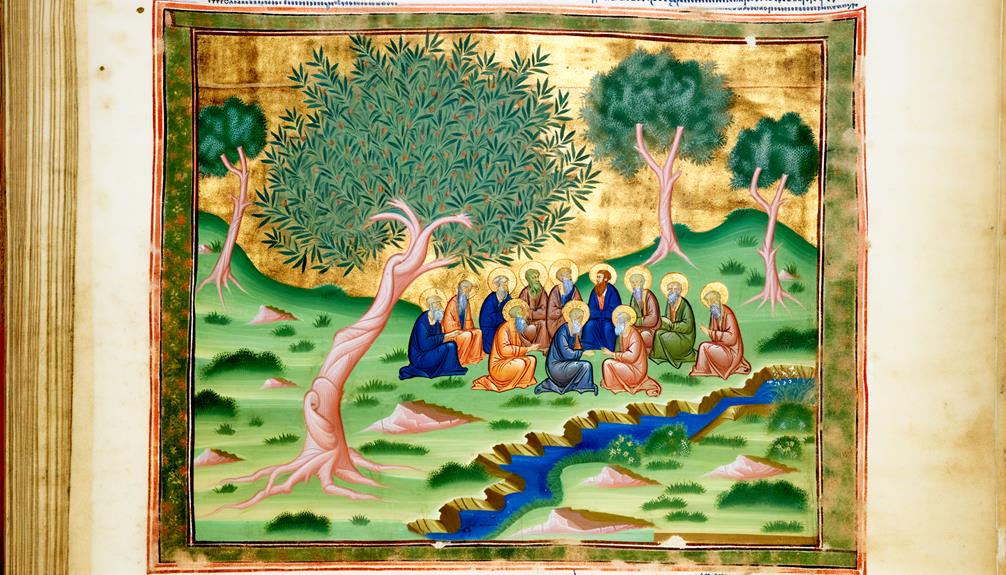
The early Church Fathers offered a rich tapestry of interpretations regarding Daphne, often employing symbolic analysis that integrated Greco-Roman mythological elements into Christian allegory.
They recontextualized Daphne’s narrative to underscore theological themes such as purity, transformation, and divine intervention.
This approach not only provided moral and spiritual lessons but also illuminated broader theological implications within early Christian thought.
Patristic Symbolic Analysis
Early Church Fathers’ interpretations of Daphne in biblical texts reveal a rich tapestry of symbolic meanings, reflecting both theological depth and historical context. They often associated Daphne with themes of purity, transformation, and divine intervention.
For instance, Origen viewed Daphne as a symbol of the soul’s struggle and ultimate metamorphosis under divine influence. Ambrose, however, interpreted Daphne’s transformation into a laurel tree as representing spiritual victory and eternal life.
These analyses were not mere allegories but profound reflections on the human condition and the divine narrative. The Fathers’ insights demonstrate how early Christian thought intricately wove biblical symbolism into a broader theological framework, offering timeless reflections on faith, morality, and the divine-human relationship.
Daphne in Christian Allegory
Interpreting Daphne through the lens of Christian allegory, early Church Fathers intricately connected her mythological narrative to foundational Christian themes such as spiritual purification, divine grace, and the soul’s journey toward redemption.
Origen and Clement of Alexandria, for instance, saw Daphne’s transformation into a laurel tree as a metaphor for the soul’s purification and sanctification through divine grace. The laurel, often associated with victory and eternal life, symbolized the triumph of divine intervention over earthly desires.
Additionally, Daphne’s evasion of Apollo’s pursuit was allegorized as the soul’s struggle against worldly temptations, emphasizing the need for divine assistance in achieving spiritual integrity.
These interpretations enriched the Christian understanding of the soul’s ascension and the transformative power of God’s grace.
Theological Implications Explored
Building upon the allegorical interpretations, the theological implications of Daphne’s myth as explored by early Church Fathers reveal profound insights into the nature of divine grace and the sanctification process.
These theological reflections highlight several key aspects:
- Transformation and Renewal: Daphne’s metamorphosis into a laurel tree symbolizes spiritual renewal and transformation through divine intervention.
- Purity and Chastity: The pursuit of Daphne by Apollo and her subsequent transformation embodies the virtue of chastity protected by divine grace.
- Divine Protection: Daphne’s escape from Apollo can be interpreted as God’s protection of the soul from worldly temptations.
- Martyrdom and Witness: The laurel tree, often a symbol of victory, can be seen as a representation of the triumph of faith and martyrdom.
These interpretations invite believers to reflect deeply on their spiritual journey.
Daphne in Religious Art

Depictions of Daphne in religious art often reflect a complex interplay of cultural symbolism, theological themes, and historical context. Frequently, Daphne is portrayed in ways that encapsulate her transformation from mortal to laurel tree, a metamorphosis that artists have historically linked to themes of purity, divine intervention, and the natural order.
These artistic renderings, whether in frescoes, sculptures, or illuminated manuscripts, imbue her character with multifaceted symbolism, often drawing parallels to biblical narratives of divine encounters and moral dilemmas.
The historical context of these artworks, spanning from early Christian iconography to Renaissance humanism, showcases the evolving interpretative lenses through which Daphne’s story is viewed, intertwined with theological reflections on virtue, resistance, and sanctity.
Modern Relevance of the Name Daphne

In contemporary society, the name Daphne continues to hold cultural and symbolic significance, reflecting a fusion of classical mythological heritage and modern interpretative frameworks. This name, derived from Greek mythology, where Daphne was a nymph transformed into a laurel tree, carries rich connotations of beauty, nature, and transformation. In the modern context, its resonance extends beyond ancient tales:
Literary and Artistic Inspiration: Daphne frequently appears in literature and art, symbolizing purity and metamorphosis.
Botanical Associations: The laurel tree remains a powerful emblem of victory and honor, often linked to the name Daphne.
Cultural Relevance: It finds a place in contemporary media, enhancing its recognition and appeal.
Personal Identity: The name’s unique blend of history and modernity makes it a popular choice for naming.
Conclusion
The exploration of the name Daphne reveals a tapestry of rich cultural, mythological, and biblical significance.
While the name itself does not appear in the Bible, the laurel, synonymous with Daphne, embodies a profound symbolism of victory and honor in scripture.
This analysis illuminates the staggering depth of meaning that early Church Fathers and religious art have ascribed to the laurel, making Daphne an evergreen symbol of triumph and spiritual excellence even in contemporary contexts.