
Meaning of Julia in the Bible: Christian Womanhood
In Romans 16:15, Julia is briefly mentioned by Paul, underscoring the inclusivity and essential contributions of women in early Christianity. This reference suggests her notable role in the church, challenging the prevailing gender norms of that era.
The name Julia carries historical and cultural weight, emerging from Latin roots associated with nobility and devotion. Additionally, her inclusion in Paul’s greetings highlights the egalitarian nature of early Christian communities amidst a stratified Roman society.
Examining this context provides deeper insight into how early Christians navigated and subtly subverted contemporary sociopolitical structures. This encourages further exploration into these dynamics.

Key Takeaways
- Julia is mentioned in Romans 16:15 as an early Christian, indicating her importance in the early church.
- Her mention underscores the inclusivity and diversity of the early Christian community.
- Julia’s presence highlights the active participation and contributions of women in early Christianity.
- She exemplifies the subversion of traditional gender roles within the early Christian context.
Biblical Mention of Julia

In the New Covenant, Julia is mentioned in Romans 16:15 as one of the early Christians whom Paul greets. This brief mention, while seemingly minor, provides significant insights into the early Christian community’s inclusivity and diversity.
Paul’s epistle to the Romans, rich in theological discourse, also serves as a social document, revealing the interconnectedness among believers. Julia’s inclusion in these greetings signals her importance within the fledgling church, suggesting she played a notable role.
This mention underscores the presence and contributions of women in early Christian circles, challenging contemporary gender norms. By acknowledging Julia, Paul affirms her as an integral part of the Christian mission, thereby highlighting the egalitarian ethos that characterized the early church.
Historical Context of Julia

Understanding the historical context of Julia necessitates examining the sociopolitical and religious landscape of the early Roman Empire, which shaped the experiences and roles of early Christians like her. During this period, Christianity was emerging within a largely pagan society, under the rule of emperors who often viewed the new faith with suspicion. Social structures were hierarchical, and religious practices were polytheistic, creating a challenging environment for Christians.
| Aspect | Description | Impact on Early Christians |
|---|---|---|
| Political System | Centralized Imperial Rule | Persecution and Legal Challenges |
| Social Hierarchy | Stratified Class System | Varied Access to Resources and Rights |
| Religious Climate | Largely Pagan with State-Sponsored Cults | Marginalization and Secrecy |
| Legal Framework | Roman Law Enforced | Legal Precariousness |
| Cultural Norms | Traditional Roman Values | Cultural Tensions |
This context influenced how individuals like Julia navigated their faith and societal roles.
Julia in Early Christianity
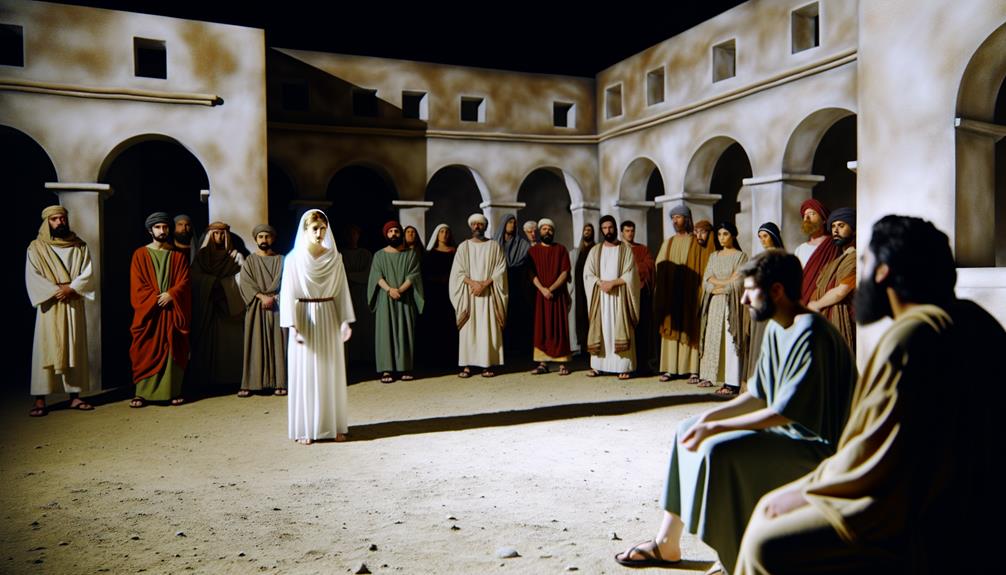
Amid the burgeoning Christian community of the early Roman Empire, Julia’s role exemplifies the complex interplay between emerging religious identities and established sociopolitical structures.
Mentioned in Romans 16:15, Julia is recognized as one of the early Christians within the nascent church, indicating the presence and participation of women in foundational Christian activities.
The inclusion of her name by Paul suggests her significance in the communal and possibly evangelical efforts of early Christianity.
This reference not only highlights the inclusivity of the early Christian movement but also underscores the subversion of traditional gender roles within the religious context.
Julia’s presence in these early texts provides invaluable insight into the dynamics of early Christian communities and their social fabric.
Cultural Significance of the Name

Exploring the cultural significance of the name Julia reveals its historical resonance and enduring appeal across various periods and societies.
Originating from the Latin ‘Iulia,’ the name is deeply rooted in Roman history, particularly linked to the Julian family, which includes figures like Julius Caesar. Over centuries, it has maintained prominence, symbolizing nobility and heritage.
In Christian contexts, Julia carries connotations of grace and devotion, reflecting its mention in the New Covenant.
The name’s adaptability across languages and cultures—such as Giulia in Italian and Julie in French—further underscores its universal appeal.
Consequently, Julia’s sustained popularity underscores its rich historical and cultural layers, making it a name imbued with timeless elegance and significance.
Insights From Paul’s Letter

Paul’s letter to the Romans provides critical insights into the early Christian community, revealing the presence and significance of a woman named Julia within this nascent religious movement. In Romans 16:15, Paul greets Julia, highlighting her as part of the extended Christian fellowship.
This mention, though brief, underscores the inclusive nature of the early church and the important roles women played. The acknowledgment of Julia, amidst other notable figures, suggests her active participation and possible influence in the ministry.
Contextually, this reference not only affirms the diversity within the early Christian community but also challenges contemporary perceptions of gender roles in religious settings. Consequently, Julia’s mention enriches our understanding of the dynamic and egalitarian aspects of early Christianity.
Conclusion
Julia’s fleeting mention in the Bible, nestled within the historical and cultural tapestry of early Christianity, reflects a nuanced legacy.
Her presence in Paul’s letter, though brief, carries the weight of early Christian identity and the subtle societal shifts of the time.
The name Julia, imbued with cultural resonance, invites reflection on the interconnectedness of history, faith, and identity.
Like a single brushstroke on a vast canvas, Julia’s mention enriches the broader narrative of biblical scholarship.