
Meaning of Simeon in the Bible: Heard by God
The name Simeon, originating from the Hebrew ‘Shimon,’ signifies ‘to hear’ or ‘to listen,’ highlighting themes of divine attentiveness. As the second son of Jacob and Leah, Simeon’s narrative in Genesis underscores ethical tensions, justice, and familial loyalty.
His descendants’ complex territorial politics within Israel’s tribes reveal shifts from prominence to marginalization. In the New scripture, Simeon’s encounter with the infant Jesus in the Temple encapsulates eschatological hope and fulfillment of divine prophecy.
His life and actions offer profound insights into themes of obedience, redemption, and divine fidelity, enriching our understanding of biblical narratives and their spiritual implications.

Key Takeaways
- Simeon means ‘to hear’ or ‘to listen,’ signifying divine attentiveness and obedience in Hebrew.
- Simeon, son of Jacob, highlights themes of justice, familial loyalty, and divine providence.
- The tribe of Simeon faced marginalization and integration into Judah, losing distinct political identity.
- Simeon’s imprisonment by Joseph in Egypt underscores themes of repentance and family reconciliation.
Origin of the Name Simeon

The name Simeon originates from the Hebrew name ‘Shimon,’ which is derived from the verb ‘shama,’ meaning ‘to hear‘ or ‘to listen.’ This etymological root underscores a deeper, symbolic resonance within biblical texts, suggesting an individual who possesses a heightened sense of awareness or divine attunement.
The name’s significance extends beyond its literal meaning, often interpreted within scriptural contexts as embodying obedience and receptivity to God’s will.
Scholarly examination reveals that such nomenclature was not merely nominal but imbued with theological and cultural significance.
Understanding the origin of ‘Simeon’ consequently provides invaluable insight into the ancient Hebrew worldview, wherein names encapsulated essential attributes and anticipated destinies, reflecting a broader narrative of covenant and communication with the divine.
Simeon, Son of Jacob

Building upon the etymological and theological significance of the name, Simeon, son of Jacob, emerges as a prominent figure in the narrative of the Twelve Tribes of Israel. This reflects the intricate interplay between personal identity and collective destiny in the biblical tradition.
Simeon, the second son of Jacob and Leah, is introduced in Genesis 29:33, where his name, meaning ‘God has heard,’ underscores divine attentiveness to Leah’s plight.
In Genesis 34, Simeon’s actions during the incident at Shechem reveal complex dimensions of justice and retribution, highlighting the ethical tensions within familial loyalty.
In addition, Simeon’s character is intricately woven into the broader patriarchal narrative, illustrating the multifaceted roles individuals play in shaping Israel’s emerging identity and theological heritage.
Significance in the Twelve Tribes
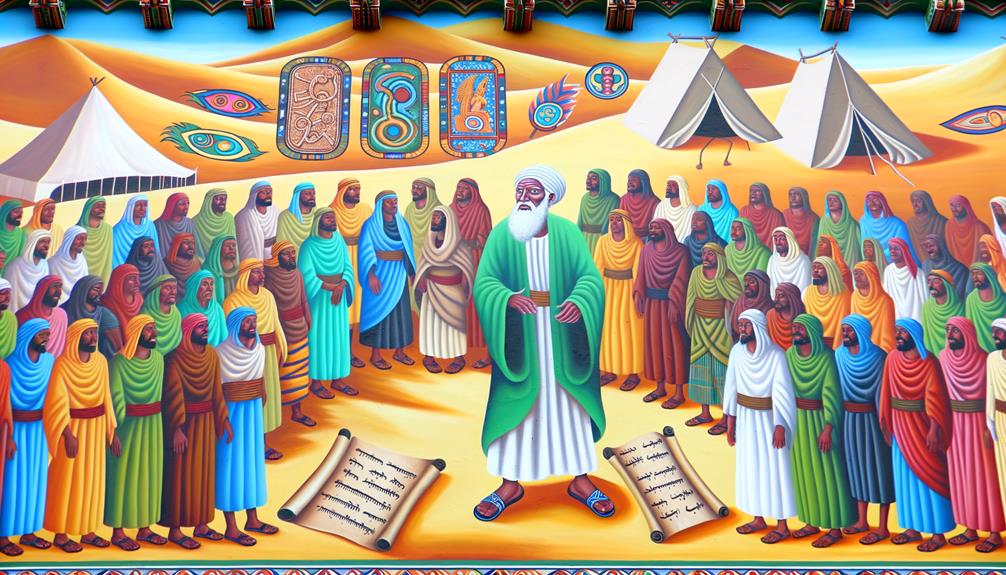
Simeon’s significance within the Twelve Tribes of Israel can be discerned through his descendants’ territorial inheritance and their subsequent roles in the sociopolitical landscape of ancient Israel.
The tribe of Simeon, initially allocated land within the larger territory of Judah (Joshua 19:1-9), experienced a unique form of dispersion. This geographical arrangement reflected their marginalization and relative obscurity compared to other tribes.
Simeon’s integration into Judah diluted their distinct tribal identity over time, impacting their influence in Israel’s collective narrative. This dispersal also limited Simeon’s independent political power, diminishing their prominence within the tribal coalition.
Analyzing these dynamics offers insight into the complexities of tribal interactions and territorial politics in Israel’s formative historical periods.
Simeon’s Role in Egypt

Simeon’s role in Egypt is profoundly marked by his imprisonment by Joseph, which serves as a pivotal moment in the narrative of Joseph’s reconciliation with his brothers.
This act of detainment was not merely punitive but strategic, setting the conditions for the release that necessitated the family’s second journey to Egypt.
Through this sequence of events, the narrative underscores themes of repentance, familial bonds, and divine providence.
Simeon’s Imprisonment by Joseph
During the pivotal moments of Joseph’s tenure in Egypt, Simeon’s imprisonment served as a significant test of his brothers’ integrity and familial loyalty.
Joseph, now a powerful Egyptian official, orchestrated this scenario to ascertain whether his brothers had indeed changed from their earlier treachery. Simeon, one of the eldest, was selected for detention, emphasizing the gravity of their previous actions against Joseph.
This act was not merely punitive but deeply symbolic, as it mirrored the earlier betrayal and underscored the need for repentance and unity within Jacob’s family.
Simeon’s detention functioned as a catalyst, compelling his brothers to confront their past misdeeds and evaluate their commitment to family bonds, setting the stage for eventual reconciliation.
Simeon’s Release Conditions
To secure Simeon’s release from imprisonment, Joseph imposed a stringent condition: his brothers must return with their youngest sibling, Benjamin, thereby proving their honesty and familial unity.
This demand served multiple purposes within the narrative framework. First, it tested the brothers’ integrity and willingness to protect Benjamin, countering their previous betrayal of Joseph.
Next, it provided Joseph an opportunity to observe whether his brothers had changed since their earlier transgressions. The condition also strategically guaranteed the presence of all his brothers in Egypt, facilitating a potential familial reconciliation.
Consequently, Simeon’s detainment was not merely punitive but instrumental in advancing the broader themes of repentance, redemption, and relational restoration within the biblical account.
Family’s Second Journey
As Joseph’s brothers set out on their second journey to Egypt, the unfolding events highlighted Simeon’s continued significance within the narrative, further emphasizing the themes of reconciliation and familial unity.
Simeon, held as a hostage in Egypt, becomes a pivotal figure for the brothers’ return, symbolizing the tangible cost of their earlier betrayal of Joseph. His detention underscores the gravity of the familial disintegration and necessitates their collective effort for his release.
This enforced solidarity prompts a deeper introspection among the brothers, driving them towards redemption.
Simeon’s role, consequently, is not merely as a captive but as a catalyst for the brothers’ moral and relational transformation, bridging their fractured past with a reconciled future.
Blessing and Prophecy
Simeon’s blessing and prophecy, as recorded in the Gospel of Luke, play an essential role in understanding the messianic expectations and theological implications within the New Covenant narrative.
Simeon, a devout man, encounters the infant Jesus at the Temple and proclaims Him as the awaited Messiah, fulfilling divine revelation.
His prophecy includes both a blessing and a forewarning: Jesus is destined to bring salvation to all nations but will also be a sign that incites opposition, revealing the true intentions of many hearts.
This dual aspect underscores the complex and transformative nature of Jesus’ mission, bridging Jewish tradition with a universal salvific promise.
Simeon’s words therefore encapsulate the hope and challenge embodied in the advent of Christ.
Simeon in the New Testament
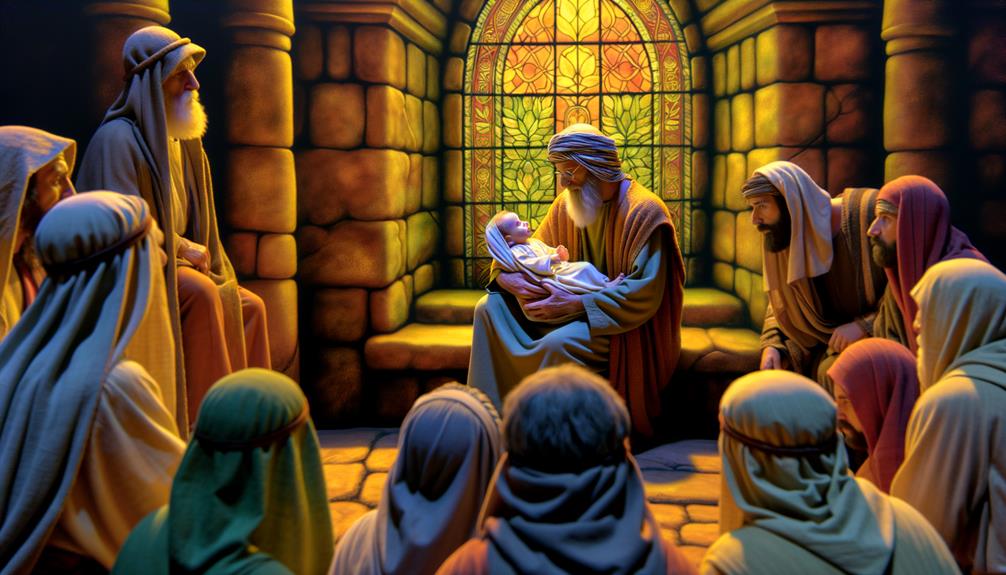
In the New Covenant, Simeon’s encounter with the infant Jesus at the Temple epitomizes the fulfillment of divine prophecy.
His subsequent blessing of Jesus and prophetic declarations highlight the Messianic significance attributed to the child.
This event underscores Simeon’s role as a pivotal witness to the manifestation of God’s salvation plan.
Encounter With Baby Jesus
Encountering the infant Jesus in the Temple, Simeon fulfills a prophetic role that underscores the deep messianic expectations present within the Jewish community during the Second Temple period. Luke’s Gospel situates Simeon as a righteous and devout figure, awaiting the “consolation of Israel.”
This encounter, framed within the rites of the Jewish law, is profoundly significant. Simeon’s recognition of Jesus as the promised Messiah reflects the culmination of Jewish eschatological hopes.
The narrative emphasizes the spiritual discernment bestowed upon Simeon, as he identifies the infant as the one who will bring salvation. This moment serves as a bridge, connecting the Old covenant prophecies with their New covenant realization, hence reinforcing the continuity and fulfillment of the divine promise.
Prophecy and Blessing
Through his prophetic declaration and blessing in the Gospel of Luke, Simeon articulates a profound theological vision that underscores the universal scope of Jesus’ mission.
In Luke 2:29-32, Simeon’s canticle, often referred to as the Nunc Dimittis, reveals Jesus as a ‘light for revelation to the Gentiles’ and ‘the glory of your people Israel.’ This dual emphasis highlights the inclusive nature of Christ’s redemptive work, bridging Jewish and Gentile divides.
Simeon’s prophecy extends beyond mere nationalistic aspirations, portraying the Messiah as a universal savior.
Additionally, his blessing to Mary, foretelling the piercing of her soul (Luke 2:34-35), anticipates the suffering and sacrifice intrinsic to Jesus’ mission.
This multifaceted prophecy enriches the theological narrative of the New Covenant.
Encounter With Baby Jesus
Simeon’s encounter with the baby Jesus in the temple illuminates his role as a prophetic figure in the biblical narrative.
Simeon’s encounter with Jesus, as detailed in Luke 2:25-35, underscores his identification as a divinely inspired seer within the biblical canon. His recognition of Jesus as the Messiah upon seeing the infant exemplifies his profound spiritual insight and alignment with the Holy Spirit.
This moment also fulfills the divine promise revealed to him, accentuating his role as a vessel for God’s revelation. Simeon’s recognition of Jesus not only confirms messianic prophecies but also situates him as a pivotal witness to the advent of salvation, thereby enriching the theological context of anticipatory fulfillment within the New Covenant.
Simeon’s Prophetic Utterance

Simeon’s prophetic utterance, articulated in Luke 2:29-32, serves as a profound declaration of the universal significance of Jesus’ birth and mission. His words, often referred to as the Nunc Dimittis, reveal deep theological insights into the role of Jesus as a light for revelation to the Gentiles and glory for Israel. Simeon’s proclamation can be analyzed through the following elements:
| Verse | Key Phrase | Interpretation |
|---|---|---|
| Luke 2:29 | “Sovereign Lord, as you have promised” | Fulfillment of divine promise |
| Luke 2:30 | “For my eyes have seen your salvation” | Recognition of Jesus as the Messiah |
| Luke 2:31 | “Which you have prepared” | Divine orchestration of salvation |
| Luke 2:32 | “A light for revelation to the Gentiles” | Inclusivity of Jesus’ mission |
| Luke 2:32 | “And the glory of your people Israel” | Affirmation of Israel’s messianic hope |
This table elucidates the multifaceted dimensions of Simeon’s prophecy.
Symbolism of Simeon

In the broader context of biblical narratives, Simeon symbolizes the devout anticipation and fulfillment of divine promises within the Jewish tradition. His role in the Gospel of Luke underscores the theological motif of divine fidelity and the eschatological hope that permeated Second Temple Judaism.
Simeon’s encounter with the infant Jesus in the Temple epitomizes the consummation of prophetic expectations, as his proclamations reflect an acute awareness of messianic fulfillment. This narrative moment holds deep hermeneutical significance, illustrating the convergence of Old Covenant prophecies and New Covenant revelations.
Simeon consequently embodies not only personal piety but also the collective longing for redemption, serving as a bridge between ancient Jewish hopes and their realization in the nascent Christian narrative.
Simeon in Early Christian Tradition

The early Christian tradition venerates Simeon as a pivotal figure whose recognition of the infant Jesus as the Messiah underscores the continuity between Jewish eschatological hopes and Christian theological claims.
Simeon’s proclamation, recorded in Luke 2:29-32, is often interpreted as a bridge linking the Old Covenant prophecies with the advent of Jesus. His declaration, embodying the Nunc Dimittis, resonates deeply within Christian liturgy, signifying the fulfillment of divine promise.
Early Christians saw in Simeon a model of devout anticipation and spiritual insight, which validated their belief in Jesus as the long-awaited Savior.
Consequently, Simeon’s role extends beyond a mere narrative function, serving as a theological linchpin in early Christian exegesis and devotional practice.
Lessons From Simeon’s Life

Building upon Simeon’s significant role in early Christian tradition, his life offers profound lessons in faith, patience, and divine fulfillment that remain relevant for contemporary spiritual reflection.
Simeon’s unwavering faith and patience, as he awaited the promised Messiah, exemplify the virtue of steadfastness in spiritual practice. His recognition of Jesus as the Christ demonstrates a deep spiritual insight and trust in divine timing.
In addition, Simeon’s life underscores the importance of divine fulfillment; God’s promises are realized in their due time, affirming the necessity of trust and hope in divine providence.
For modern believers, Simeon’s example serves as a proof of the enduring power of faith and the ultimate realization of divine promises, encouraging a deeper spiritual commitment.
Conclusion
The exploration of Simeon’s origin, his place among Jacob’s sons, his significant role in Egypt, the blessings and prophecies associated with him, his prophetic utterance, his symbolic representation, his presence in early Christian tradition, and the lessons derived from his life illuminates the multifaceted dimensions of his biblical narrative.
This thorough analysis underscores Simeon’s enduring influence, profound legacy, and the rich tapestry of meanings ascribed to his character within the biblical context.