
Meaning of Zeus in the Bible: Pagan Contrast
In the Bible, Zeus is mentioned explicitly in Acts 14:12 when the townspeople of Lystra identify Barnabas as Zeus and Paul as Hermes following their miraculous acts. This reflects the deep entrenchment of Greco-Roman polytheism and its myths in local cultures.
Early Christian missionaries often faced the challenge of distinguishing their monotheistic teachings from prevailing pagan traditions. Paul’s engagement with such beliefs, as exemplified in his discourse at the Areopagus (Acts 17:22-31), underscores the broader theological and cultural negotiation occurring in the spread of Christianity.
Exploring these encounters uncovers profound insights into the early Church’s interactions with diverse religious landscapes.

Key Takeaways
- Acts 14:12: Lystra’s people identified Barnabas as Zeus due to local polytheistic beliefs.
- Idolatry Concerns: Zeus symbolizes the broader biblical warning against idol worship.
- Syncretic Challenges: Early Christians faced difficulties distinguishing monotheism from Zeus worship in pagan regions.
- Philosophical Engagement: Paul addressed Zeus worship to contrast Christian monotheism with pagan polytheism.
Greco-Roman Influence on Early Christianity
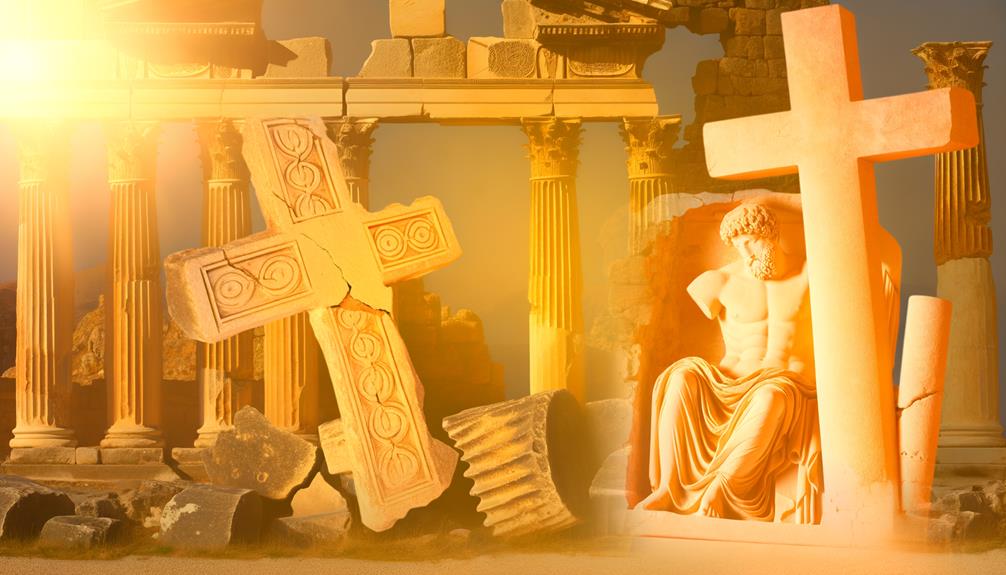
The profound impact of Greco-Roman culture on early Christianity is evident in the way religious practices, philosophical ideas, and theological concepts were interwoven into the nascent Christian tradition.
The Hellenistic world provided a fertile ground for the spread of Christianity, offering a common language (Koine Greek) and a shared cultural framework.
Philosophical schools like Stoicism and Platonism influenced Christian thought, fostering a synthesis of reason and faith.
Rituals and symbols from Roman religious practices were adapted, metamorphosing into Christian liturgy and sacraments.
In addition, the Greco-Roman emphasis on civic virtue and ethical living found resonance in Christian moral teachings.
This cultural amalgamation facilitated the shift of Christianity from a sect within Judaism to a dominant religious force across the Roman Empire.
Zeus and Acts 14:12

In Acts 14:12, the inhabitants of Lystra, influenced by their polytheistic traditions, identified Barnabas as Zeus and Paul as Hermes, reflecting their deep-seated mythological culture.
This association underscores the early Christian missionaries‘ encounters with Greco-Roman religious beliefs, highlighting the theological challenges in conveying monotheistic teachings to a polytheistic audience.
Understanding this context is essential for interpreting the narrative’s implications for early Christian evangelism and its reception in diverse cultural landscapes.
Barnabas Called Zeus
Acts 14:12 recounts how the inhabitants of Lystra referred to Barnabas as Zeus, reflecting their polytheistic beliefs and the cultural lens through which they interpreted the apostolic miracles. This identification underscores the pervasive influence of Greek mythology in Lystra. The townspeople, witnessing miraculous acts, naturally aligned Barnabas with Zeus, the chief deity in their pantheon. This incident illustrates the early church’s challenge in a polytheistic world, emphasizing the theological struggle to distinguish the monotheism of Christianity from prevailing pagan traditions.
| Aspect | Details |
|---|---|
| Cultural Context | Greek mythology’s influence in Lystra |
| Theological Implication | Distinguishing monotheism vs. polytheism |
| Historical Insight | Apostolic miracles interpreted through a pagan lens |
This event highlights the complex dynamics of early Christian evangelism and the necessity for clear theological communication.
Paul Referred As Hermes
Paul’s identification as Hermes by the inhabitants of Lystra, as recounted in Acts 14:12, reveals the deep entrenchment of Hellenistic mythology and its interpretive frameworks in understanding extraordinary events. This attribution stems from the role Hermes played in Greek mythology as the messenger god, paralleling Paul’s eloquent preaching and dynamic presence.
- Historical Context: Hermes was known as the divine herald, emphasizing communication, which aligns with Paul’s role in disseminating the Gospel.
- Theological Interpretation: The incident underscores the early Christian struggle to differentiate their faith from prevailing pagan beliefs.
- Cultural Interaction: It illustrates how local customs influenced the reception of Christian missionaries.
Cultural Context in Lystra
The cultural milieu of Lystra, deeply entrenched in Hellenistic traditions, provides a nuanced backdrop for understanding the locals’ identification of Barnabas as Zeus and Paul as Hermes in Acts 14:12. This identification is rooted in the pervasive influence of Greek mythology and the pantheon of gods that dominated the region. The citizens of Lystra, familiar with these deities, interpreted the miraculous actions of Barnabas and Paul through their mythological lens. This event illustrates the interplay between the early Christian message and existing religious frameworks.
| Aspect | Detail | Significance |
|---|---|---|
| Location | Lystra | Hellenistic city |
| Religious Influence | Greek mythology | Zeus, Hermes prominent |
| Biblical Event | Acts 14:12 | Paul’s first missionary journey |
| Local Reaction | Deification of Barnabas and Paul | Reflects syncretism |
| Theological Insight | Contextual interpretation of miracles | Challenges for early Christian message |
Paul’s Response to Pagan Gods
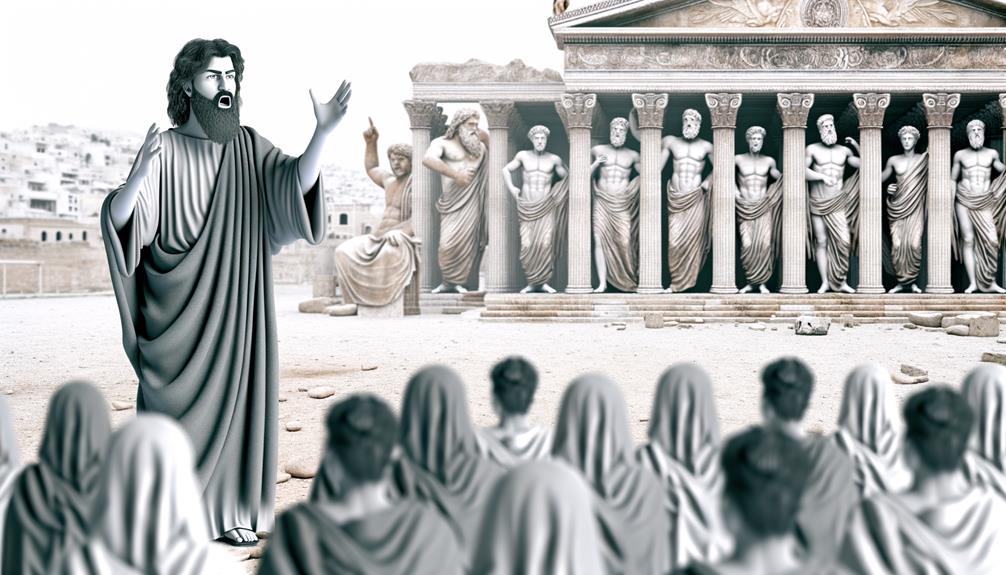
How did Paul navigate the complex landscape of pagan beliefs to present the gospel to a diverse audience steeped in various mythologies? In Acts 17:22-31, Paul addresses the Areopagus in Athens, employing a strategic approach to engage with Greek philosophers and commoners alike.
Identification of Shared Concepts: Paul starts by acknowledging their religiosity and references an altar ‘To an Unknown God,’ bridging their beliefs with the gospel.
Use of Local Context: He quotes their poets, ‘For in him we live and move and have our being,’ making his message relatable.
Contrasting Idols with the True God: He contrasts the living God with lifeless idols, emphasizing divine creation and sovereignty.
Call to Repentance: Paul urges repentance, highlighting the resurrection of Jesus as validation.
This method showcases his profound understanding of both pagan culture and theological principles.
Zeus in Early Christian Writings

Early Christian writings often addressed the figure of Zeus to delineate the distinctions between Greco-Roman mythology and the monotheistic tenets of Christianity.
Apologists such as Justin Martyr and Tertullian critiqued Zeus as emblematic of pagan polytheism, arguing that the multiplicity of gods was antithetical to the Christian doctrine of one, omnipotent God.
By engaging with familiar Greco-Roman deities, early Christians sought to demonstrate the superiority and coherence of their faith.
Texts like the Acts of the Apostles reflect these themes, portraying encounters where Christian figures refute the legitimacy of Zeus worship.
Such writings not only fortified Christian identity but also facilitated theological dialogues aimed at converting adherents of polytheism to the nascent Christian tradition.
Cultural Context of Zeus Worship
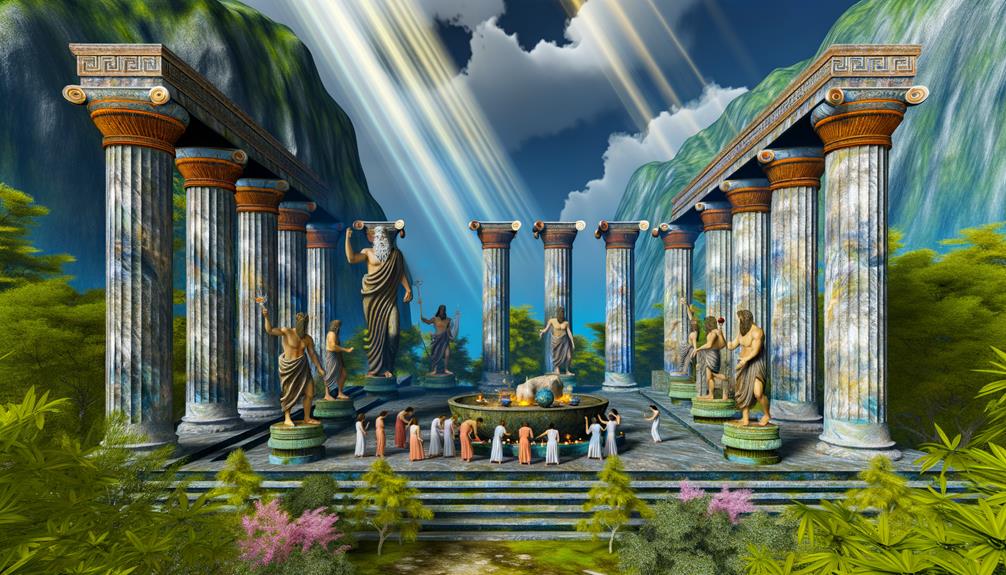
Zeus worship permeated various aspects of ancient Greco-Roman culture, serving as a cornerstone for religious rituals, civic identity, and mythological narratives. As the chief deity, Zeus symbolized authority and cosmological order, reflecting the hierarchical structure of Greco-Roman society. His worship extended beyond mere religious practice, influencing various domains:
- Political Life: Zeus was invoked in state ceremonies, symbolizing unity and divine sanction for rulers.
- Public Festivals: Events like the Olympic Games honored Zeus, reinforcing communal bonds.
- Art and Literature: Zeus featured prominently in classical works, shaping cultural expressions.
This multifaceted reverence underscores Zeus’ integral role in shaping ancient cultural and theological landscapes.
Syncretism in Ancient Religions
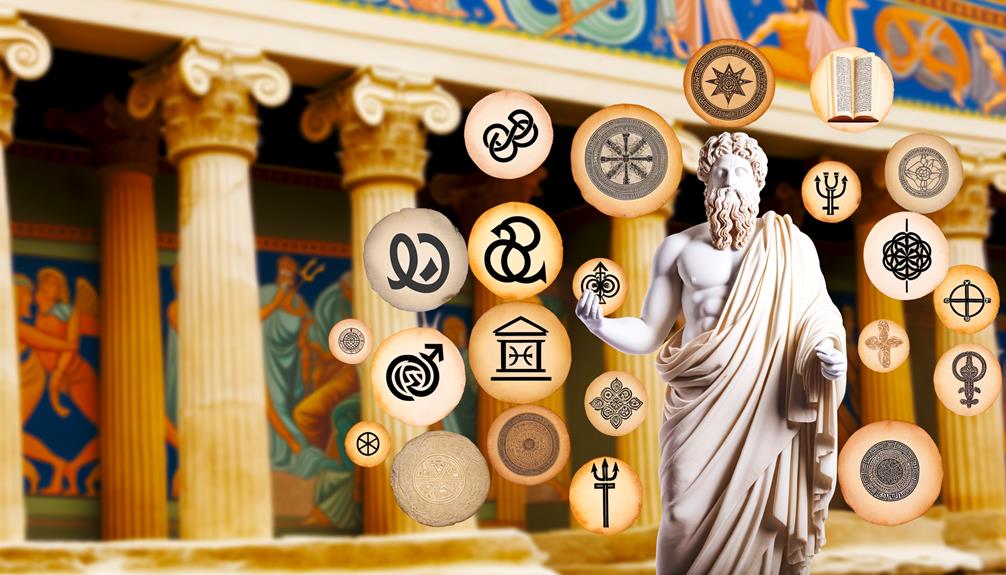
Syncretism in ancient religions manifested through the blending of diverse theological traditions, often resulting in the amalgamation of deities, rituals, and mythologies from different cultures into a cohesive religious framework.
This process was particularly evident in the Hellenistic period when the expansive Greek Empire encountered various local deities and practices.
Zeus, for instance, was frequently equated with gods from other pantheons, such as the Roman Jupiter and the Egyptian Ammon.
This syncretism allowed for the integration of foreign gods into the Greek religious system, facilitating cultural exchange and mutual understanding.
Theological adaptability was essential in maintaining the relevance of religious systems amidst political and social transformations, illustrating the dynamic nature of ancient belief systems.
Lessons for Modern Believers

For modern believers, the account of Zeus in the Bible serves as a compelling reminder to contextualize their faith within a diverse cultural framework, recognizing the historical interplay between different religious traditions.
This understanding underscores the importance of vigilance against idolatry, which remains a pertinent concern, as well as drawing moral insights from mythological narratives that can enrich contemporary spiritual practices.
Embracing Cultural Contexts
Understanding the cultural contexts in which biblical texts were written is essential for modern believers to fully grasp the nuanced ways in which ancient societies, including those with pantheons like the Greeks, influenced the theological landscape of early Christianity. This exploration enriches one’s faith by providing a more thorough understanding of scriptural references and doctrinal development.
Hellenistic Influence: The pervasive Greek culture during the New Testament era impacted how early Christians articulated their beliefs.
Syncretism Challenges: Early Christians navigated a world rich with diverse religious traditions, often countering prevailing polytheistic norms.
Linguistic Nuances: Greek language and philosophy shaped the transmission and interpretation of Christian texts.
Interfaith Dialogues: Understanding these contexts enhances modern dialogue between Christianity and other world religions.
Understanding Idolatry Concerns
In examining the concept of idolatry within the biblical framework, it becomes evident that the early Christian community’s struggle against idol worship was not merely a rejection of physical statues but an admonition against any allegiance that usurped the primacy of God. Idolatry, thus, encompassed a broader spectrum, including devotion to wealth, power, and even cultural ideologies. This theological stance underscores the importance of exclusive worship and loyalty to God, reminding modern believers to identify and resist contemporary forms of idolatry.
| Historical Context | Theological Insight | Modern Application |
|---|---|---|
| Early Christianity | Primacy of God | Identify modern idols |
| Polytheistic Cultures | Exclusive Worship | Focus on spiritual growth |
| Roman Influence | Allegiance Issues | Avoid cultural distractions |
| Biblical Warnings | Devotion to God | Prioritize faith |
| Apostolic Teachings | Rejection of Idols | Cultivate true worship |
Moral Lessons From Myths
Mythological narratives, particularly those involving deities like Zeus, offer profound moral lessons that can be reinterpreted to provide ethical guidance for modern believers. These stories, often steeped in rich historical context, can serve as allegories, emphasizing virtues and cautioning against vices. For instance, the tales of Zeus highlight the consequences of hubris and the importance of justice and mercy.
- Justice and Retribution: Zeus’s role as the arbiter underscores the significance of fairness and the moral necessity of holding wrongdoers accountable.
- Hubris and Humility: His interactions emphasize the dangers of pride and the virtues of humility.
- Loyalty and Betrayal: The complex relationships among gods illuminate the value of loyalty and the perils of betrayal.
Conclusion
The exploration of Zeus within the biblical context illuminates the staggering influence of Greco-Roman culture on early Christianity.
Acts 14:12 and Paul’s rebuttal of pagan deities underscore the vigorous theological encounter between monotheism and polytheism.
Early Christian texts and the cultural reverence for Zeus reveal a world steeped in religious syncretism.
Modern believers are consequently urged to discern the intricate historical and cultural tapestry that shaped Christian doctrine, ensuring a robust comprehension of their faith’s profound heritage.