Quiver Meaning in the Bible: Blessings Sign
In the Bible, a quiver is often a symbol of preparedness, strength, and divine protection. Psalm 127:4-5 likens children to arrows in a quiver, signifying future potential and parental responsibility.
Historically, as seen in Genesis 27:3, it had a practical use for storing arrows, denoting survival and resourcefulness. Theologically, it reflects spiritual readiness and the need for believers to be equipped for life’s challenges, as hinted in Ephesians 6:11-17.
Isaiah 49:2 metaphorically speaks of God’s protective nature, concealing His servants like arrows in His quiver. Exploring further reveals deeper insights into spiritual preparedness and divine provision.

Key Takeaways
- A full quiver symbolizes strength, preparedness, and God’s blessing, as seen in Psalms 127:4-5.
- Children are compared to arrows, indicating their potential influence and the responsibility to nurture them (Psalm 127:4).
- Quivers represent divine protection and readiness for spiritual battles, emphasizing faith and righteousness.
- The quiver signifies both physical survival and spiritual preparedness, intertwining practical and symbolic meanings.
Biblical Symbolism of the Quiver

In biblical texts, the quiver often symbolizes preparedness and strength, as illustrated in Psalms 127:4-5, where children are likened to arrows in the hands of a warrior. This vivid metaphor underscores the importance of readiness and the potential for future influence.
Theological interpretations suggest that just as a quiver holds arrows, a family nurtures children to fulfill divine purposes. Scriptural references emphasize the protective and providential aspects of a quiver, reinforcing its role in safeguarding one’s legacy.
Historically, the quiver’s practical use in warfare reflects an understanding of spiritual battles, where faith and righteousness are the believer’s armament. Consequently, the quiver emerges as a multifaceted symbol, embodying both physical and spiritual preparedness in biblical literature.
Old Testament References

The Old Scriptures contains numerous references to the quiver, illustrating its significance in both practical and symbolic terms throughout various narratives and prophecies.
In Psalms 127:4-5, the quiver is depicted as a symbol of blessing and prosperity: ‘Like arrows in the hands of a warrior are children born in one’s youth. Blessed is the man whose quiver is full of them.’
In Genesis 27:3, Isaac instructs Esau to take his quiver and bow, emphasizing its role in daily life and survival.
Similarly, prophetic texts such as Isaiah 49:2 use the quiver metaphorically, where the servant of the Lord is likened to a polished arrow hidden in God’s quiver, signifying divine preparation and purpose.
Quiver as Strength

In the biblical context, a quiver filled with arrows is frequently portrayed as a symbol of strength and preparedness, as seen in Psalm 127:4-5 where children are described as ‘arrows in the hand of a warrior.’
This imagery reflects the notion of protection and defense, underscoring the importance of having resources ready for life’s battles.
Historically, a full quiver also signified prosperity and God’s blessing, indicating a well-equipped and secure household.
Symbol of Preparedness
A quiver, often depicted in ancient scriptures as a container for arrows, symbolizes the readiness and strength of a warrior. This is exemplified in Psalm 127:4-5, where children are likened to arrows in the hand of a mighty man.
Theologically, this symbolizes a state of preparedness, reflecting the notion that spiritual and familial resources must be readily available for life’s battles.
Scripturally, the quiver signifies not just the physical preparedness of ancient warriors, but also the spiritual readiness of believers.
Historically, warriors kept their quivers well-stocked, as an empty quiver signified vulnerability.
Consequently, a quiver full of arrows represents strength, resourcefulness, and the proactive stance one must take in both spiritual and worldly engagements.
Source of Protection
Serving as a symbol of strength and divine protection, the quiver in biblical texts is often associated with God’s provision and the safeguarding of His people, as illustrated in Isaiah 49:2 where the prophet describes being made into a polished arrow and concealed in God’s quiver.
This imagery denotes a place of security and readiness under divine care. Historically, a quiver, housing arrows for defense, represents God’s preparedness to protect His followers.
Psalms 127:4-5 similarly portrays children as arrows in a warrior’s quiver, emphasizing the strength and protection they provide.
Understanding the quiver as a divine repository of strength underscores the biblical theme of God’s unwavering commitment to shield and empower His people in times of need.
Sign of Prosperity
Symbolizing strength and prosperity, the quiver in biblical literature often conveys the blessings of a fruitful lineage, as evidenced in Psalms 127:5 where a full quiver signifies divine favor and societal standing.
In ancient Israelite culture, children were viewed as tangible manifestations of God’s covenantal promises. A quiver filled with arrows metaphorically represented a household blessed with numerous offspring, thereby securing the family’s future and reinforcing social stability.
Biblical patriarchs, such as Jacob, saw their descendants as essential to their legacy and divine mission. Historical context further reveals that numerous offspring could contribute to agricultural labor and defense, enhancing familial wealth and security.
Consequently, the imagery of a full quiver underscores the harmonious interplay between divine blessing and societal prosperity.
Preparedness and Protection

In examining the theme of ‘Preparedness and Protection‘ within the biblical concept of a quiver, we observe a profound emphasis on spiritual readiness, as highlighted in Ephesians 6:11-17, where believers are urged to put on the full armor of God.
This divine armor, symbolized through various protective elements, underscores the necessity of being equipped for spiritual battles.
Additionally, the vigilant faithfulness encouraged in passages like 1 Peter 5:8 reflects the ongoing need for believers to remain alert and prepared against adversarial forces.
Spiritual Readiness Emphasized
The biblical metaphor of a quiver filled with arrows underscores the importance of spiritual readiness, as seen in Psalm 127:4-5, where children are depicted as ‘arrows in the hand of a warrior,’ emphasizing preparedness and divine protection. This imagery reveals several key insights:
- Spiritual Training: Just as arrows require careful crafting and honing, so too must believers be diligently nurtured and instructed in faith.
- Readiness for Battle: A filled quiver symbolizes readiness to confront spiritual challenges, aligning with Ephesians 6:13’s exhortation to ‘take up the whole armor of God.’
- Divine Provision: The quiver’s fullness signifies God’s provision and blessing, as reflected in Psalm 127’s broader context.
- Generational Continuity: Children as arrows indicate the perpetuation of faith, ensuring spiritual legacy and fortification for future generations.
Divine Armor Symbolism
Building on the concept of spiritual readiness, the Apostle Paul in Ephesians 6:11-17 presents the metaphor of the ‘armor of God’ as a thorough means of divine protection and preparedness for believers. This passage highlights six key components of this spiritual armor, each symbolizing a vital aspect of faith and virtue. By donning this armor, Christians fortify themselves against spiritual adversities.
| Armor Piece | Scriptural Reference |
|---|---|
| Belt of Truth | Ephesians 6:14 |
| Breastplate of Righteousness | Ephesians 6:14 |
| Shoes of Peace | Ephesians 6:15 |
| Shield of Faith | Ephesians 6:16 |
| Helmet of Salvation | Ephesians 6:17 |
| Sword of the Spirit | Ephesians 6:17 |
This divine armor underscores the necessity of holistic spiritual preparedness in the Christian journey.
Faithful Vigilance Encouraged
Scripture repeatedly exhorts believers to maintain a state of faithful vigilance, as embodied in 1 Peter 5:8, which warns, ‘Be sober-minded; be watchful. Your adversary the devil prowls around like a roaring lion, seeking someone to devour.’
This call to vigilance is not merely defensive but encompasses preparedness and protection:
- Ephesians 6:11-18 – The Armor of God emphasizes readiness against spiritual warfare.
- Matthew 25:1-13 – The Parable of the Ten Virgins underscores the importance of preparedness.
- Nehemiah 4:17-18 – Historical vigilance in rebuilding Jerusalem’s walls reflects proactive protection.
- Proverbs 4:23 – Guarding one’s heart is integral to maintaining spiritual and moral vigilance.
This holistic approach to vigilance guarantees believers are equipped to face both spiritual and temporal challenges.
Children as Arrows

In Psalm 127:4, children are metaphorically depicted as arrows in the hands of a warrior, symbolizing their potential to achieve great purposes and extend the legacy of their parents.
This imagery emphasizes the responsibility of parents to guide and nurture their children, preparing them for future endeavors.
Historically, arrows were essential tools for both defense and provision, underscoring the crucial role children play in the continuity and strength of a family.
Theological interpretations suggest that, just as warriors must skillfully aim and release arrows, parents must instill values and faith in their children.
This biblical analogy highlights the significant impact of upbringing on shaping individuals who can uphold and propagate spiritual and moral principles.
Heritage and Legacy
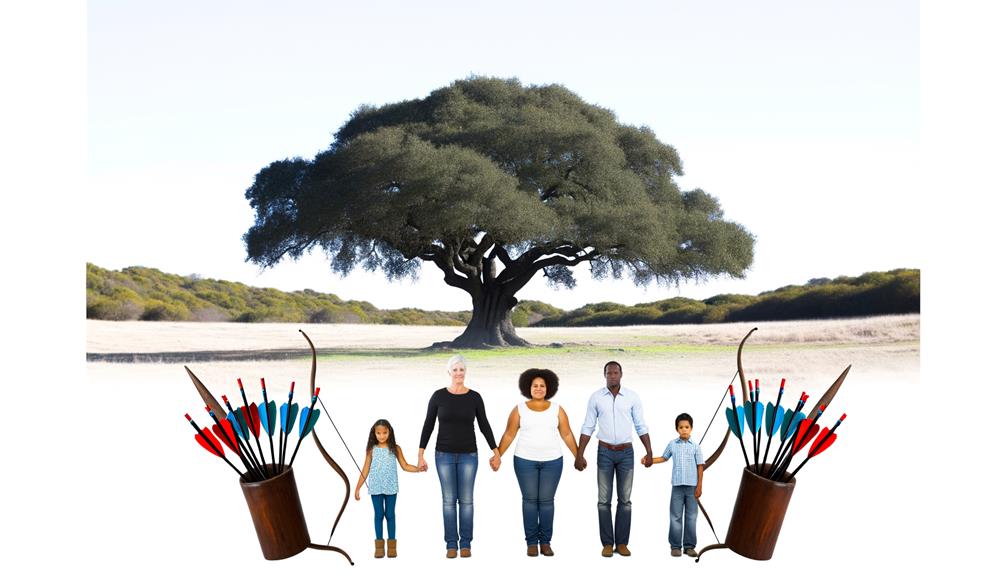
The biblical concept of quivers filled with arrows not only signifies the blessings of progeny but also underscores the enduring heritage and spiritual legacy that parents impart to their children.
Psalms 127:3-5 highlights children as a heritage from the Lord, emphasizing their role in continuing familial and spiritual traditions.
Biblically, a well-stocked quiver symbolizes:
- Divine Blessing: Children are seen as gifts from God.
- Spiritual Teaching: Parents are entrusted with nurturing their faith.
- Cultural Continuity: Ensuring the transmission of values and beliefs.
- Community Strength: A robust family contributes to societal stability.
Historically, this imagery assured the faithful of God’s providence, reflecting a deeper theological truth about the responsibility of fostering a godly legacy across generations.
Divine Provision

Central to the biblical imagery of a quiver is the theme of divine provision, which underscores God’s ongoing care and sustenance for His people.
Psalm 127:4-5 likens children to arrows in the hands of a warrior, emphasizing that they are blessings bestowed by God. Historically, a full quiver symbolized readiness and abundance, reflecting God’s faithful provision in times of need.
Through this metaphor, scripture communicates that just as a warrior relies on his quiver for defense and sustenance, believers can trust in God’s unfailing supply.
This divine provision assures that God’s resources are abundant and timely, reinforcing the belief that He equips His followers with what is necessary for life and godliness (2 Peter 1:3).
Modern Interpretations

Contemplating the enduring symbolism of the quiver, contemporary theologians explore its relevance in modern faith practices and spiritual life. Drawing from Psalms 127:4-5, the quiver, once a symbol of divine provision, now embodies broader themes of spiritual readiness and stewardship.
Four primary interpretations are often highlighted:
- Family Legacy: Reflecting on children as arrows, emphasizing the importance of nurturing future generations.
- Spiritual Armory: Encouraging believers to be equipped with faith, scripture, and prayer.
- Missionary Zeal: Viewing the quiver as a call to spread the gospel with precision and dedication.
- Community Strength: Interpreting a full quiver as the collective strength and support within faith communities.
These interpretations offer rich insights into how ancient symbols sustain relevance in contemporary spirituality.
Conclusion
In summation, the quiver in biblical texts represents an array of profound theological insights—strength, preparedness, protection, and divine provision.
Through Old Scriptures references, children are analogized as arrows, symbolizing heritage and legacy, reaching towards eternity.
The quiver embodies an overwhelming sense of divine safeguarding and provision, echoing through ages and interpretations.
In the boundless landscape of scriptural exegesis, the quiver stands as an indomitable symbol of God’s providence and the enduring legacy of faith.