Sequoia Meaning In The Bible: Strength and Longevity
While the sequoia tree is not explicitly mentioned in the Bible, it serves as a powerful symbol of strength, resilience, and eternal life—key themes in biblical literature. Trees within Scripture, such as the Cedars of Lebanon and the Tree of Life, embody divine connection and spiritual fortitude.
The sequoia’s towering presence and deep roots mirror the steadfastness and resilience promoted through passages like Psalm 1:3 and Isaiah 61:3, which liken the righteous to enduring and fruitful trees. Understanding these symbols can provide profound insights into the spiritual messages conveyed through biblical narratives.
Many more connections await those who explore further.

Key Takeaways
- Sequoias symbolize strength and resilience, mirroring biblical themes of spiritual fortitude and divine support.
- Their longevity represents the promise of eternal life in Scripture.
- Deep roots of sequoias encourage believers to root themselves deeply in faith.
- The immense height of sequoias showcases the grandeur of God’s creation.
Biblical Symbolism of Trees

In biblical literature, trees often serve as profound symbols representing life, growth, and divine connection.
Rooted in the scriptures, trees such as the Tree of Life in Genesis 2:9 exemplify God’s provision and the promise of eternal life. The cedars of Lebanon, mentioned in Psalm 92:12, symbolize strength and righteousness.
Additionally, the fig tree, frequently referenced across both Old and New Covenants, embodies peace and prosperity (Micah 4:4).
Trees also illustrate pivotal moments of divine interaction, such as Moses encountering God in the burning bush (Exodus 3:2).
These arboreal symbols are not mere botanical references but carry deep theological significance, reflecting God’s presence, wisdom, and the unfolding narrative of salvation history.
Trees as Metaphors for Faith

The imagery of trees in the Bible often serves as a profound metaphor for faith, illustrating how spiritual strength and divine wisdom interconnect.
The roots, representing spiritual fortitude, anchor believers in their faith, while the branches symbolize the expansive reach of divine wisdom bestowed upon them.
This duality underscores the holistic growth of a devout life, deeply rooted in spiritual principles and flourishing in wisdom.
Roots of Spiritual Strength
Why do trees, with their deep roots and towering presence, so often serve as powerful metaphors for faith and spiritual strength in biblical scripture?
Biblical texts frequently draw upon the imagery of trees to symbolize the stability and resilience of faith. The deep roots of trees, particularly the mighty sequoia, represent a firm foundation in divine teachings, essential for spiritual growth and perseverance.
- Psalm 1:3 describes the righteous as trees planted by streams of water, yielding fruit in season, signifying a life nourished by God’s word.
- Jeremiah 17:8 emphasizes trust in the Lord, likening the faithful to a tree with roots spreading to the river, unshaken by heat or drought.
Branches of Divine Wisdom
Many biblical passages employ the metaphor of tree branches to illustrate the manifold expressions of divine wisdom and the interconnected nature of faith. The branches signify the spread of spiritual insights emanating from a central source, much like the sequoia’s vast canopy. This symbolism is evident in passages such as John 15:5, where Jesus states, “I am the vine, you are the branches.” Historically, trees have served as potent emblems in Judeo-Christian traditions, reflecting growth, resilience, and divine sustenance.
| Scripture | Meaning |
|---|---|
| John 15:5 | Unity with Christ |
| Psalm 1:3 | Righteousness and prosperity |
| Isaiah 11:1 | Messianic prophecy |
| Romans 11:17 | Inclusion of Gentiles |
These scriptures guide believers towards a profound understanding of faith’s interconnectedness and divine wisdom.
Strength and Resilience in Scripture
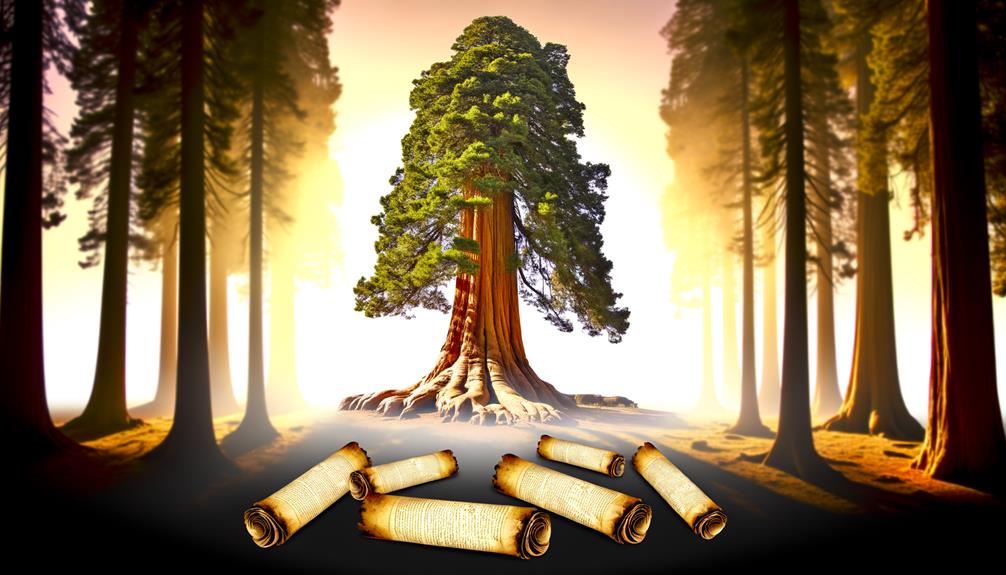
The concept of strength and resilience is profoundly woven into the fabric of Scripture, symbolized vividly through various metaphors and narratives.
Biblical accounts, such as Job’s unwavering faith amid suffering and Paul’s endurance through persecution, illuminate the spiritual fortitude expected of believers.
These scriptural exemplars serve as lessons, encouraging Christians to embody resilience rooted in divine strength.
Biblical Symbolism Explained
Within the tapestry of biblical narratives, the sequoia tree emerges as a profound symbol of strength and resilience, reflecting the enduring spirit portrayed throughout Scripture. Rich in theological depth, the symbolism of the sequoia can be dissected through various scriptural and historical lenses.
- Stature and Longevity: The sequoia’s towering presence and centuries-long lifespan evoke the steadfastness of divine promises and eternal truths in the Bible.
- Deep Roots: Just as a sequoia’s roots anchor it firmly, believers are encouraged to root themselves deeply in faith and God’s Word.
Thus, the sequoia metaphorically encapsulates biblical resilience and strength.
Examples of Resilience
Countless narratives within the Bible exemplify resilience, portraying individuals who, anchored in their faith, triumph over formidable challenges. Figures such as Job, David, and Paul stand as timeless exemplars of strength and resilience. Job’s unwavering faith amid profound suffering, David’s steadfastness in facing Goliath, and Paul’s perseverance through persecution illustrate the depth of spiritual resilience. This resilience is not merely a personal trait but a reflection of divine support and guidance.
| Biblical Figure | Challenge Faced | Source of Resilience |
|---|---|---|
| Job | Loss and Suffering | Faith in God’s Justice |
| David | Facing Goliath | Trust in God’s Power |
| Paul | Persecution and Imprisonment | Commitment to Christ |
These examples underscore the profound interplay between human endurance and divine providence.
Lessons for Believers
Building upon these powerful examples of resilience, believers today can extract profound lessons on strength and perseverance from Scripture. Biblical narratives are rich with instances where faith and fortitude triumph over adversity.
For instance, the Scripture offers enduring wisdom through:
- Job’s Endurance: Job’s unwavering faith amidst severe trials exemplifies ultimate resilience.
- Moses’ Leadership: Leading the Israelites out of Egypt, Moses demonstrated unparalleled perseverance.
These accounts serve as spiritual touchstones, encouraging believers to remain steadfast in their faith.
Longevity and Eternal Life

In exploring the theme of longevity and eternal life within the biblical context, it is essential to reflect on the symbolic representation of the sequoia tree as a proof of divine creation and the promise of everlasting life.
The sequoia’s remarkable lifespan, often spanning millennia, echoes the biblical notion of eternal life granted through faith (John 3:16).
Historically, trees have been emblematic of life and endurance in Scripture, as seen in the Tree of Life in Genesis.
The sequoia’s towering presence and longevity can therefore be seen as a metaphor for the enduring nature of God’s promises.
Through this lens, believers are reminded of God’s perpetual covenant and the eternal life promised to those who follow His path.
Divine Creation and Nature

Reflecting on the majesty of the natural world, the sequoia tree stands as a tribute to the intricate and purposeful design inherent in divine creation. Scriptural narratives consistently highlight the profound connection between God and His creation, suggesting an intentional and harmonious universe. The sequoia, with its towering presence and ancient roots, exemplifies this divine craftsmanship.
- Immense Height: Sequoias can reach over 300 feet, showcasing the grandeur of God’s creation.
- Longevity: With lifespans surpassing 3,000 years, sequoias echo the eternal nature of the Divine.
These attributes mirror theological principles found in scriptural texts, emphasizing a world meticulously fashioned by a higher power.
Sequoias and Biblical Imagery

The majestic sequoia tree, with its imposing stature and enduring presence, often draws parallels to the towering and steadfast symbols found within biblical imagery.
Throughout the Scriptures, trees frequently symbolize strength, longevity, and divine blessing. The cedars of Lebanon, for instance, are lauded for their grandeur and resilience (Psalm 92:12). Similarly, the sequoia’s immense height and longevity evoke the timeless, unshakeable nature of divine promises.
In a theological context, such imagery emphasizes God’s eternal and unwavering covenant with humanity. Historically, these natural symbols were potent reminders of God’s creation and sovereignty.
Consequently, the sequoia serves as a modern-day emblem of biblical principles, mirroring the profound spiritual truths depicted in ancient texts.
Lessons From Ancient Trees

Ancient trees like the sequoia impart profound lessons on endurance, stability, and the perpetual nature of divine wisdom as reflected in biblical narratives.
The longevity and strength of these venerable giants echo the steadfastness of faith and the enduring truth of God’s word. Scripturally, trees are often symbols of righteousness and divine creation, as seen in Psalm 1:3, where the righteous are compared to a tree planted by streams of water.
- Endurance: The sequoia’s resilience through centuries mirrors the enduring faithfulness of God’s promises.
- Stability: Their deep roots symbolize the importance of grounding oneself in scriptural truth.
Through these lessons, sequoias enrich our spiritual understanding.
Conclusion
In the tapestry of biblical symbolism, trees stand as verdant sentinels of divine wisdom and eternal truths.
The sequoia, with its towering presence and ancient roots, metaphorically embodies the steadfast faith, resilience, and longevity extolled in scripture.
These arboreal giants serve as living parables, reflecting the divine creation’s majesty and the promise of eternal life.
Through the lens of theological insight, sequoias echo the sacred narrative, reminding humanity of the profound lessons woven into the fabric of nature.