Sphere Meaning in the Bible: Cosmic Significance
In biblical literature, the sphere symbolizes divine perfection, unity, and eternity. Scriptural references in Isaiah 40:22, Job 26:7, and Proverbs 8:27 often interpret the Earth’s circularity as evidence of its spherical nature.
The sphere reflects God’s unending love and perpetual presence, embodying the concept of ‘shalom’ and ‘teleios,’ representing completeness and maturity. Additionally, the sphere connects with themes of divine protection and God’s eternal essence, illustrating theological principles such as omnipotence and omniscience.
By exploring its rich symbolism and multifaceted meanings, one gains a profound understanding of divine attributes and cosmic harmony.

Key Takeaways
- The sphere symbolizes divine perfection, wholeness, and completeness, reflecting God’s nature and creation.
- Isaiah 40:22 and other scriptures suggest a spherical Earth, indicating biblical cosmology’s awareness of Earth’s roundness.
- The sphere represents eternal perfection and divine completeness, embodying God’s unending love and grace.
- Psalms highlight God’s guardianship, portraying Him as a refuge and protector for His followers.
The Circle in Isaiah

The reference to the ‘circle of the earth‘ in Isaiah 40:22 has been a subject of extensive theological and scholarly analysis, highlighting its potential implications for biblical cosmology.
The Hebrew term ‘chug’ is often translated as ‘circle’ or ‘compass,’ suggesting a round or spherical shape. This depiction has prompted debates regarding the ancient Hebrews’ understanding of the earth’s form, raising questions about whether it reflects a rudimentary knowledge of a spherical earth or a more symbolic representation of God’s omnipotence and sovereignty over creation.
Scholars explore the context within Isaiah, examining linguistic, cultural, and historical dimensions to discern whether the passage conveys cosmological insight or serves as an allegory for divine transcendence and omnipresence.
Divine Protection in Psalms
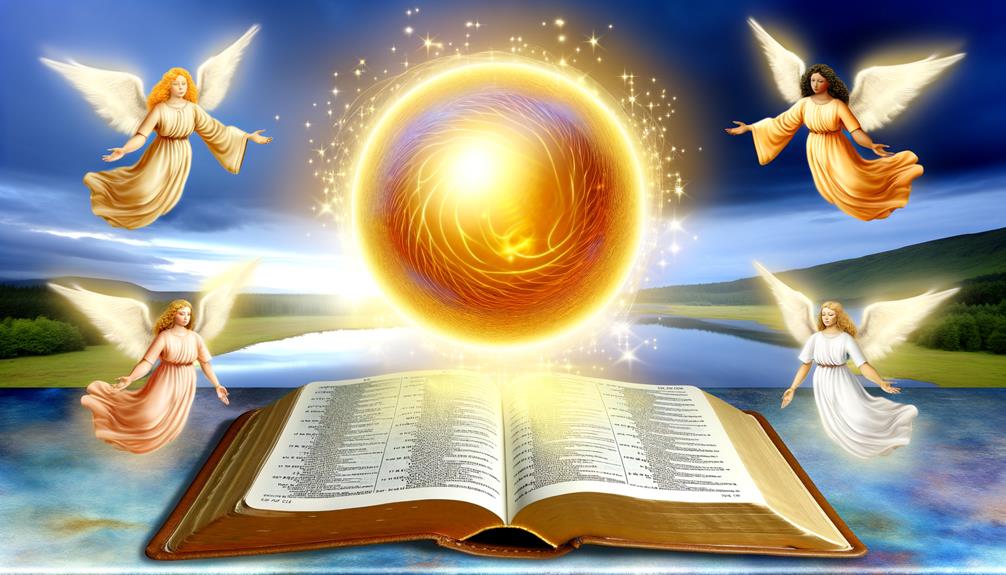
Exploring the theme of divine protection in Psalms reveals a profound theological assertion of God’s unwavering guardianship and refuge for His followers. The Psalms, rich in poetic imagery, encapsulate the essence of divine security through various expressions of faith and trust.
Analyzing these texts uncovers four key aspects:
- Refuge – Psalms like 46:1 declare, ‘God is our refuge and strength, an ever-present help in trouble.’
- Shelter – Psalm 91:4 portrays God as covering His people with His feathers.
- Deliverance – Psalm 34:7 speaks of the angel of the Lord encamping around those who fear Him.
- Protection – Psalm 121 emphasizes that the Lord watches over His people, neither slumbering nor sleeping.
This theological framework offers comfort and assurance.
Spherical Imagery in Revelation

Amidst the rich theological imagery of divine protection in Psalms, the Book of Revelation introduces a distinct use of spherical imagery that further elucidates God’s cosmic sovereignty and eschatological plans. This imagery is prevalent in Revelation, portraying a complete, unified, and all-encompassing divine order. The vision of the New Jerusalem, descending from heaven, is depicted as a perfect cube, emphasizing completeness and divine perfection. The spherical elements in Revelation serve as metaphors for totality and the divine omnipresence.
| Symbol | Interpretation |
|---|---|
| New Jerusalem | Divine perfection and completeness |
| Seven Seals | Fullness of divine judgment |
| Seven Trumpets | Extensive proclamation of God’s will |
| Golden Bowls | Entirety of divine wrath |
| Holy City | Perfectly ordered divine domain |
This table encapsulates the key spherical symbols, enhancing our understanding of Revelation’s profound theological messages.
The Earth’s Roundness

The concept of Earth’s roundness finds intriguing reflections in biblical texts, particularly in Isaiah 40:22, which describes God sitting above ‘the circle of the earth.’
This verse, along with other scriptural references, has been subject to various historical interpretations, influencing theological perspectives on the shape of the Earth.
Biblical Descriptions of Earth
Numerous passages within the Bible have been interpreted to suggest an understanding of the Earth’s roundness, reflecting a complex interplay between ancient cosmology and theological symbolism.
Key verses often cited include:
- Isaiah 40:22 – ‘He sits enthroned above the circle of the earth…’
- Job 26:7 – ‘He spreads out the northern skies over empty space; he suspends the earth over nothing.’
- Proverbs 8:27 – ‘When he established the heavens, I was there, when he drew a circle on the face of the deep…’
- Ecclesiastes 1:6 – ‘The wind blows to the south and turns to the north; round and round it goes…’
These scriptures, when examined closely, reveal a nuanced portrayal of Earth’s form, encompassing both physical and spiritual dimensions.
Historical Interpretations of Roundness
Building upon the nuanced portrayal of Earth’s form in biblical scriptures, historical interpretations of the Earth’s roundness have evolved considerably through the ages, influenced by theological, philosophical, and scientific developments.
Early Christian theologians like Augustine and Aquinas engaged with classical Greek thought, particularly the works of Ptolemy and Aristotle, which posited a spherical Earth. Medieval scholars synthesized these ideas with scriptural exegesis, contributing to a more all-encompassing worldview.
The Renaissance marked a significant shift as empirical observations by explorers like Magellan, and later, astronomical evidence from Copernicus and Galileo, substantiated Earth’s roundness.
Consequently, the interplay between sacred texts and empirical inquiry has been pivotal in shaping our understanding of Earth’s form within a theological context.
Completeness in Biblical Symbolism

In biblical symbolism, the sphere frequently represents divine perfection, an attribute ascribed to God’s nature and His creation.
This geometric form embodies wholeness and completeness, reflecting the theological concept of shalom, which signifies peace, harmony, and the fulfillment of God’s purposes.
Symbol of Divine Perfection
The sphere, with its unbroken and continuous form, serves as a profound symbol of divine perfection and completeness in biblical symbolism. This geometric figure uniquely encapsulates the essence of God’s infinite nature and the perfect unity found in His creation.
The sphere’s symbolism can be understood through several key theological concepts:
- Eternal Nature: Reflecting God’s timeless existence, the sphere has no beginning or end.
- Omnipresence: Emulating God’s presence everywhere, a sphere’s surface is uniformly expansive.
- Unity: Illustrating the indivisible nature of God’s oneness, the sphere remains whole and undivided.
- Harmony: Representing divine order, the sphere’s symmetry signifies the balance inherent in God’s design.
Thus, the sphere is a compelling representation of divine perfection in biblical thought.
Wholeness in Biblical Context
Understanding the concept of wholeness in biblical context involves examining various scriptural references that portray completeness as an integral aspect of God’s covenant with humanity.
In the Old Covenant, the Hebrew word ‘shalom’ signifies peace, completeness, and welfare, encapsulating the holistic well-being intended by God (Isaiah 26:3).
The New Covenant echoes this theme through the Greek term ‘teleios,’ often translated as ‘perfect’ but connoting maturity and full development (Matthew 5:48).
Paul’s epistles frequently stress the importance of spiritual completeness in Christ (Colossians 2:10).
Consequently, biblical symbolism consistently underscores a divine trajectory towards restoration and wholeness, reflecting God’s ultimate plan for humanity’s redemption and unity in His eternal kingdom.
Eternity and the Sphere

Throughout biblical exegesis, the sphere is often conceptualized as a symbol of eternal perfection and divine completeness. This geometric form, with no beginning or end, encapsulates the essence of eternity. Scriptural interpretations reveal the sphere as an emblem of God’s unending nature and the eternal life promised to believers.
Consider the following:
- Perpetual Motion: Much like the ceaseless rotation of a sphere, God’s love and grace are unending.
- Divine Omnipresence: The spherical form symbolizes God’s presence encompassing all creation.
- Infinite Wisdom: The sphere’s perfect shape reflects the boundless knowledge of the Divine.
- Eternal Covenant: The sphere signifies the everlasting covenant between God and humanity.
These elements collectively underscore the theological depth infused in the symbolism of the sphere.
God’s Infinite Nature

In examining God’s infinite nature, one must consider the profound theological implications of His omnipotence, omniscience, and omnipresence as transcending all temporal and spatial limitations. These divine attributes underscore God’s ability to operate beyond the confines of human understanding, thereby reinforcing the concept of His boundless essence.
| Attribute | Definition | Biblical Reference |
|---|---|---|
| Omnipotence | God’s unlimited power and authority | Jeremiah 32:17 |
| Omniscience | God’s all-encompassing knowledge | Psalm 147:5 |
| Omnipresence | God’s presence everywhere simultaneously | Psalm 139:7-10 |
| Eternality | God’s existence without beginning or end | Revelation 1:8 |
| Immutability | God’s unchanging nature | Malachi 3:6 |
Understanding these attributes aids in the comprehension of the divine sphere as an infinite, unbounded reality.
Conclusion
The sphere, as illustrated in biblical texts, serves as a profound metaphor for divine completeness and eternal protection.
From Isaiah’s circle to the spherical imagery in Revelation, the Bible employs this shape to symbolize God’s infinite nature and the wholeness of creation.
Much like an unbroken circle, these scriptural references underscore the perpetual and boundless nature of divine providence, reinforcing the theological concept of an all-encompassing, eternal deity.