
Warfare Meaning in the Bible: Spiritual Battles
Warfare in the Bible is multifaceted, encompassing historical battles, divine commands, symbolic struggles, spiritual confrontations, and apocalyptic conflicts. In the Old Scriptures, battles such as those in Joshua and Judges illustrate divine intervention and Israel’s faithfulness to God.
Divine commands, like the conquest of Canaan, reinforce national identity and covenantal imperatives. Symbolic warfare in Psalms and spiritual struggles in the New Scriptures highlight inner battles against evil, with Ephesians 6:12 describing warfare against dark spiritual forces.
Revelation’s apocalyptic visions depict ultimate spiritual conflict, underscoring divine justice and redemption. Exploring these dimensions reveals deeper theological insights.

Key Takeaways
- Warfare in the Bible often illustrates spiritual struggles and divine intervention in human affairs.
- Old Testament battles emphasize Israel’s obedience to God’s commands as crucial for victory.
- Symbolic warfare in Psalms represents spiritual resilience and reliance on God’s strength.
- New Testament teachings, especially in Ephesians, highlight the battle against spiritual forces of evil.
Old Testament Battles
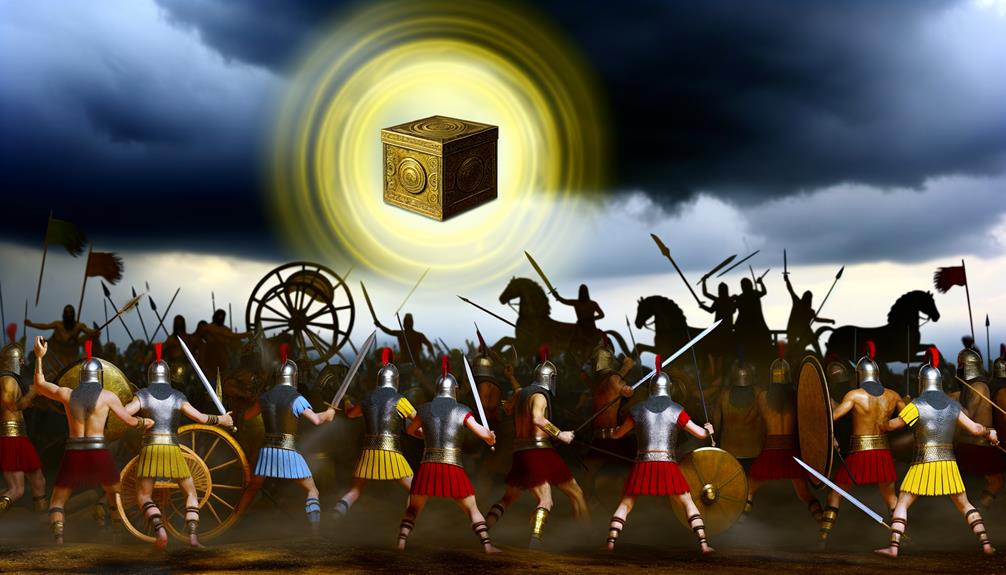
Frequently, the Old Covenant narrates numerous battles that not only shaped the history of Israel but also conveyed profound theological messages. These conflicts, chronicled in books such as Joshua, Judges, Samuel, and Kings, served as more than mere records of military engagements.
They illustrated divine intervention and the covenantal relationship between God and Israel. For instance, the Battle of Jericho (Joshua 6) exemplifies obedience to divine commands leading to victory. Additionally, David’s triumph over Goliath (1 Samuel 17) highlights faith in God’s power as a determinant of success.
These narratives underscore the belief that Israel’s fortunes were directly tied to their fidelity to God, offering a theological framework within which these historical events are interpreted and understood.
Divine Commands and Warfare
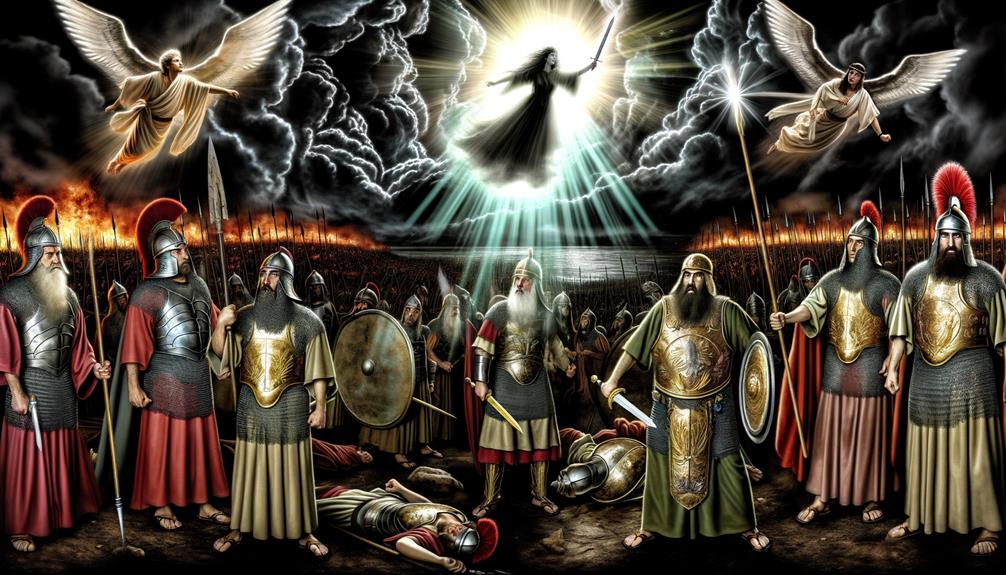
In the context of the Old Scripture, divine commands often served as the driving force behind Israel’s military actions, reflecting a complex interplay between divine will and human agency.
Scriptural accounts, such as the conquest of Canaan, illustrate how God’s directives to figures like Joshua were pivotal in shaping military strategies and outcomes (Joshua 1:1-9). These commands were perceived not merely as tactical orders but as covenantal imperatives, reinforcing Israel’s identity as a chosen nation under divine sovereignty.
Theologically, such narratives underscore the belief that victory in warfare was contingent upon obedience to God’s will, highlighting the moral and spiritual dimensions of combat.
This divine-human partnership underscores the sanctity and purpose embedded in Israelite warfare, offering profound insights into their historical and religious ethos.
Symbolic Warfare in Psalms

The Psalms often employ metaphorical language to depict warfare, reflecting the ongoing spiritual and existential struggles faced by the faithful. Historically, the Israelites encountered numerous external threats, and these experiences are mirrored in the Psalms as symbolic representations of internal battles.
For instance, in Psalm 144:1, ‘Blessed be the Lord, my Rock, who trains my hands for war, my fingers for battle,’ the imagery underscores divine preparation for spiritual resilience.
Theologically, these verses emphasize reliance on God’s strength rather than physical prowess.
Scriptural analysis reveals that such symbolism in Psalms serves to fortify the believer’s faith, portraying life’s challenges as spiritual conflicts where divine intervention is paramount, consequently providing hope and encouragement amidst adversity.
Spiritual Warfare in the New Testament

Spiritual warfare in the New Scripture is characterized by a profound emphasis on the believer’s struggle against spiritual forces of evil, as delineated in Ephesians 6:12. The Apostle Paul identifies these forces as principalities, powers, and rulers of darkness, reflecting a cosmic battle beyond physical domains. Theologically, this underscores the necessity for spiritual vigilance and the equipping of the ‘armor of God’ to stand firm.
- Armor of God: Includes elements such as the belt of truth and breastplate of righteousness (Ephesians 6:14).
- Prayer and Supplication: Essential tools for believers to maintain spiritual fortitude (Ephesians 6:18).
This teaching is foundational for understanding spiritual resilience.
Apocalyptic Warfare in Revelation

Revelation, the final book of the New Covenant, presents a vivid depiction of apocalyptic warfare, where celestial and terrestrial domains clash in a culmination of the cosmic struggle foretold throughout scripture. This eschatological vision, characterized by symbolic imagery and prophetic language, portrays the ultimate battle between good and evil.
Central figures include Christ, the Lamb, and adversaries like the Beast and the Dragon, representing Satan. Revelation 19:11-21 and 20:7-10 describe Christ’s triumphant return and the final defeat of Satan, underscoring divine justice and the fulfillment of God’s redemptive plan.
Through its apocalyptic narrative, Revelation provides profound theological insights into the sovereignty of God, the reality of spiritual conflict, and the ultimate victory of righteousness.
Conclusion
The concept of warfare in the Bible spans physical battles, divine commands, symbolic struggles, spiritual conflicts, and apocalyptic visions.
From the Old Covenant’s historical accounts to the New Covenant’s spiritual exhortations, what can be gleaned about the nature of conflict and divine intention?
By examining these themes through historical context, theological insight, and scriptural analysis, one discerns a multifaceted portrayal of warfare that transcends mere physicality, reflecting deeper spiritual truths and eschatological expectations.