
What Is the Meaning of Baptism in the Bible? Salvation
Baptism in the Bible represents a significant spiritual purification and initiation into the Christian faith, intimately connected to ancient Jewish purification rites. The Greek term ‘baptizo’ means ‘to immerse,’ symbolizing the washing away of sins as taught by John the Baptist.
Jesus’ own baptism by John emphasizes its spiritual gravity, marking the start of His ministry with divine approval and the descent of the Holy Spirit. Early Christian communities saw baptism as both a rite of initiation and a public declaration of faith, signifying unity with Christ in His death and resurrection.
Exploring further reveals deeper theological dimensions.

Key Takeaways
- Baptism symbolizes the washing away of sins and spiritual purification (Mark 1:4, Ezekiel 36:25).
- It represents identification with Christ’s death, burial, and resurrection, signifying new life (Romans 6:3-4).
- Baptism serves as an initiation and public declaration of faith within the Christian community.
- The act of baptism involves the Holy Spirit’s renewal and empowerment for righteous living (Acts 2:38, Titus 3:5).
Biblical Origins of Baptism

Tracing its roots to ancient Jewish purification rituals, baptism in the Bible emerges as a significant rite symbolizing spiritual cleansing and renewal.
The term ‘baptism’ itself derives from the Greek word ‘baptizo,’ meaning ‘to immerse’ or ‘to wash.’ This act of immersion is deeply embedded within the New Covenant, particularly in the ministry of John the Baptist, who called for repentance and the washing away of sins (Mark 1:4).
Jesus’ own baptism by John marks a pivotal moment, underscoring the practice’s spiritual gravity (Matthew 3:13-17).
Early Christian communities adopted baptism as a critical sacrament, serving as both an initiation into the faith and a public declaration of one’s commitment to Christ, thereby perpetuating its theological and communal significance.
Old Testament Prefigurations

The Old Covenant offers several prefigurations of baptism, each contributing to a richer theological understanding of this sacrament.
Key examples include Noah’s Ark, symbolizing salvation through water, the Red Sea crossing, representing deliverance and liberation, and various ritual purifications, which emphasize the necessity of spiritual cleansing.
These typological instances collectively underscore the multifaceted significance of baptism within the biblical narrative.
Noah’s Ark Symbolism
In the narrative of Noah’s Ark, the waters of the flood serve as a typological precursor to the cleansing and redemptive waters of baptism. This Old Covenant event is interpreted as a prefiguration of baptism, where the floodwaters symbolize both judgment and salvation.
The deluge eradicates the sinful world, paralleling how baptism signifies the washing away of sin. Noah and his family, saved through the Ark, represent the faithful who are delivered from divine judgment through the sacrament of baptism.
This typology underscores the dual aspects of baptism—purification and new life. By examining Noah’s Ark through this lens, one gains a deeper insight into the theological significance of baptism as both a means of divine grace and a symbol of rebirth.
Red Sea Crossing
Building upon the typological foundation of Noah’s Ark, the crossing of the Red Sea in the Old Scripture further elucidates the profound symbolism of baptism as a passage from bondage to liberation.
The Israelites’ escape from Egyptian captivity, facilitated by God parting the waters, serves as a powerful prefiguration of Christian baptism. This event signifies the movement from a state of slavery—representative of sin—to one of freedom and new life.
Just as the Israelites emerged from the waters as a redeemed people, baptism signifies emerging from spiritual death to new life in Christ.
The Red Sea crossing therefore deepens our understanding of baptism as a transformative act, marking the change from the old self to a renewed existence in faith.
Ritual Purifications
As we explore the Old Covenant, various ritual purifications reveal deeper theological underpinnings that prefigure the sacrament of baptism, underscoring the shift from impurity to sanctification.
Levitical laws mandated ceremonial washings for priests (Exodus 30:17-21) and purification rites for those rendered unclean (Leviticus 14:8-9). These practices symbolized inner cleansing and preparation for divine service.
The ritual bath, or mikveh, was essential for converting Gentiles to Judaism, further illustrating the transformative nature of water.
Ezekiel’s prophecy (Ezekiel 36:25) of God sprinkling clean water on Israel to purify them from impurities presages the New Covenant sacrament.
Consequently, these prefigurations collectively foreshadow the spiritual cleansing and rebirth actualized in Christian baptism.
John the Baptist’s Role
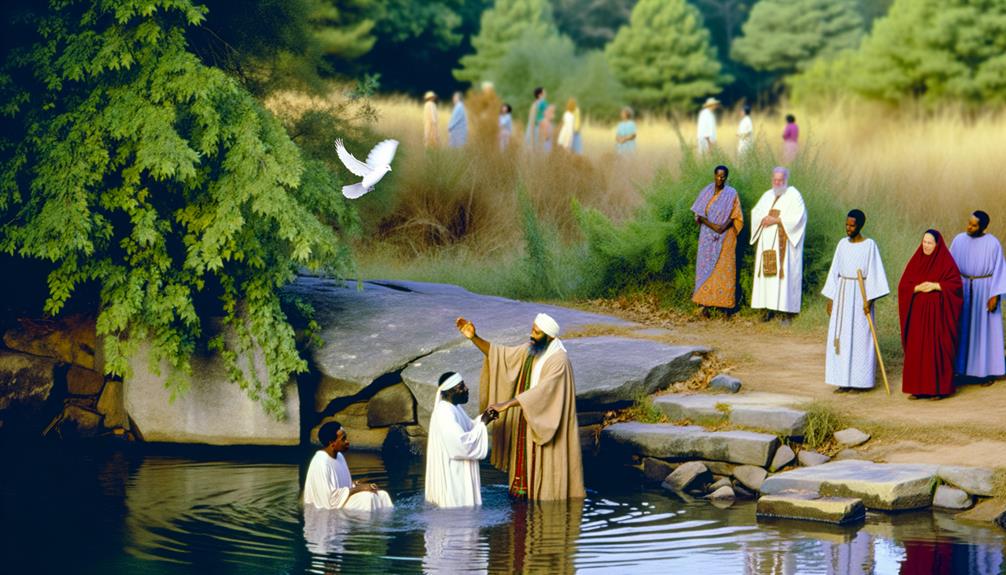
John the Baptist’s role in the biblical narrative is essential, as he serves as the forerunner who prepares the way for Jesus Christ through the practice of baptism. His ministry, as depicted in the Synoptic Gospels, emphasizes repentance and the imminent Kingdom of God.
John’s baptism, administered in the Jordan River, symbolizes purification and the commitment to a transformed life. His actions fulfill the prophecy of Isaiah, identifying him as ‘the voice of one crying in the wilderness’ (Isaiah 40:3).
Theologically, John’s baptism underscores the necessity of inner purification preceding the advent of the Messiah. This preparatory role is vital in understanding the shift from Old Testament ritualistic practices to the New Testament’s focus on spiritual renewal and redemption.
Jesus’ Baptism
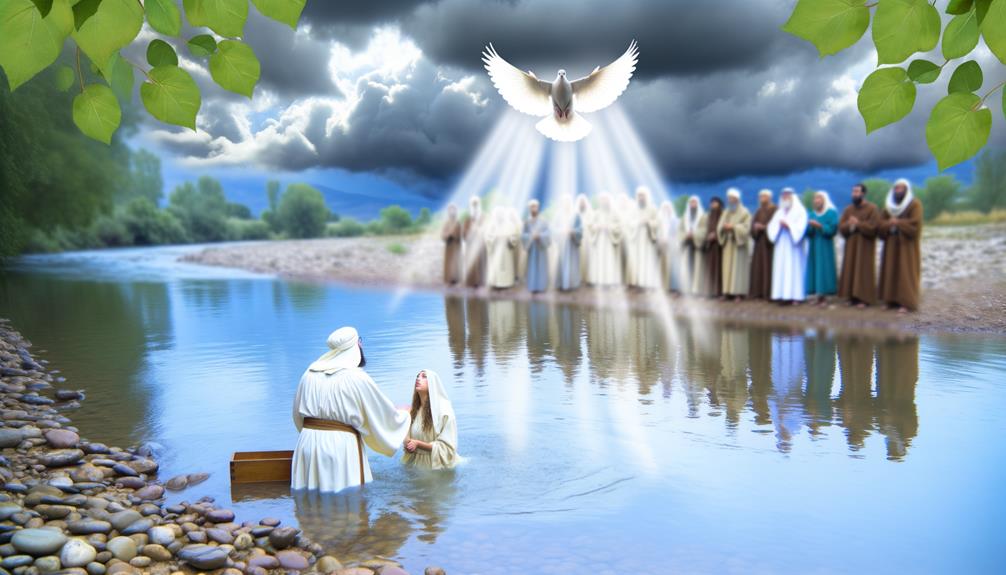
The baptism of Jesus stands as a pivotal moment in the New Covenant, encapsulating themes of fulfilling all righteousness, divine approval, and the Holy Spirit’s descent.
This event not only signifies Jesus’ active submission to God’s will but also marks His divine endorsement, as evidenced by the heavenly voice declaring Him God’s beloved Son.
In addition, the descent of the Holy Spirit in the form of a dove underscores the inauguration of Jesus’ public ministry and the anointing of His messianic mission.
Fulfilling All Righteousness
In the account of Jesus’ baptism, the phrase ‘to fulfill all righteousness‘ signifies a profound theological and covenantal act that aligns with the divine will and inaugurates His public ministry.
This phrase encapsulates Jesus’ commitment to complete obedience to God’s salvific plan.
By submitting to baptism, Jesus identifies with humanity’s sinful condition, prefiguring His atoning death and resurrection.
Theologically, it underscores His role as the Suffering Servant and the perfect mediator between God and humanity.
This act also fulfills Old Covenant prophecies and typologies, solidifying His messianic identity.
Consequently, Jesus’ baptism is not merely a ritual act but a deliberate fulfillment of divine righteousness, establishing His credentials and mission as the Redeemer.
Divine Approval Significance
Upon witnessing the heavens open and the Spirit descending like a dove, Jesus’ baptism receives divine approval, marking it as a pivotal moment of endorsement by God the Father.
This event, recorded in all four Gospels, signifies not only Jesus’ divine sonship but also the inauguration of His public ministry.
The Father’s voice, proclaiming, ‘This is my beloved Son, with whom I am well pleased’ (Matthew 3:17), affirms Jesus’ identity and mission.
This divine approval underscores the theological import of baptism, illustrating its role as a means of divine affirmation.
It also prefigures the Christian sacrament, wherein believers are similarly acknowledged as children of God, thereby establishing a foundational precedent for the practice and its spiritual significance.
Holy Spirit Descent
Frequently noted in biblical scholarship, the descent of the Holy Spirit during Jesus’ baptism serves as a profound theological event that signifies the anointing and empowerment of Jesus for His messianic mission.
This event, described in all four Gospels, manifests the Trinitarian presence—Father, Son, and Holy Spirit—at a pivotal moment.
The Holy Spirit’s descent in the form of a dove symbolizes peace and divine approval, marking Jesus as the chosen one.
Exegetically, this act fulfills Old Covenant prophecies such as Isaiah 42:1, wherein the Spirit rests upon God’s servant.
Additionally, it underscores the inauguration of Jesus’ public ministry, providing Him with divine authority and guidance, thereby reinforcing the salvific purpose of His mission on Earth.
Baptism in Early Church

Examining historical texts and early Christian writings reveals that baptism held a central and transformative role in the rites and theology of the early Church. This sacrament was perceived as a crucial initiation into the Christian community, symbolizing both purification and rebirth.
Early Church Fathers such as Tertullian and Augustine emphasized its theological significance, linking it to the remission of sins and the reception of the Holy Spirit.
Key characteristics of early Christian baptism include:
- Catechetical Instruction: Pre-baptismal teaching was required to prepare candidates.
- Ritual Immersion: Full immersion in water was commonly practiced.
- Trinitarian Formula: Baptisms were performed in the name of the Father, Son, and Holy Spirit.
- Eucharistic Connection: Baptism often preceded participation in the Eucharist.
Symbolism of Water

In understanding the early Church’s baptismal practices, one must consider the profound symbolism of water as both a physical element and a theological metaphor within biblical texts.
Water serves as a cleansing agent, signifying purification from sin, as seen in passages like Ezekiel 36:25. Additionally, water symbolizes life and sustenance, echoing the living water motif in John 4:14, which represents eternal life.
The destructive and redemptive powers of water are also evident in narratives such as Noah’s flood (Genesis 7) and the Israelites’ crossing of the Red Sea (Exodus 14), illustrating both judgment and deliverance.
Consequently, water in baptism encompasses themes of purification, life, and divine intervention, making it a multifaceted symbol within Christian theology.
Spiritual Rebirth

Spiritual rebirth, a central tenet of Christian baptism, signifies the transformative process whereby individuals are regenerated and renewed through the Holy Spirit. This concept is rooted deeply in scriptural exegesis, emphasizing an ontological change:
Regeneration: Baptism symbolizes the washing away of sin, leading to a new spiritual birth (Titus 3:5).
Renewal: The Holy Spirit renews the believer, instilling a new heart and spirit (Ezekiel 36:26-27).
Union with Christ: Baptism signifies unity with Christ in his death and resurrection (Romans 6:3-4).
Adoption: Through baptism, individuals become children of God (Galatians 3:26-27).
Empowerment: The Holy Spirit empowers believers for righteous living (Acts 2:38).
This transformative journey underscores the profound spiritual shift marked by baptism.
Baptism and Salvation

The relationship between baptism and salvation has been a pivotal subject in theological discourse, highlighting its essential role in the believer’s journey to redemption.
Scriptural exegesis reveals various interpretations: some traditions assert that baptism is indispensable for salvation, invoking Mark 16:16 and Acts 2:38, where repentance and baptism are presented as prerequisites for receiving the Holy Spirit.
Conversely, other theological perspectives emphasize faith alone, referencing Ephesians 2:8-9, which underscores grace through faith as the foundation of salvation.
The Pauline epistles, particularly Romans 6:3-4, elucidate baptism as symbolic of dying and rising with Christ, encapsulating the transformative essence of salvation.
These diverse viewpoints underscore the multifaceted nature of baptism’s role in the soteriological framework.
Baptismal Practices Today

Contemporary baptismal practices reflect a rich tapestry of theological interpretations and cultural expressions that have evolved from historical doctrinal foundations. These practices vary considerably among Christian denominations, each imbuing the ritual with distinct meanings and methods.
Current practices can be categorized as follows:
- Infant Baptism: Predominant in traditions like Catholicism and Orthodoxy, signifying the child’s initiation into the faith.
- Believer’s Baptism: Emphasized in Baptist and Pentecostal circles, focusing on individual confession of faith.
- Mode of Baptism: Ranges from immersion, pouring, to sprinkling, each with theological implications.
- Ecumenical Movements: Encourage mutual recognition of baptisms across denominational lines.
These variations underscore the complex interplay between tradition, theology, and cultural context.
Conclusion
In fundamentally, baptism, deeply rooted in biblical tradition, serves as a conduit for spiritual rebirth and symbol of salvation.
From Old Covenant prefigurations to its pivotal role in early Christian communities, baptism signifies purification and commitment to a life in Christ.
Water, as a multifaceted symbol, underscores this transformative journey.
As contemporary practices evolve, the core of baptism remains steadfast, echoing the age-old belief that ‘actions speak louder than words’ in the domain of faith.