
Writing on the Wall Meaning Bible: Impending Judgment
The phrase ‘writing on the wall‘ originates from the biblical Book of Daniel, chapter 5, where it conveys divine judgment against King Belshazzar. During a lavish feast, a supernatural hand appears and inscribes a mysterious message that the king’s advisors cannot interpret.
The prophet Daniel deciphers the writing—’Mene, Mene, Tekel, Parsin’—foretelling Belshazzar’s downfall due to his hubris and moral failure. This event underscores themes of divine sovereignty, the transient nature of earthly power, and moral accountability.
These ideas continue to resonate in contemporary discourse, symbolizing unavoidable consequences for actions. Explore the historical and theological significance of this remarkable narrative.
Key Takeaways
- The phrase originates from the Book of Daniel, specifically Daniel 5, symbolizing divine judgment.
- It involves a disembodied hand writing a message at King Belshazzar’s feast, foretelling his downfall.
- The message, interpreted by Daniel, signifies the numbered days, weighed deeds, and division of Belshazzar’s kingdom.
- It underscores themes of moral accountability, divine sovereignty, and the transience of earthly power.
Biblical Origin

The phrase ‘writing on the wall‘ originates from the Biblical story in the Book of Daniel, where divine handwriting foretells the fall of King Belshazzar’s reign. This narrative is found in Daniel 5:1-31, a text rich in theological and historical significance.
The apparition of the handwriting serves as a divine message, interpreted by the prophet Daniel, warning of imminent doom due to the king’s impiety and misuse of sacred temple vessels. This story is pivotal in illustrating the sovereignty of divine judgment over human arrogance.
Theologically, it underscores the theme of divine retribution and the transient nature of earthly power. Historically, it provides insight into the Babylonian empire’s decline, marking a critical moment in Judeo-Christian religious literature.
The Scene at Belshazzar’s Feast
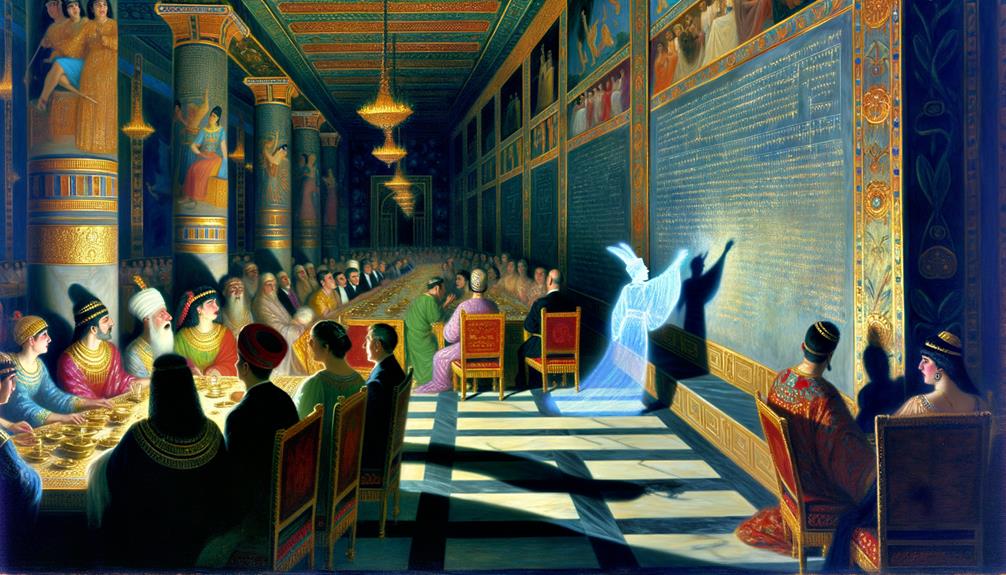
Amid the opulence and revelry of Belshazzar’s feast, a sudden and unsettling apparition of a disembodied hand inscribing mysterious words on the wall abruptly shifted the atmosphere from one of indulgence to dread.
The Babylonian king, Belshazzar, had arrogantly used sacred vessels from the Jerusalem temple to toast pagan gods, heightening the dramatic irony of the scene.
This feast, described in Daniel 5, serves as a pivotal moment revealing divine judgment.
The supernatural occurrence not only disrupted the king’s blasphemous celebration but also underscored the transient nature of earthly power.
This historical and theological narrative emphasizes the sovereignty of God and prefigures the imminent fall of Babylon, marking a significant juncture in the Biblical account of divine retribution.
Deciphering the Handwriting

Confronted by the enigmatic inscription, Belshazzar summoned his wisest advisors, yet their inability to interpret the divine message only deepened the king’s alarm and highlighted the limitations of human wisdom in the face of divine mysteries.
This moment, as depicted in the Book of Daniel, underscores the tension between earthly authority and divine revelation. Historically, Babylonian magi and enchanters were revered for their supposed esoteric knowledge, yet their failure here accentuates the supremacy of divine communication.
Theologically, this scene serves to illuminate the transient nature of human power and the enduring sovereignty of the divine. The inscrutable words on the wall hence symbolize a divine judgment that surpasses human comprehension, prompting a profound reflection on the limits of earthly wisdom.
Daniel’s Interpretation
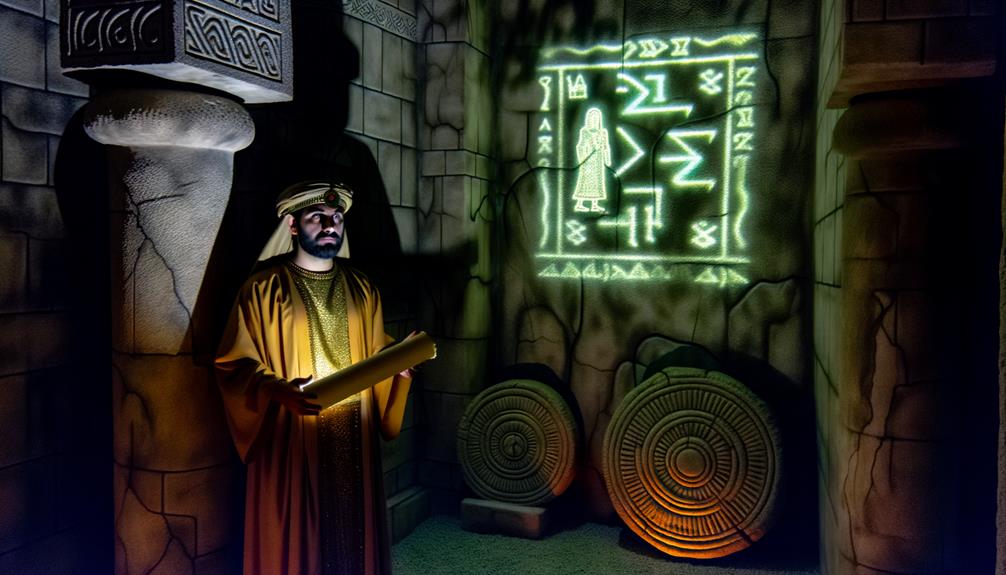
Daniel’s interpretation of the mysterious handwriting on the wall provided both a translation and a profound prophetic judgment.
His exegesis revealed that the words ‘Mene, Mene, Tekel, Upharsin’ foretold the imminent downfall of King Belshazzar’s reign and the subsequent division of his kingdom.
This episode not only underscores the intersection of divine intervention and earthly governance but also highlights the role of prophetic voices in ancient Near Eastern political landscapes.
Mysterious Handwriting Deciphered
The enigmatic inscription that appeared on the wall during King Belshazzar’s feast was meticulously interpreted by Daniel, revealing a divine judgment that heralded the imminent fall of Babylon.
Daniel, renowned for his wisdom and prophetic gifts, deciphered the Aramaic words ‘Mene, Mene, Tekel, Parsin.’
He explained that ‘Mene’ signified that God had numbered the days of Belshazzar’s reign and brought it to an end.
‘Tekel’ indicated that the king had been weighed and found wanting in the divine scales of justice.
‘Parsin’ foretold the division of the kingdom, to be given to the Medes and Persians.
This interpretation not only provided immediate context but also illuminated the theological underpinnings of divine sovereignty and moral accountability.
Prophetic Judgment Revealed
In a moment of profound theological significance, Daniel’s interpretation of the mysterious handwriting revealed an unequivocal prophetic judgment against King Belshazzar and the Babylonian empire.
The cryptic message ‘Mene, Mene, Tekel, Upharsin’ was decoded by Daniel to signify the impending doom: ‘Mene’ indicated that God had numbered the days of Belshazzar’s reign, bringing it to an end; ‘Tekel’ signified that the king had been weighed and found wanting; and ‘Upharsin’ foretold the division and conquest of the kingdom by the Medes and Persians.
This revelation underscored the divine sovereignty in world affairs and served as a potent reminder of the moral and spiritual accountability of rulers, echoing themes of judgment and divine retribution central to biblical theology.
Historical and Cultural Impact
The phrase ‘writing on the wall‘ originates from the biblical story of Belshazzar’s feast in the Book of Daniel, where it signified imminent doom and divine judgment.
This ancient narrative has transcended its original context to acquire varied interpretations in modern culture, often symbolizing inevitable consequences or forewarnings.
Understanding this evolution requires examining both the historical-theological origins and contemporary applications of the phrase.
Ancient Biblical Context
Within the ancient Near Eastern milieu, the phrase ‘writing on the wall‘ originates from a pivotal moment in the Book of Daniel, where a mysterious inscription portends the imminent fall of Babylon.
This event occurs during King Belshazzar’s feast, where a divine hand inscribes the words ‘Mene, Mene, Tekel, Upharsin’ on the palace wall.
Daniel interprets these Aramaic words as a divine judgment against Belshazzar’s reign, signaling that his days are numbered, his reign has been weighed and found wanting, and his kingdom will be divided and given to the Medes and Persians.
This narrative reflects the theological conviction of divine sovereignty and judgment, embedding itself deeply within the cultural consciousness of subsequent Judeo-Christian thought.
Modern Interpretations
Echoing through centuries, the phrase ‘writing on the wall’ has transcended its ancient biblical origins to become a potent symbol in modern historical and cultural discourse, reflecting themes of inevitable consequence and forewarning. This idiom finds relevance in various contexts, from literature to political rhetoric, emphasizing the recognition of impending doom or necessary change. Theological insights underscore its role as a divine message that transcends time, warning individuals and societies alike of imminent judgment or transformation.
| Context | Interpretation | Example |
|---|---|---|
| Literature | Forewarning | George Orwell’s “1984” |
| Politics | Inevitable Change | Fall of the Berlin Wall |
| Popular Culture | Symbol of Impending Consequence | Films like “The Matrix” |
This enduring phrase continues to shape our understanding of foresight and consequence.
Modern Usage and Relevance

In contemporary discourse, the phrase ‘writing on the wall‘ frequently serves as a metaphor for an impending and unavoidable outcome, often of a negative nature.
Rooted in the biblical narrative of Belshazzar’s feast in the Book of Daniel, this idiom has transcended its scriptural origins to permeate modern vernacular.
Its application in contemporary settings often underscores forewarnings in economic, political, or social contexts. Despite its ancient origins, the phrase retains theological gravitas, echoing themes of divine judgment and fate.
Recognizing the ‘writing on the wall’ involves an awareness of subtle signs that predict future adversity, demanding a nuanced understanding of both historical precedent and current dynamics.
Consequently, it remains a powerful rhetorical device in modern communication.
Conclusion
The phrase ‘writing on the wall‘ coincidentally encapsulates a moment of divine intervention and prophetic revelation in the biblical narrative, specifically during Belshazzar’s feast.
Daniel’s interpretation revealed not just the immediate doom for Babylon but also offered a timeless warning against hubris.
Historically and theologically, this event underscores themes of judgement and accountability, resonating through centuries.
Today, it serves as a poignant metaphor for impending consequences, maintaining its relevance across diverse cultural and secular contexts.