
Shewbread Meaning in the Bible: Sacred Symbolism
In the Bible, ‘shewbread,’ also known as the “bread of the Presence,” refers to twelve loaves placed on a designated table in the Tabernacle. These loaves symbolize God’s perpetual covenant and continuous provision for the twelve tribes of Israel.
Prepared from the finest wheat flour and arranged in two rows, the bread signifies purity and dedication. Each week, the loaves were replaced, underlining the ongoing commitment to divine sustenance and fellowship.
This sacred practice not only conveyed unity among the tribes but also embodied the divine-human relationship central to Hebrew theology. Further exploration reveals its deeper theological and modern implications.

Key Takeaways
- Shewbread symbolizes God’s perpetual covenant and provision for the twelve tribes of Israel.
- The twelve loaves represent unity and the spiritual bond among the tribes.
- Weekly renewal of the bread signifies ongoing divine sustenance and faithfulness.
- Preparation with fine flour and frankincense underscores purity and reverence in worship.
Biblical Origins

The term ‘shewbread,’ also known as ‘showbread’ or ‘bread of the Presence,’ originates from ancient Hebrew religious practices described in the Old Scripture, specifically within the context of the Tabernacle rituals as outlined in the books of Exodus and Leviticus.
This bread held profound symbolic significance, representing God’s perpetual covenant with the Israelites. Placed on a specially designated table within the Holy Place, shewbread was an emblem of divine provision and sustenance.
Scriptural passages detail that twelve loaves, corresponding to the twelve tribes of Israel, were arranged in two rows. This ritual underscored the continuous worship and recognition of God’s omnipresence.
Consequently, shewbread functioned as a tangible manifestation of spiritual principles integral to Hebrew theology.
Preparation Process

Understanding the preparation process of shewbread reveals further layers of its sacred significance within ancient Hebrew worship practices. This intricate procedure was not merely culinary but deeply ritualistic, aligning with the meticulous standards outlined in Leviticus.
The preparation involved several key elements:
- Ingredients: The finest wheat flour was used, symbolizing purity and dedication.
- Quantity: Twelve loaves were baked, representing the twelve tribes of Israel.
- Arrangement: The loaves were arranged in two stacks of six on a specially designed table in the Holy Place.
Each step imbued the shewbread with profound theological meaning, reflecting the covenant between God and His people through ritualistic observance.
Symbolic Significance

Shewbread, also known as the ‘bread of the Presence,’ carries profound symbolic significance within biblical theology, representing God’s perpetual provision and the continual fellowship between the Divine and Israel.
This bread, placed on a table within the sacred space of the Tabernacle, serves as a tangible reminder of God’s sustenance and faithfulness to His covenant people.
It exemplifies divine abundance, as each loaf symbolizes the tribes of Israel, signifying unity and collective reliance on God.
The shewbread also underscores the concept of holiness, being set apart for a sacred purpose, thereby emphasizing the sanctity of God’s relationship with His chosen people.
The constant presence of the shewbread highlights an unending divine-human communion, foundational to Israel’s spiritual identity.
Ritual Practices
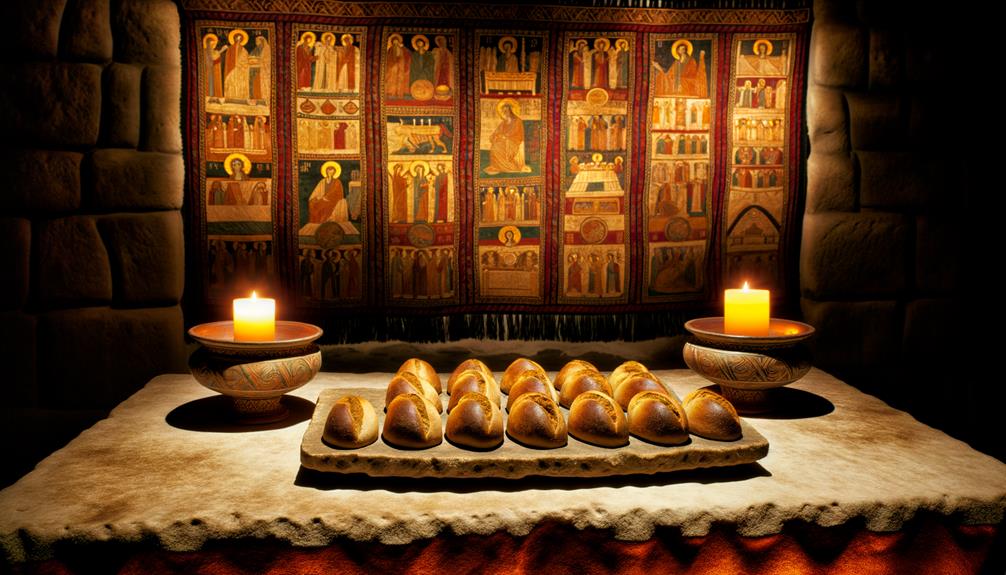
Placing the shewbread within the Tabernacle involved intricate ritual practices that underscored its sacred significance and the meticulous observance required by the priests. These practices were emblematic of the covenantal relationship between God and Israel, and included:
Preparation: The shewbread was prepared with fine flour, symbolizing purity and divine provision.
Arrangement: Twelve loaves, representing the twelve tribes of Israel, were placed in two rows on the golden table.
Incense Offering: Frankincense was placed alongside the loaves, to be burned as an offering, signifying prayers ascending to God.
Weekly Renewal: Every Sabbath, the old bread was replaced with fresh loaves, emphasizing continual divine sustenance.
These rituals were meticulously executed, reflecting the importance of obedience and reverence in worship.
Modern Interpretations

Modern interpretations of shewbread within biblical scholarship often explore its theological symbolism and its relevance to contemporary faith practices. Scholars posit that the shewbread, also known as ‘bread of the Presence,’ represents God’s sustenance and provision, a tangible reminder of divine care.
In contemporary Christian theology, this symbolism extends to the Eucharist, reinforcing the idea of spiritual nourishment and unity with the divine. Additionally, some modern Jewish perspectives view shewbread as a symbol of communal worship and covenantal relationship.
Conclusion
The concept of shewbread in the Bible encapsulates a multifaceted tradition encompassing intricate preparation, profound symbolic meaning, and specific ritual practices.
Remarkably, the annual consumption of the shewbread by the priests, as per Leviticus 24:5-9, underscores its ritual significance.
An intriguing statistic is that each of the twelve loaves represented one of the twelve tribes of Israel, symbolizing unity and divine provision.
Modern interpretations continue to explore its theological and cultural implications, enriching contemporary understanding.