
What Is the Meaning of A.D in the Bible? Timeline and History
In the context of the Bible, ‘A.D.’ stands for ‘Anno Domini,’ Latin for ‘In the Year of Our Lord,’ signifying the years following the birth of Jesus Christ. This term was introduced by the 6th-century monk Dionysius Exiguus to replace the ‘Diocletian era,’ thereby aligning historical dating with Christian events.
Theologically, A.D. marks the centrality of Christ’s incarnation in human chronology, intertwining sacred timelines with the secular world.
The adoption of Anno Domini reshaped the Western calendar, embedding Christological significance into the framework of historical time, and enhancing understanding of its deep-rooted implications. Explore further to grasp the full impact of A.D.
in Christian theology and historical development.

Key Takeaways
- ‘A.D.’ stands for ‘Anno Domini’ in Latin, which means ‘In the Year of Our Lord.’
- It marks the years following the birth of Jesus Christ, a central event in Christian theology.
- ‘A.D.’ emphasizes Christ’s significance in historical and spiritual contexts, aligning timekeeping with Christian beliefs.
- The term reflects the integration of sacred chronology into the measurement of historical events.
Origin of A.D

The term ‘A.D,’ an abbreviation for ‘Anno Domini,’ which translates to ‘In the Year of Our Lord’ in Latin, was introduced in the 6th century by the monk Dionysius Exiguus as a means to identify years based on the estimated birth year of Jesus Christ.
Contextually, this system replaced the Roman ‘Diocletian era,’ which was named after a persecutor of Christians. Theologically, it signified a shift in focus, centering the chronology around Christ’s incarnation.
Anno Domini Explained

Building upon the historical and theological roots established by Dionysius Exiguus, ‘Anno Domini’ serves as a pivotal marker that not only redefined the chronological framework of the era but also encapsulates the profound impact of Jesus Christ’s birth on human history. This Latin term, meaning “In the Year of Our Lord,” signifies the commencement of the Gregorian calendar system, aligning temporal measurement with Christological significance.
| Aspect | Explanation |
|---|---|
| Origin | Introduced by Dionysius Exiguus in the 6th century |
| Meaning | “In the Year of Our Lord” |
| Theological Impact | Centers history around the birth of Jesus Christ |
| Chronological Utility | Standardizes historical dating and synchronizes with Christian theological events |
The adoption of ‘Anno Domini’ reflects a shift from secular to sacred timekeeping, emphasizing the centrality of Christ in human chronology.
Historical Context

Amid the tapestry of early medieval history, the establishment of the ‘Anno Domini‘ dating system by Dionysius Exiguus marks a significant convergence of ecclesiastical authority and chronological methodology.
Dionysius, a 6th-century monk, sought to create a calendar that centered on the incarnation of Christ, thereby aligning Christian liturgical practices with a precise temporal framework.
This innovation was not merely chronological but theological, underscoring the centrality of Christ in human history. By replacing the Diocletian era, which commemorated a persecutor of Christians, with ‘Anno Domini,’ Dionysius sanctified time itself, imbuing it with spiritual significance.
This recalibration of history through a Christocentric lens facilitated a unified ecclesiastical identity and reinforced the pervasive influence of Christianity throughout the medieval period.
Biblical References
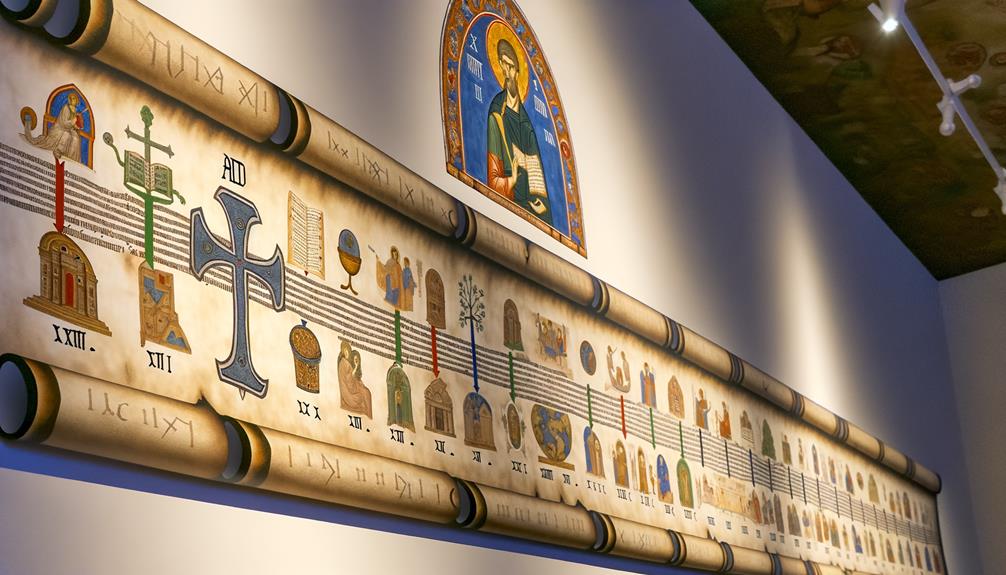
Biblical references to time and chronology frequently underscore the theological significance of events, offering a divine framework for understanding history. Scripture often situates pivotal moments within a temporal context to emphasize their spiritual and prophetic importance.
For instance, the New Covenant marks the birth of Jesus Christ as a transformative event, fundamentally altering the course of human history. This demarcation aligns with the Anno Domini (A.D.) system, which signifies ‘In the Year of Our Lord.’
The Bible uses genealogies, prophetic timelines, and eschatological visions to structure its narrative, illustrating God’s sovereignty over time. By doing so, it not only provides a historical record but also imparts a theological message, linking temporal events with eternal truths and divine purposes.
Gregorian Calendar

In the context of Christian chronology, the Gregorian Calendar, introduced by Pope Gregory XIII in 1582, serves as a pivotal framework for marking time and aligning liturgical events with the A.D. system.
This calendar reform aimed to correct discrepancies in the Julian Calendar, ensuring that Easter and other significant Christian observances occurred at their intended times.
The Gregorian Calendar adjusted the leap year rule and realigned the date of the vernal equinox, thereby refining the synchronization with the solar year.
These modifications not only facilitated ecclesiastical precision but also reinforced the theological underpinning of A.D. (‘Anno Domini,’ Latin for ‘in the year of our Lord’), providing a coherent temporal structure that underscores the centrality of Christ’s incarnation within the Christian worldview.
Role in Christianity

The Gregorian Calendar’s establishment not only rectified chronological inconsistencies but also reinforced the theological significance of the A.D. system in marking the pivotal events of Christendom.
Within Christianity, A.D. (Anno Domini) plays an essential role, serving as a constant reminder of the incarnation of Jesus Christ and the dawn of a new covenant.
This system embeds theological resonance in the fabric of time itself, emphasizing:
- Incarnation: The birth of Jesus marks the commencement of A.D., symbolizing God’s presence among humanity.
- Redemption: It highlights the salvific events of Christ’s life, death, and resurrection.
- Eschatology: It denotes the anticipation of Christ’s second coming, underpinning Christian hope and future expectancy.
Thus, the A.D. system integrates temporal and spiritual dimensions, enriching Christian faith.
A.D. Vs. C.E

While both A.D. (Anno Domini) and C.E. (Common Era) serve as chronological markers, their usage reflects differing cultural and theological perspectives on the measurement of historical time.
A.D., Latin for ‘in the year of our Lord,’ explicitly references the birth of Jesus Christ, central to Christian theology. This nomenclature underscores the importance of Christ’s incarnation in delineating historical epochs.
Conversely, C.E., a more secular term, aims to provide a neutral alternative, accommodating diverse religious and cultural backgrounds. Though C.E. retains the same chronological framework as A.D., its adoption signifies a shift towards inclusivity and pluralism in historical discourse.
Theological contexts often prefer A.D. for its explicit Christological significance, while C.E. is favored in academic and interfaith settings.
Impact on History
The designation of A.D., or Anno Domini, has profoundly influenced the shaping of Western civilization, serving as a cornerstone for the Gregorian calendar’s adoption and the establishment of historical chronology.
Its theological implications underscore the centrality of Christ’s birth in historical reckoning, thereby embedding Christian doctrine into the fabric of societal development.
This integration of sacred chronology into temporal measurement has yielded a unified historical framework that continues to guide contemporary understanding of time and history.
Shaping Western Civilization
Understanding the meaning of A.D. in the Bible is essential for comprehending its profound influence on the shaping of Western civilization, particularly regarding historical and theological development.
The concept of Anno Domini (A.D.), meaning ‘in the year of our Lord,’ has been pivotal in structuring Western chronology. Its impact can be analyzed through:
- Historical Framework: A.D. established a uniform timeline, integrating religious events with secular history.
- Theological Significance: It underscored the centrality of Christ’s incarnation, reinforcing Christian doctrine in societal norms.
- Cultural Identity: The A.D. system fostered a Christian-centric worldview, influencing art, literature, and governance.
Gregorian Calendar Adoption
Adopting the Gregorian calendar marked a significant recalibration of timekeeping, aligning ecclesiastical observances with astronomical realities and profoundly influencing historical chronology. Introduced by Pope Gregory XIII in 1582, this calendar replaced the Julian system to correct discrepancies in the calculation of Easter and other liturgical dates.
Theological Implications | Historical Impact | Key Changes
— | — | —
Aligned with Council of Nicaea | Unified Western Chronology | Leap Year Adjustments
Enhanced Liturgical Accuracy | Standardized Global Dating | Removed 10 Days
Reinforced Papal Authority | Facilitated Trade | Improved Seasonal Tracking
Synced with Solar Year | Influenced Scientific Research | Adopted Internationally
This adjustment not only synchronized the civil calendar with the solar year but also reinforced the ecclesiastical authority, having lasting impacts on both religious and secular understanding of time.
Historical Chronology Establishment
Pope Gregory XIII’s introduction of the Gregorian calendar markedly altered historical chronology, profoundly impacting both theological interpretations and the broader understanding of historical events.
The shift from the Julian to the Gregorian calendar corrected the drift of equinoxes, aligning Christian liturgical dates more accurately with the astronomical year. This recalibration influenced historical chronology in several ways:
- Liturgical Consistency: Enabled more precise observance of Christian holidays, particularly Easter.
- Chronological Accuracy: Improved alignment of historical events with their actual dates, enhancing historical research reliability.
- Global Standardization: Facilitated a unified dating system, essential for international diplomacy and historical documentation.
These changes underscore the theological and historical significance of ‘Anno Domini’ in the context of both sacred and secular histories.
Modern Usage

In contemporary contexts, the designation ‘A.D.’ continues to influence the structuring of our calendar system, underscoring its enduring relevance beyond theological discourse.
The integration of ‘Anno Domini‘ in educational curricula guarantees that students encounter its historical and cultural significance, facilitating a deeper understanding of Western chronology.
Additionally, digital communication trends reflect both the persistence and the adaptation of this term within modern frameworks of timekeeping and historical reference.
Contemporary Calendar Context
The designation ‘A.D.’—an abbreviation for the Latin term ‘Anno Domini,’ meaning ‘in the year of our Lord’—plays a pivotal role in contemporary calendar systems, signifying dates from the traditional birth year of Jesus Christ onward. Its use underscores the theological and historical anchoring of modern chronology.
The contemporary calendar context involves:
- Chronological Standardization: A.D. is globally recognized, facilitating international date consistency.
- Cultural Continuity: It preserves Judeo-Christian influences in secular and religious contexts.
- Systematic Organization: It provides a chronological framework essential for historical and future record-keeping.
The theological implications of ‘A.D.’ affirm the enduring impact of Jesus Christ’s birth on modern temporal structures, highlighting an intersection between faith and daily life.
Educational Curriculum Integration
Integrating the concept of ‘A.D.’ into educational curricula provides students with a thorough understanding of historical chronology and its theological underpinnings.
This inclusion allows learners to grasp the significance of Anno Domini (Latin for ‘In the Year of Our Lord’) as a marker that delineates the epoch following the birth of Jesus Christ.
By exploring ‘A.D.’, students can appreciate how this term reflects Christocentric historical perspectives, influencing Western historical timelines.
Understanding ‘A.D.’ also fosters theological literacy, enabling students to contextualize biblical events within broader historical frameworks.
Such integration enriches their comprehension of religious history and its pervasive impact on modern culture and societal structures, thereby promoting a well-rounded, informed worldview.
Digital Communication Trends
Frequently, digital communication trends reflect evolving societal norms and theological influences, shaping contemporary understandings of historical terminology such as ‘A.D.’. In the digital age, the abbreviation ‘A.D.’ (Anno Domini) has undergone nuanced transformations, influenced by broader cultural shifts and technological advancements.
- Theological Reinterpretation: Online platforms facilitate diverse theological discussions, prompting a re-examination of ‘A.D.’ within both religious and secular contexts.
- Educational Resources: Digital tools and e-learning modules incorporate ‘A.D.’ alongside ‘C.E.’ (Common Era), reflecting inclusive educational practices.
- Social Media Influence: The ubiquity of social media enables the rapid dissemination of interpretative content, making traditional terms like ‘A.D.’ more accessible and subject to public discourse.
These trends underscore the dynamic intersection between historical terminology and modern digital landscapes.
Conclusion
The term A.D., originating from the Latin ‘Anno Domini,’ signifies the era commencing with the birth of Jesus Christ. This designation, integral to the Gregorian calendar, has shaped historical and theological contexts within Christianity and beyond.
While some may argue for the use of C.E. (Common Era) to maintain secularism, the enduring influence of A.D. reflects its profound impact on historical chronology and religious identity.
This underscores its continued relevance in both academic and ecclesiastical discussions.