Typology Meaning in the Bible
Typology in the Bible is a hermeneutical method involving the interpretation of Old Covenant events, persons, or institutions as prefigurations of New Covenant realities. This method reveals a unified divine plan within Scripture, highlighting God’s progressive revelation of His redemptive work.
For instance, the sacrificial system foreshadows Christ’s ultimate sacrifice (Hebrews 10:1-10), and the Exodus symbolizes liberation fulfilled in Christ (John 8:36). The New Covenant’s application of these types, such as Jesus as the Paschal Lamb (John 1:29), underscores continuity and deepens theological insight.
An exploration of these typologies enriches our understanding of salvation history‘s cohesive narrative.

Key Takeaways
- Typology interprets Old Testament events, persons, or institutions as foreshadowings of New Testament realities.
- It reveals God’s unified and progressive redemptive plan across Scripture.
- Old Testament sacrifices and events prefigure Christ’s ultimate sacrifice and redemptive work.
- Prophetic figures like Moses and David symbolize aspects of Christ’s messianic role.
Definition of Typology

Typology, in a biblical context, refers to the interpretive method by which certain events, persons, or institutions in the Old Covenant are understood as prefigurations or foreshadowings of corresponding realities in the New Covenant.
This method is rooted in the theological premise that Scripture contains a unified and divine plan. For instance, the sacrifice of Isaac (Genesis 22:1-19) is often seen as a type of Christ’s sacrificial death (Hebrews 11:17-19).
Typology operates under the belief that God’s redemptive work is progressively revealed through historical events that bear prophetic significance.
Scholars argue that typology bridges Old and New covenant theology, enhancing the coherence and depth of biblical narratives, thereby providing a richer understanding of divine revelation.
Old Testament Foundations

The Old Scripture lays the groundwork for typology through symbolic events and prophetic figures that prefigure New Scripture realities.
For instance, the sacrificial system, as seen in Leviticus, anticipates the ultimate sacrifice of Christ (Hebrews 10:1-10).
Additionally, figures such as Moses and David serve as types of Christ, illustrating God’s redemptive plan through their roles and actions (Deuteronomy 18:15, 2 Samuel 7:12-16).
Symbolic Old Testament Events
While analyzing the Old Scripture, one encounters numerous events that hold profound symbolic significance, serving as foundational typologies that prefigure and illuminate New Covenant realities.
For instance, the Exodus event (Exodus 12-14) symbolizes liberation from sin, paralleling Christ’s redemptive work (John 8:36). The crossing of the Red Sea prefigures baptism (1 Corinthians 10:1-2), a shift from bondage to spiritual freedom.
Similarly, the manna provided in the wilderness (Exodus 16) typifies the Eucharist, embodying Christ as the Bread of Life (John 6:31-35). The sacrificial system instituted in Leviticus foreshadows the ultimate sacrifice of Jesus (Hebrews 10:1-10), revealing a deeper divine plan.
These events provide theological insights, enriching our understanding of salvation history and divine promises.
Prophetic Figures and Types
Numerous prophetic figures in the Old Scripture serve as types, offering profound insights into Christ’s messianic role and mission. For instance, Moses functions as a type of Christ, interceding on behalf of the Israelites (Exodus 32:30-32) as Christ intercedes for humanity (Hebrews 7:25). Similarly, Jonah’s three days in the belly of the fish (Jonah 1:17) prefigure Christ’s three days in the tomb (Matthew 12:40). These typological connections highlight the anticipatory nature of Old Covenant prophecy, pointing towards the ultimate fulfillment in Christ.
| Prophetic Figure | Typological Significance |
|---|---|
| Moses | Intercession (Exodus 32:30-32) |
| Jonah | Resurrection (Jonah 1:17, Matthew 12:40) |
| David | Kingship (2 Samuel 7:12-16) |
Such biblical typologies enrich theological understanding and underscore the cohesive narrative of salvation history.
New Testament Fulfillments
Examining New Covenant fulfillments reveals how Old Scriptures types find their ultimate completion in the life and mission of Jesus Christ.
Theological analysis demonstrates that events, persons, and institutions in the Old Scriptures prefigure New Scriptures realities. For instance, the sacrificial system outlined in Leviticus is consummated in Christ’s atoning sacrifice (Hebrews 10:1-14).
Likewise, the Passover lamb (Exodus 12:21-27) typifies Christ as the ‘Lamb of God’ (John 1:29). Such fulfillments underscore scriptural continuity and divine orchestration across both Scriptures.
Through typology, the New Scriptures not only validates the Old Scriptures but also deepens the understanding of its prophetic nature, intricately revealing God’s redemptive plan through Jesus Christ (Matthew 5:17; Luke 24:44).
Adam as a Type of Christ

In theological discourse, Adam is often typologically seen as a prefiguration of Christ, with his role in humanity’s fall serving as a counterpoint to Christ’s role in humanity’s redemption (Romans 5:14-19).
Adam’s transgression brought sin and death into the world, while Christ’s obedience and sacrifice bring righteousness and eternal life.
The Apostle Paul underscores this typological relationship in 1 Corinthians 15:22, ‘For as in Adam all die, so also in Christ shall all be made alive.’
This typology highlights the contrast between the first Adam, who succumbed to temptation, and the second Adam, Christ, who overcame temptation and sin.
Consequently, Adam and Christ are central figures in understanding the overarching narrative of fall and redemption in Christian theology.
The Passover Lamb
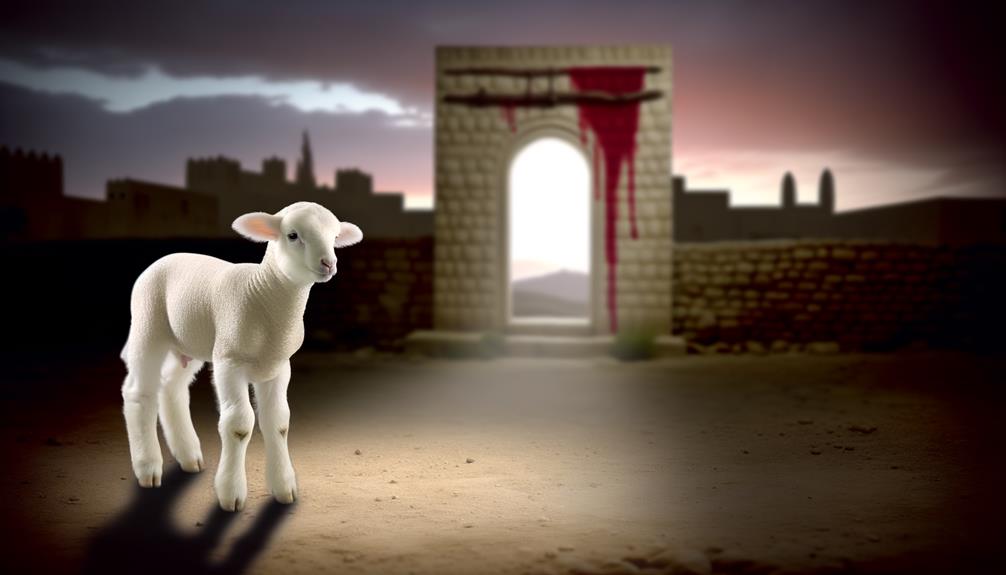
The Passover Lamb, as described in Exodus 12:1-13, serves as a profound typological symbol of sacrifice, prefiguring Christ’s ultimate atonement on the cross (1 Corinthians 5:7).
This sacrificial act not only signifies the Israelites’ deliverance from Egyptian bondage but also foreshadows the redemptive liberation available through Jesus Christ.
The theological implications of this typology underscore the continuity of God’s salvific plan, culminating in Christ’s sacrificial death and resurrection.
Symbol of Sacrifice
Central to the typological understanding of Christ’s atonement, the Passover Lamb serves as a profound symbol of sacrifice, foreshadowing the ultimate redemption through Jesus Christ as depicted in 1 Corinthians 5:7.
This typology illustrates the theological principle that Christ’s sacrificial death fulfills the Old Scripture paradigm of atonement. In Exodus 12, the Passover Lamb’s blood, applied to the doorposts, spared the Israelites from divine judgment, symbolizing deliverance from sin.
Theologically, the lamb represents purity and innocence, qualities ascribed to Christ in 1 Peter 1:19, who is described as a ‘lamb without blemish or defect.’
This sacrificial motif underscores the continuity and fulfillment of divine salvation history, bridging the Old Covenant with the New Scripture’s soteriological promises.
Foreshadowing Christ’s Sacrifice
Typologically, the Passover Lamb in Exodus 12 serves as a prophetic precursor to Christ’s sacrificial atonement, as elucidated in New Covenant scripture. The Apostle Paul explicitly correlates Christ with the Passover lamb in 1 Corinthians 5:7, affirming, ‘For Christ, our Passover lamb, has been sacrificed.’ This typology is further reinforced in John 1:29, where John the Baptist declares Jesus as ‘the Lamb of God, who takes away the sin of the world.’ The theological parallels are profound, illustrating the continuity between Old and New Scriptures.
| Element | Passover Lamb | Christ |
|---|---|---|
| Sacrificial Context | Exodus 12 | 1 Corinthians 5:7 |
| Purpose | Deliverance from Death | Salvation from Sin |
| Symbolic Significance | Blood on Doorposts | Blood of the Cross |
| Prophetic Fulfillment | Immediate Deliverance | Eternal Redemption |
Deliverance From Bondage
Deliverance from bondage, as symbolized by the Passover Lamb, encapsulates a foundational theme in biblical theology, illustrating God’s redemptive intervention in liberating the Israelites from Egyptian slavery (Exodus 12:1-14).
This event prefigures Christ’s ultimate sacrifice, wherein Jesus is identified as the ‘Lamb of God‘ (John 1:29).
The blood of the Passover lamb, which saved the Israelites from the plague of the firstborn, typologically points to the atoning blood of Christ, which redeems humanity from sin (1 Peter 1:19).
Theological analysis underscores that the Passover lamb serves as a precursor to the New Covenant revelation of salvation through Christ’s sacrifice, thereby linking Old and New Covenant themes of deliverance and divine provision.
The Tabernacle and Temple
The Tabernacle and Temple in the Bible serve as profound typological symbols, representing God’s dwelling place among His people and foreshadowing the ultimate sanctuary found in Christ.
Scripturally, the Tabernacle (Exodus 25:8-9) and Solomon’s Temple (1 Kings 6) are physical embodiments of God’s presence.
Theologically, these structures prefigure the incarnation of Christ as the divine dwelling among humanity (John 1:14).
Hebrews 9:11-12 elucidates how Christ, as the High Priest, entered the greater and more perfect tabernacle, securing eternal redemption.
This typology underscores the shift from a physical to a spiritual temple, culminating in the indwelling of the Holy Spirit within believers (1 Corinthians 6:19).
Consequently, the Tabernacle and Temple are essential in understanding God’s redemptive plan.
Jonah and Jesus

As the Tabernacle and Temple illustrate God’s dwelling and redemptive plan, the narrative of Jonah presents a typological foreshadowing of Jesus Christ’s death, burial, and resurrection. This typology is evident in several key aspects:
- Descent and Burial: Jonah’s descent into the belly of the fish (Jonah 1:17) parallels Jesus’ burial in the tomb (Matthew 12:40).
- Three Days and Nights: Both Jonah and Jesus spent three days and nights in their respective places of confinement.
- Deliverance: Jonah’s deliverance from the fish (Jonah 2:10) prefigures Jesus’ resurrection (Matthew 28:6).
- Preaching and Repentance: Jonah’s preaching to Nineveh (Jonah 3:3-5) anticipates Jesus’ call to repentance (Matthew 4:17).
This typology underscores the continuity of God’s salvific plan.
Typology in Prophecy

Examining typology in prophecy reveals how Old Covenant figures and events prefigure and illuminate the person and work of Jesus Christ, providing a deeper understanding of scriptural fulfillment.
For instance, the suffering servant in Isaiah 53 is a type of Christ, illustrating His future suffering and atonement (Isaiah 53:4-5). Similarly, the Passover lamb in Exodus 12 foreshadows Christ as the ultimate sacrifice for sin (1 Corinthians 5:7).
These typological elements enrich our comprehension of Messianic prophecies and their realization in the New Covenant. Typology serves as a hermeneutical bridge, linking Old Covenant shadows with New Covenant realities, thereby underscoring the coherence and divine authorship of Scripture.
Through typology, prophecy becomes a multifaceted evidence to God’s redemptive plan.
Significance for Believers

Understanding typology’s role in prophecy not only enhances theological insight but also deepens personal faith by illustrating God’s consistent and purposeful plan throughout Scripture. For believers, typology offers several significant benefits:
- Affirmation of Divine Sovereignty: Typology underscores God’s control over history, as seen in the fulfillment of Old Covenant types in the New Testament (e.g., Exodus 12:46 and John 19:36).
- Strengthened Faith: Witnessing fulfilled prophecies strengthens believers’ trust in God’s promises (Luke 24:44).
- Enhanced Scriptural Understanding: Typology aids in comprehending complex biblical narratives by revealing deeper connections (Hebrews 8:5).
- Christ-Centered Focus: Typological interpretations consistently point to Christ, enriching worship and devotion (Colossians 2:17).
These aspects collectively enrich the believer’s spiritual journey and theological understanding.
Conclusion
Typology in biblical theology reveals the intricate tapestry of divine revelation, interweaving Old Covenant symbols with New Covenant fulfillments.
Through figures like Adam, the Passover Lamb, and Jonah, the Scriptures disclose a foreshadowing of Christ’s redemptive work.
The tabernacle and temple serve as earthly shadows of heavenly realities, while prophetic typology bridges the temporal with the eternal.
Consequently, typology enriches believers’ understanding, affirming the cohesive and prophetic nature of the biblical narrative.