
Queen Of The South Bible Meaning: Wisdom and Witness
The Queen of the South, known as the Queen of Sheba, appears in 1 Kings 10:1-13 and Matthew 12:42. She is celebrated for her visit to King Solomon, where she recognized his divine wisdom and offered lavish gifts.
This encounter exemplifies the ancient Near Eastern practice of rulers seeking wisdom and acknowledging divine authority. In the New scriptures, Jesus references her to critique the faithlessness of his contemporaries, highlighting her quest for truth and wisdom.
This narrative underscores universal themes of wisdom, faith, and divine revelation. Explore further to uncover the enduring significance of her story in theological discussions.

Key Takeaways
- The Queen of the South refers to the Queen of Sheba, who visited King Solomon to witness his wisdom and wealth.
- She symbolizes the pursuit of divine wisdom and truth beyond cultural and geographical boundaries.
- Jesus mentions her to contrast her earnest search for wisdom with the lack of faith in His contemporaries.
- Her journey and gifts highlight the recognition of God’s wisdom and authority in ancient Near Eastern practices.
Biblical References
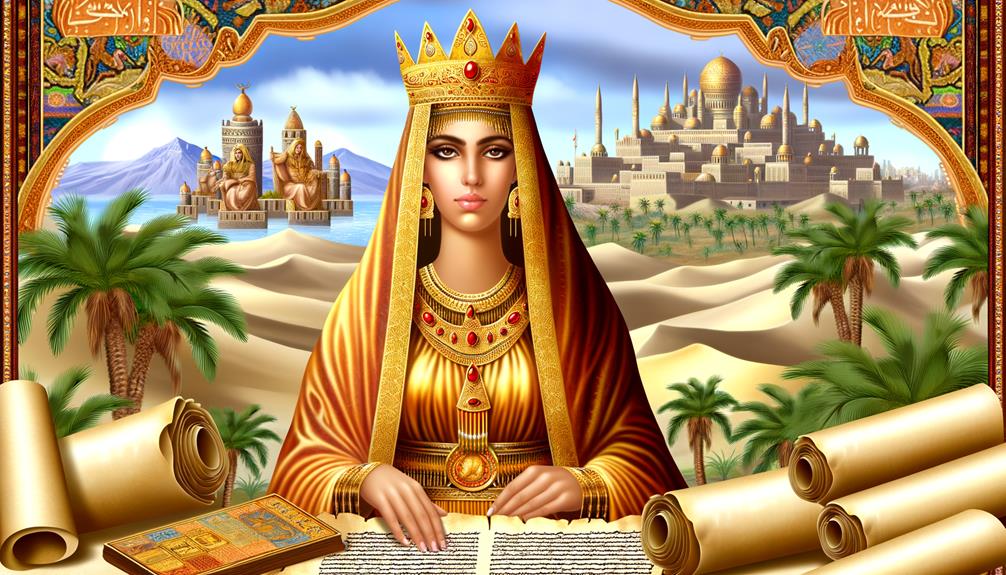
Frequently cited in scriptural analysis, the ‘Queen of the South‘ is referenced in both the Old and New Writings, specifically in 1 Kings 10:1-13 and Matthew 12:42.
In 1 Kings, she visits King Solomon, drawn by his renowned wisdom and wealth, bearing gifts of gold, spices, and precious stones. This encounter underscores her recognition of divine wisdom bestowed upon Solomon.
In the New Testament, Jesus mentions her as a witness to the wisdom he offers, highlighting her journey as an act of faith. Her acknowledgment of Solomon’s wisdom is used to contrast the contemporary generation‘s failure to heed Jesus’ teachings.
These references provide rich theological insights into wisdom, faith, and the recognition of divine authority.
Historical Background

Understanding the historical background of the ‘Queen of the South‘ provides essential context for her appearances in biblical narratives.
This title refers to a monarch who visited King Solomon, renowned for his wisdom and wealth, as depicted in the Hebrew Scriptures.
The term ‘Queen of the South’ is often associated with the ancient kingdom of Sheba, located in the southwestern Arabian Peninsula.
This visit is not merely a diplomatic encounter but a significant theological moment, as it underscores the universal recognition of Solomon’s divinely endowed wisdom.
Such visits were emblematic of the ancient Near Eastern practice of rulers seeking wisdom and establishing alliances.
The Queen’s journey and her subsequent recognition of Solomon’s God reinforce themes of divine wisdom and global acknowledgment of Israel’s God.
The Queen of Sheba
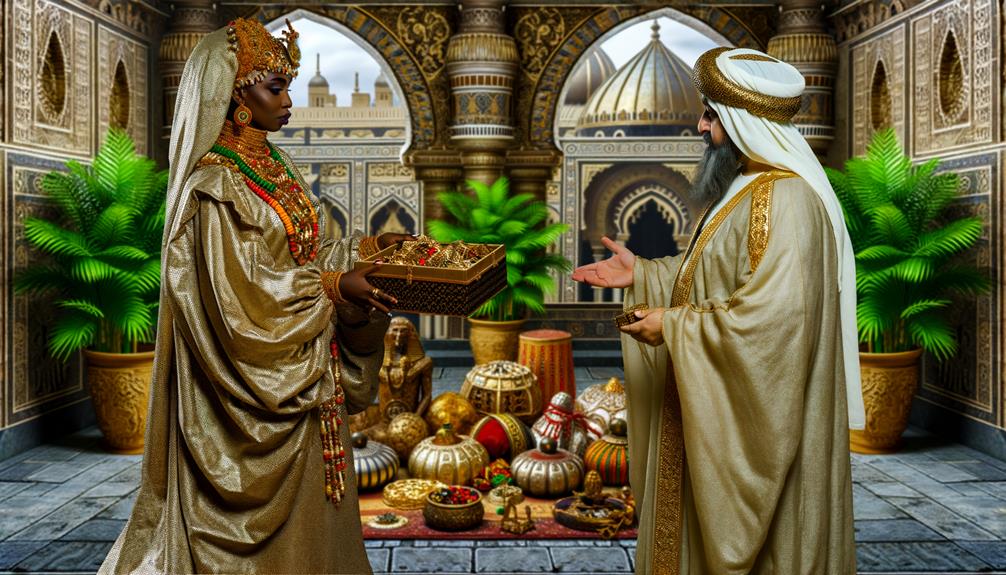
The Queen of Sheba‘s historic visit to King Solomon, as detailed in 1 Kings 10 and 2 Chronicles 9, underscores her immense wealth and the lavish gifts she brought, which included gold, spices, and precious stones.
Scriptural accounts highlight her quest to test Solomon with hard questions, reflecting a deep pursuit of wisdom and understanding.
Theologically, her recognition of Solomon’s divine wisdom illustrates the broader biblical theme of seeking and acknowledging God’s truth.
Historic Visit Described
In biblical accounts, the historic visit of the Queen of Sheba to King Solomon is depicted as a momentous event underscoring her quest for wisdom and understanding.
According to 1 Kings 10 and 2 Chronicles 9, the Queen traveled from the distant land of Sheba, likely modern-day Yemen or Ethiopia, to test Solomon with hard questions. This journey signifies a profound recognition of Solomon’s God-given wisdom, which had garnered international acclaim.
Theologically, her visit symbolizes the universality of divine wisdom, transcending geographical and cultural boundaries. The narrative emphasizes the importance of seeking wisdom and truth, virtues held in high regard within the biblical tradition.
Her encounter with Solomon highlights the deep interpersonal and intercultural engagements valued in scriptural teachings.
Wealth and Gifts
Among the notable aspects of the Queen of Sheba‘s visit to Solomon are the extraordinary wealth and opulent gifts she brought, which underscored her own royal status and the significance of the encounter.
As described in 1 Kings 10:2, she arrived with a caravan bearing gold, precious stones, and spices in great abundance. These gifts were not merely tokens of diplomacy but also symbolized her recognition of Solomon’s wisdom and God’s blessings upon Israel.
Theologically, the Queen’s generosity reflects the acknowledgment of divine favor and the interconnectedness of material wealth and spiritual insight.
Her offerings enriched the Israelite kingdom and demonstrated the far-reaching reputation of Solomon’s wisdom and the prosperity granted by divine providence.
Wisdom and Testing
Recognizing Solomon’s renowned wisdom, the Queen of Sheba initiated a journey to test his intellect with challenging questions and enigmas. This encounter, detailed in 1 Kings 10:1-13 and 2 Chronicles 9:1-12, underscores her quest for truth and understanding. Her inquisitive nature highlights three key aspects:
- Verification of Wisdom: Sheba’s testing of Solomon was not merely curiosity but a means to ascertain the veracity of his wisdom as proclaimed.
- Exchange of Knowledge: This meeting facilitated a profound exchange, enriching both with diverse perspectives and insights.
- Theological Implication: The Queen’s reverence for Solomon’s God after witnessing his wisdom suggests a recognition of divine influence, affirming the theological principle that true wisdom is God-given.
Her visit symbolized a blend of intellectual rigor and spiritual reverence.
Journey to Solomon

The Queen of the South‘s journey to meet King Solomon is laden with historical and theological significance, motivated by her desire to witness his renowned wisdom firsthand.
She set out with a caravan of lavish gifts, symbolizing both her wealth and the high esteem in which she held Solomon.
This encounter not only underscores the exchange of wisdom and wealth but also highlights a broader narrative of seeking divine knowledge.
Motivation for Journey
Driven by an insatiable desire for wisdom and understanding, the Queen of the South commenced her journey to visit King Solomon. This expedition was motivated by several factors that reveal her theological and intellectual pursuits.
- Reputation of Solomon’s Wisdom: The Queen had heard of Solomon’s unmatched wisdom and sought to test and learn from it, as recorded in 1 Kings 10:1-2.
- Divine Curiosity: Her journey symbolizes a quest for divine knowledge, illustrating a broader spiritual yearning, reflecting the theological depth of her character.
- Cultural Exchange: The visit also signifies a historical moment of intercultural dialogue, showcasing the Queen’s role in bridging different civilizations through shared wisdom and understanding.
These motivations underscore her profound commitment to enlightenment and spiritual growth.
Gifts for Solomon
Bearing an array of lavish gifts, the Queen of the South set forth on her journey to Solomon, exemplifying the customary practices of diplomacy and tribute in the ancient Near Eastern world.
Her offerings included gold, spices, and precious stones, as detailed in 1 Kings 10:2. These gifts symbolized not only her respect and recognition of Solomon’s wisdom but also the wealth and prosperity of her own kingdom.
Scripturally, this act of presenting gifts underscores the Queen’s earnest desire to seek and honor divine wisdom.
Theologically, it reflects the broader biblical motif of seeking knowledge and understanding from God-anointed leaders, highlighting the interconnectedness of wisdom, faith, and material blessings in the Judeo-Christian tradition.
Wisdom and Wealth
Beginning her journey to Solomon, the Queen of the South sought not only to confirm the tales of his unparalleled wisdom but also to engage in a profound exchange of intellectual and spiritual wealth. This pilgrimage is detailed in 1 Kings 10 and 2 Chronicles 9, where she poses challenging questions to Solomon, testing his divinely granted wisdom. Theologically, her quest represents the human pursuit of divine truth and understanding.
Key aspects of her journey include:
- Verification of Solomon’s Wisdom: She traveled to ascertain the truth of Solomon’s famed intellect.
- Exchange of Wealth: The Queen brought significant gifts, symbolizing the merging of material and spiritual riches.
- Recognition of Divine Blessing: Her acknowledgment of Solomon’s wisdom as a gift from God underscores the divine-human relationship.
Symbolism and Wisdom

The Queen of the South, also known as the Queen of Sheba, is a profound symbol of wisdom and a seeker of truth within biblical literature. Her journey to meet King Solomon, as recounted in 1 Kings 10 and 2 Chronicles 9, signifies a quest for divine wisdom and understanding.
Sheba’s queen brings lavish gifts, yet her primary purpose is to seek Solomon’s famed wisdom, symbolizing the universal pursuit of knowledge and enlightenment. Theologically, her story underscores the value placed on divine wisdom, transcending cultural and geographic boundaries.
Her willingness to travel great distances emphasizes the importance of seeking and acknowledging truth, embodying an archetype of intellectual and spiritual aspiration in Judeo-Christian thought.
Jesus’ Mention of Her

In the Gospels of Matthew and Luke, Jesus invokes the Queen of the South to illustrate the significance of seeking and recognizing divine wisdom. Her visit to King Solomon (1 Kings 10:1-13) is cited as a model of earnest pursuit of spiritual understanding.
Jesus’ reference underscores the following points:
- Diligence in Seeking Wisdom: The Queen of the South traveled great distances to hear Solomon’s wisdom, symbolizing an earnest quest for divine truth.
- Condemnation of Spiritual Apathy: Jesus contrasts her diligence with the indifference of His contemporaries, highlighting their failure to recognize wisdom greater than Solomon’s.
- Universal Call to Wisdom: Her inclusion in Jesus’ teaching signifies that divine wisdom is accessible to all, transcending cultural and geographical boundaries.
Theological Interpretations

Building on Jesus’ invocation of the Queen of the South, various theological interpretations have emerged to explore the deeper implications of her story within the broader biblical narrative.
Historically, the Queen of the South, identified as the Queen of Sheba, is seen as a seeker of wisdom, traveling to Jerusalem to test King Solomon’s reputed knowledge (1 Kings 10:1-13).
Scripturally, Jesus references her as one who recognized divine wisdom, contrasting her quest with the spiritual blindness of His contemporaries (Matthew 12:42).
Theologically, she symbolizes the inclusivity of God’s revelation, demonstrating that divine wisdom transcends ethnic and geographical boundaries, embracing all who earnestly seek truth.
Consequently, her story underscores a universal call to acknowledge and respond to divine wisdom.
Contemporary Significance

Frequently, the story of the Queen of the South is invoked in contemporary theological discussions to illustrate the ongoing relevance of seeking and recognizing divine wisdom across all cultures and epochs. Her journey to hear Solomon’s wisdom underscores several key points:
- Universal Quest for Wisdom: The narrative emphasizes that the quest for divine understanding transcends geographical and cultural boundaries, highlighting the universal nature of spiritual truth.
- Recognition of Divine Authority: The Queen’s acknowledgment of Solomon’s wisdom symbolizes the recognition of divine authority and guidance in human affairs.
- Inclusive Revelation: This story serves as a reminder that God’s wisdom is accessible to all who earnestly seek it, irrespective of their origin, thereby promoting an inclusive view of divine revelation.
These points remain significant in contemporary theological discourse.
Conclusion
In examining the Queen of the South, one must consider her as a paragon of wisdom and discernment, akin to Solomon himself.
Her journey to Solomon’s court embodies the quest for divine wisdom, an endeavor praised even by Jesus.
This figure serves as a bridge between ancient wisdom and modern theological reflection, illustrating the timeless pursuit of enlightenment.
Consequently, she stands as a proof of the enduring significance of seeking and recognizing true wisdom across ages.