
Saviour Meaning In The Bible: Deliverer Revealed
In the Bible, the term ‘Saviour‘ signifies God’s role in delivering His people, evidenced through figures such as Moses (Exodus 3:1-10) and the Judges (Judges 3:9-10). The Hebrew term ‘yasha’ implies divine intervention for salvation, epitomized by Yahweh in Isaiah 43:11.
This notion is fully realized in the New Covenant through Jesus Christ, whose sacrificial death and resurrection fulfill Old Covenant prophecies (Isaiah 53:5) and offer salvation to all believers (John 3:16). These themes underscore a continuous divine plan of redemption, inviting deeper exploration into their theological significance.

Key Takeaways
- The term ‘saviour’ in the Bible signifies divine intervention and deliverance, often linked to God’s covenantal faithfulness.
- Key figures like Moses and the judges are depicted as saviours, representing God’s rescuing role in Israel’s history.
- Jesus Christ is the ultimate Saviour, fulfilling Old Testament prophecies through His sacrificial death and resurrection.
- Salvation in the New Testament emphasizes justification by faith, redemption through Christ, and the promise of eternal life.
Saviour in the Old Testament

In the Old Covenant, the concept of a saviour is intricately woven into the narrative of Israel’s history, exemplified by figures such as Moses and David who acted as deliverers under God’s guidance.
The Hebrew term ‘yasha’ (to save or deliver) frequently appears in the Old Scriptures, denoting divine intervention. Isaiah 43:11 states, ‘I, even I, am the Lord, and apart from me there is no savior.’ This underscores that while human agents were employed, ultimate salvation emanated from Yahweh.
Judges 3:9-10 chronicles the cyclical deliverance of Israel through judges, emphasizing God’s role in raising saviours.
Consequently, the Old Scriptures saviour motif illustrates God’s enduring covenantal faithfulness and His commitment to redeeming His people.
Moses as a Deliverer

Moses stands as a quintessential figure of deliverance within the biblical narrative, exemplifying divine intervention and leadership.
His early life, marked by providential preservation (Exodus 2:1-10), set the stage for his role in leading the Israelites out of Egyptian bondage through the Exodus (Exodus 12:31-42).
Through his leadership, Moses not only facilitated the physical liberation of his people but also established a covenantal relationship between God and Israel, encapsulated in the giving of the Law at Mount Sinai (Exodus 19-24).
Moses’ Early Life
The narrative of Moses’ early life, as detailed in the book of Exodus, reveals his divine appointment as a deliverer of the Hebrew people from Egyptian bondage. Born during a time of intense persecution, Moses’ infancy was marked by providence when he was hidden in a basket and discovered by Pharaoh’s daughter (Exodus 2:1-10). His upbringing within the Egyptian royal household paradoxically prepared him for his future role. This dual identity, Hebrew by birth and Egyptian by nurture, uniquely positioned Moses as a mediator between two worlds, foreshadowing his deliverance mission.
| Event | Scriptural Reference |
|---|---|
| Birth and Hidden by Mother | Exodus 2:1-2 |
| Placed in the Nile | Exodus 2:3-4 |
| Discovered by Pharaoh’s Daughter | Exodus 2:5-6 |
| Raised in Pharaoh’s Palace | Exodus 2:7-10 |
This formative period underscored God’s sovereign orchestration in Moses’ life.
Exodus and Leadership
God’s commissioning of Moses at the burning bush (Exodus 3:1-10) marks the pivotal moment where he assumes the mantle of deliverer, tasked with leading the Israelites out of Egyptian enslavement. This encounter reveals three essential aspects of Moses’ leadership:
- Divine Authority: Moses is granted God’s authority to confront Pharaoh (Exodus 3:10).
- Prophetic Role: Moses acts as God’s spokesperson, delivering the divine message to both Israelites and Egyptians (Exodus 7:1-2).
- Mediator: Moses serves as an intermediary between God and the people, guiding them through the wilderness (Exodus 19:3-6).
These elements underscore Moses’ role not just as a political leader, but as a divinely appointed saviour, embodying God’s salvific purposes.
Judges as Saviours
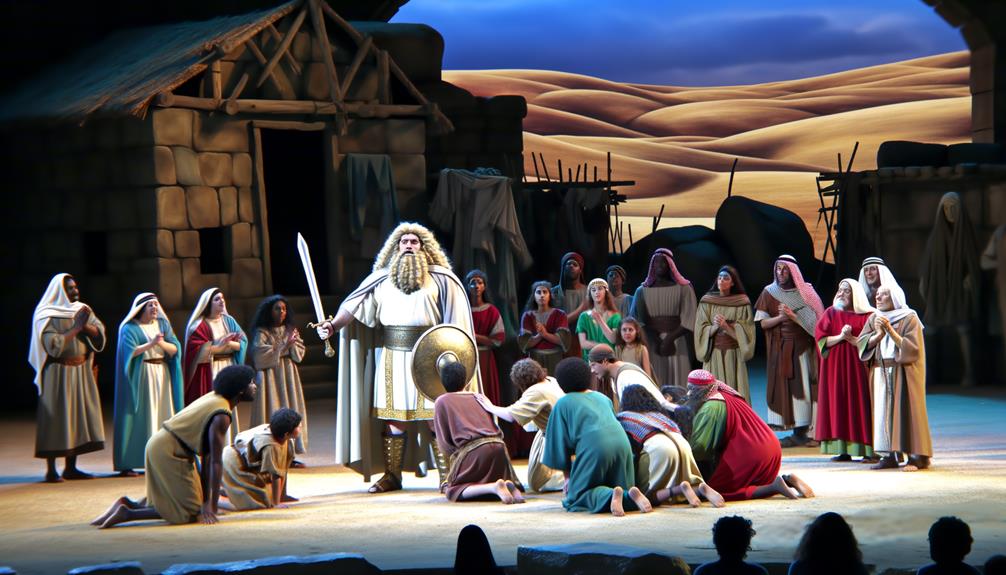
The Book of Judges presents a series of leaders raised by God to deliver Israel from cycles of oppression and idolatry.
These judges, such as Deborah and Gideon, acted as saviours, embodying divine intervention through acts of deliverance as described in Judges 2:16.
Their roles were pivotal in maintaining a covenantal relationship between Israel and Yahweh, signifying God’s unwavering commitment to His people.
Role of Judges
Frequently, the Book of Judges portrays the judges not merely as legal arbiters, but as divinely appointed saviours who deliver Israel from oppression and restore covenantal faithfulness. These figures serve multifaceted roles that extend beyond judicial decision-making, encompassing military leadership, spiritual guidance, and societal reform.
- Military Leadership: Judges like Deborah (Judges 4) and Gideon (Judges 6-7) led Israel to military victories, serving as instruments of divine intervention.
- Spiritual Guidance: Figures such as Samuel (1 Samuel 7) admonished Israel to abandon idolatry and return to Yahweh.
- Societal Reform: Judges often acted to reestablish justice and order, as seen in the actions of Jephthah (Judges 11).
This multifaceted role underscores their importance in maintaining Israel’s faithfulness to the covenant.
Deliverance From Oppression
Throughout the Book of Judges, individual judges emerge as divinely sanctioned deliverers who rescue Israel from cycles of oppression, as exemplified by Othniel’s conquest over Cushan-Rishathaim (Judges 3:9-10). These judges, appointed by God, functioned as instruments of divine intervention, providing both military and spiritual leadership. Their actions underscore the theological theme of divine deliverance in times of national distress. The cyclical pattern of Israel’s disobedience, oppression, repentance, and deliverance highlights God’s enduring mercy and faithfulness.
| Judge | Oppressor | Scriptural Reference |
|---|---|---|
| Othniel | Cushan-Rishathaim | Judges 3:9-10 |
| Ehud | Eglon | Judges 3:15-30 |
| Deborah | Jabin and Sisera | Judges 4:4-24 |
Through these narratives, the Book of Judges illustrates God’s salvific power.
Prophecies of a Messiah

Numerous Old covenant scriptures foretell the coming of a Messiah who would deliver and redeem Israel, serving as the ultimate saviour for humanity.
Prophecies regarding this awaited figure are woven throughout the Hebrew Bible, providing profound theological insight and hope.
Key examples include:
- Isaiah 53:5: ‘But he was pierced for our transgressions, he was crushed for our iniquities; the punishment that brought us peace was on him, and by his wounds we are healed.’
- Micah 5:2: ‘But you, Bethlehem Ephrathah… out of you will come for me one who will be ruler over Israel.’
- Jeremiah 23:5: ‘The days are coming… when I will raise up for David a righteous Branch… he will reign wisely.’
These scriptures collectively underscore the anticipation of a divinely appointed saviour.
Jesus Christ: The Ultimate Saviour

In the New Covenant, Jesus Christ is portrayed as the ultimate Saviour, fulfilling Old Covenant prophecies and bringing redemption through His sacrificial death on the cross (Isaiah 53:5; John 3:16).
His atonement provides the promise of salvation to all who believe, encapsulating the essence of divine grace and mercy (Ephesians 2:8-9).
This pivotal role underscores the theological premise that salvation is not attained through human effort but through faith in Christ’s redemptive work (Romans 3:24-25).
Redemption Through Sacrifice
Central to Christian theology is the belief that Jesus Christ, through His sacrificial death and resurrection, accomplished the redemption of humanity, as evidenced in scriptures such as John 3:16 and Romans 5:8. This foundational doctrine posits that:
- Atonement for Sin: Christ’s death serves as the ultimate atonement, reconciling humanity with God (Hebrews 9:12).
- Fulfillment of Prophecy: His sacrifice fulfills Old Covenant prophecies concerning the Messiah (Isaiah 53:5).
- Victory Over Death: The resurrection signifies victory over sin and death, offering believers eternal life (1 Corinthians 15:55-57).
These scriptural insights emphasize the depth of Christ’s sacrificial love and the transformative power of His redemptive act, underscoring His role as the ultimate Saviour.
Promise of Salvation
The promise of salvation through Jesus Christ stands as a cornerstone of Christian faith, rooted in the assurance of eternal life and reconciliation with God as articulated in passages such as John 14:6 and Acts 4:12.
Jesus proclaims, ‘I am the way, the truth, and the life. No one comes to the Father except through me’ (John 14:6), underscoring His exclusive role as the mediator between humanity and God.
Acts 4:12 further emphasizes this promise: ‘Salvation is found in no one else, for there is no other name under heaven given to mankind by which we must be saved.’
These scriptures collectively affirm Jesus as the ultimate Saviour, embodying God’s redemptive plan for humankind.
Qualities of a Biblical Saviour

A Biblical saviour epitomizes divine compassion, unwavering faithfulness, and ultimate sacrificial love, as exemplified in scriptures such as Isaiah 53 and John 3:16. These qualities form the cornerstone of the saviour’s role in Biblical theology.
Divine Compassion: Demonstrated through acts of healing and forgiveness, a saviour’s compassion reflects God’s mercy (Matthew 9:36).
Unwavering Faithfulness: The saviour remains steadfast in fulfilling God’s promises, as seen in the covenantal assurance provided in Hebrews 10:23.
Ultimate Sacrificial Love: Embodied supremely in Jesus Christ’s atonement, this love is captured poignantly in John 15:13, ‘Greater love has no one than this: to lay down one’s life for one’s friends.’
These elements collectively underscore the profound nature of a Biblical saviour.
Symbolic Acts of Deliverance

Illustrating God’s intervention and salvation, symbolic acts of deliverance in the Bible often serve to reveal deeper spiritual truths, such as the parting of the Red Sea in Exodus 14:21-22. This miraculous event not only signifies physical liberation from Egyptian bondage but also prefigures spiritual deliverance.
Similarly, the crossing of the Jordan River in Joshua 3:14-17 symbolizes the shift from wilderness wandering to entering the Promised Land, representing a passage from death to new life.
These acts are rich in typology, offering profound theological insights into God’s sovereignty and redemptive power. They underscore the recurring biblical theme that salvation is both a historical and spiritual reality, orchestrated by divine intervention to fulfill God’s covenant promises.
Salvation in the New Testament
Salvation in the New Covenant is profoundly encapsulated in the person and work of Jesus Christ, as evidenced by key scriptural passages such as John 3:16 and Romans 10:9-10. The New Testament presents salvation as a transformative experience, grounded in faith and confession.
Key elements include:
- Justification by Faith: Romans 5:1 underscores that believers are justified through faith, granting peace with God.
- Redemption through Christ: Ephesians 1:7 highlights that redemption and forgiveness of sins are achieved through Christ’s sacrifice.
- Eternal Life: John 3:16 promises eternal life to those who believe in Jesus, signifying a new spiritual birth.
These elements collectively illuminate the all-encompassing nature of salvation in the New Testament.
Saviours in the Psalms

The Psalms frequently portray God as the ultimate Saviour, offering a rich tapestry of divine intervention and deliverance amidst human adversity.
Psalms 18:2 refers to God as ‘my rock, my fortress, and my deliverer,’ emphasizing His role as a protector.
Psalm 34:17 asserts, ‘The righteous cry out, and the Lord hears them; he delivers them from all their troubles,’ highlighting God’s responsiveness to human suffering.
Additionally, Psalm 46:1 declares, ‘God is our refuge and strength, an ever-present help in trouble,’ illustrating His continual presence as a source of salvation.
These verses collectively underscore that in the Psalms, God is consistently depicted as a steadfast Saviour, providing solace and rescue in times of distress.
The Divine Plan of Redemption

In the biblical narrative, the divine plan of redemption unfolds as a meticulously orchestrated framework, wherein God intervenes in human history to restore creation through covenantal promises and the ultimate sacrifice of Jesus Christ. This salvific plan is deeply embedded in Scripture, revealing God’s unwavering commitment to humanity.
Key elements include:
- Covenantal Promises: Initiated with Abraham (Genesis 12:1-3), reaffirmed with David (2 Samuel 7:12-16), and fulfilled in Christ (Matthew 1:1).
- Prophetic Foretelling: Prophets like Isaiah (Isaiah 53) and Jeremiah (Jeremiah 31:31-34) foretold the coming of a Redeemer.
- Christ’s Sacrifice: The culmination of redemption is found in Jesus’ atoning death and resurrection (John 3:16, Romans 5:8).
This divine schema underscores God’s redemptive love and faithfulness.
Conclusion
The concept of a saviour in the Bible evolves from Old Covenant figures like Moses and the Judges, who acted as deliverers, to the prophetic anticipation of a Messiah.
This trajectory finds its culmination in Jesus Christ, regarded as the ultimate Saviour in the New Covenant.
The Psalms and other scriptures affirm this divine plan of redemption, emphasizing a consistent theological theme of salvation.
This progression underscores the unified narrative of divine deliverance throughout biblical texts.