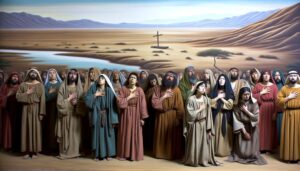
Meaning of Time in the Bible: Divine Seasons
The concept of time in the Bible is both complex and rich in theological significance. From the Creation narrative in Genesis, where God establishes a temporal framework, to prophetic timeframes like Daniel’s seventy weeks, Scripture portrays time as a divine construct key to understanding God’s purposes.
The Old Covenant situates time within covenants and liturgical practices, while the New Covenant emphasizes ethical urgency and eternal life through Christ. Jesus’ teachings, replete with visions of temporal and eternal realities, further explore its depth.
Exploring these layers reveals a divine tapestry where time intricately reflects God’s engagement with humanity’s spiritual journey.

Key Takeaways
- Time is a divine construct, established during creation to structure existence and emphasize sacred rhythms.
- Prophetic timeframes in the Bible convey visions of future events, divine interventions, and moral imperatives.
- Jesus’ teachings highlight the transient nature of life and the promise of eternal existence, urging spiritual readiness.
- New Testament perspectives emphasize ethical living and the transformative power of divine grace within the believer’s journey.
Creation and Time in Genesis

In the Book of Genesis, the concept of time is intricately woven into the narrative of creation, where God delineates the structure of days and nights to establish the temporal framework of the universe.
This divine orchestration marks the rhythm of existence, beginning with ‘Let there be light‘ (Genesis 1:3), which initiates the first day. The sequential ordering of six days of creation, followed by a day of rest, underscores the sanctity and cyclical nature of time.
Each ‘day’ in the Hebrew text, termed ‘yom,’ signifies a period defined by divine activity and purpose. The creation narrative not only offers a chronological account but also imbues time with theological significance, portraying it as a divine construct integral to the cosmos.
Time in the Old Testament

The Old Scriptures present time as a multifaceted concept, interweaving divine chronology with human history to convey theological truths and covenantal themes. The Hebrew Bible employs various terms and narratives to articulate this complex relationship, often emphasizing:
Covenantal Time: God’s promises unfold through specific temporal markers, such as the ‘seventy weeks’ in Daniel.
Liturgical Time: Festivals and Sabbaths punctuate the Israelite calendar, reflecting sacred rhythms.
Historical Epochs: Divisions of time, like the eras of the Patriarchs, Judges, and Kings, structure Israel’s narrative.
Eschatological Time: Forward-looking dimensions, such as the ‘Day of the Lord,’ underscore future divine interventions.
These elements collectively illustrate a theological tapestry where time is imbued with divine purpose and reveals God’s ongoing engagement with humanity.
Prophetic Timeframes

Articulating visions of future events, prophetic timeframes in the Bible serve as essential instruments for conveying divine revelations and impending judgments. These timeframes often encapsulate both immediate and eschatological implications, as seen in the prophecies of Daniel and Revelation.
Daniel’s seventy weeks (Daniel 9:24-27) and John’s depiction of the thousand-year reign (Revelation 20:1-6) illustrate the intricate weaving of temporal markers with divine purposes. Historical context reveals that such timeframes were not merely chronological but symbolized broader theological truths and moral imperatives.
Through meticulous scriptural analysis, one can discern that prophetic timeframes offer a profound linkage between divine foreknowledge and human history, providing believers with both warnings and hope for the future.
Jesus and the Concept of Time

In examining Jesus’ teachings, one discovers a profound interplay between temporal existence and the promise of eternal life.
His parables and sermons frequently emphasize the transient nature of earthly life while pointing towards an everlasting kingdom.
This dual focus not only underscores the urgency of spiritual readiness but also illuminates the eternal dimension inherent in his message.
Jesus’ Timeless Teachings
Jesus’ teachings transcend temporal boundaries, illuminating eternal truths that resonate through all eras and cultures. His messages emphasize principles that are not confined to the constraints of time:
- Love and Compassion: Jesus’ call to love one another (John 13:34) remains a universal directive.
- Forgiveness: His instruction to forgive ‘seventy times seven’ (Matthew 18:22) underscores an infinite grace.
- Humility and Service: The example of washing the disciples’ feet (John 13:14-15) establishes a timeless model of servant leadership.
These teachings, deeply rooted in scriptural context, reflect a continuity that transcends historical epochs and cultural variations, offering perennial wisdom and guidance.
Eternal Life Promises
The promise of eternal life, as articulated by Jesus, fundamentally redefines the human experience of time and existence.
In John 3:16, Jesus proclaims, “For God so loved the world, that he gave his only Son, that whoever believes in him should not perish but have eternal life.” This promise transcends temporal limitations, offering believers a continuity of life beyond physical death.
Theologically, it signifies not just unending duration but a quality of life in communion with God. Historically, this teaching provided profound hope and purpose, particularly in early Christian communities facing persecution.
Scripturally, it aligns with the eschatological vision in Revelation, where time culminates in an eternal, divine fellowship. Consequently, Jesus’ promise reshapes temporal existence into a divine continuum.
Time in Parables
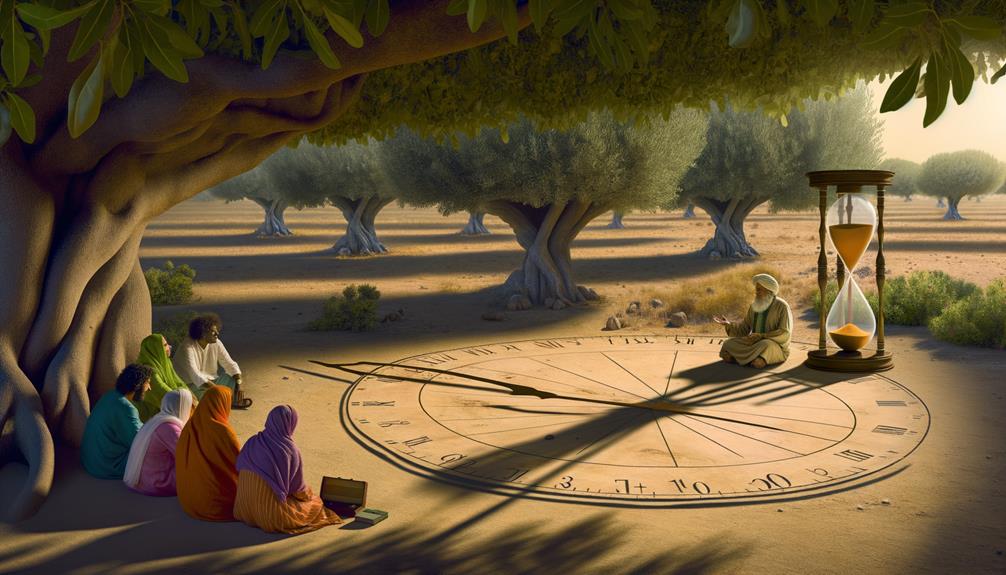
Frequently, the parables of Jesus employ the concept of time as a profound theological instrument to convey spiritual truths and eschatological themes.
Jesus often uses time to underscore the urgency and imminence of God’s kingdom, illustrating the necessity of readiness and vigilant living.
Consider the following parables:
- The Ten Virgins (Matthew 25:1-13): Emphasizes preparedness and the unpredictability of Christ’s return.
- The Fig Tree (Luke 21:29-31): Symbolizes the signs of the times, urging discernment.
- The Workers in the Vineyard (Matthew 20:1-16): Highlights divine grace irrespective of human concepts of time and merit.
These parables leverage temporal elements to illuminate divine truths, urging listeners towards spiritual vigilance.
New Testament Perspectives

Building upon the profound use of time in Jesus’ parables, New Scripture writings further expand on temporal themes by intertwining them with concepts of salvation history, eschatology, and ethical living. The New Covenant writers present time as a divine gift, emphasizing the critical juncture of Christ’s incarnation and the awaiting of His return. Key passages highlight the urgency of ethical conduct, the immediacy of divine grace, and the forward-looking hope of redemption.
| Concept | Scriptural Reference |
|---|---|
| Salvation History | Galatians 4:4 |
| Ethical Living | Ephesians 5:15-16 |
| Divine Grace | Titus 2:11-12 |
| Redemption Hope | Romans 13:11-12 |
This theological framework underscores the transformative power of time in the believer’s journey.
Eschatology and Eternal Time

In eschatological discourse, the concept of eternal time is pivotal, as it transcends earthly temporal constraints to reflect the divine nature of God’s plan for ultimate redemption and final judgment. This theological framework is deeply rooted in scriptural texts, offering profound insights into the intersection of divine omnipotence and human destiny.
Key elements include:
- Resurrection of the Dead: Scriptural promises of life beyond physical death.
- Final Judgment: The ultimate divine verdict upon humanity.
- New Heaven and New Earth: A renewed creation free from sin and suffering.
These aspects underscore the transformative power of divine time, inviting believers to reflect on their spiritual journey within the broader, eternal narrative orchestrated by God.
Conclusion
In the biblical narrative, time serves as both a vessel and an anchor, weaving through creation, prophecy, and parable to reveal divine orchestration.
Like the threads of a tapestry, each moment is imbued with purpose, connecting the temporal with the eternal.
Through the lens of scripture, time is not merely chronological but theological, where beginning and end converge in the promise of eschatological fulfillment.
Consequently, time in the Bible is a sacred continuum, echoing the divine heartbeat.