
Meaning of Valley in the Bible: Trials and Renewal
In the Bible, valleys symbolize trials, spiritual growth, and divine encounters. They serve as places of testing and transformation, as seen in the Valley of Elah where David triumphed over Goliath by faith (1 Samuel 17), and the Valley of Dry Bones where God resurrected Israel from despair (Ezekiel 37).
Valleys such as Achor highlight repentance and hope (Joshua 7; Hosea 2:15). Psalm 23:4 portrays the valley as a place of divine comfort amidst adversity.
These valleys hold rich theological and historical significance, presenting profound insights into faith and divine interaction. Commence further for a deeper understanding.

Key Takeaways
- Valleys in the Bible often symbolize trials, spiritual growth, and divine encounters.
- The Valley of Elah represents faith triumphing over fear, as seen in David’s victory over Goliath.
- The Valley of Dry Bones in Ezekiel 37 signifies resurrection, restoration, and the Holy Spirit’s revitalizing power.
- Valleys like Achor illustrate moments of divine testing, judgment, and subsequent hope and repentance.
Symbolism of Valleys

In the Bible, valleys often symbolize periods of trial, humility, and spiritual growth, providing a profound theological insight into the human experience.
The ‘Valley of the Shadow of Death’ in Psalm 23:4 exemplifies this symbolism, depicting a journey through profound adversity where God’s presence brings comfort.
Historically, valleys were places of battles and encounters, as seen in the Valley of Achor (Joshua 7:24-26), which signifies trouble and later hope.
Valleys also represent moments of reflection and divine encounter, as illustrated by the Valley of Vision (Isaiah 22:1-5), where spiritual blindness and revelation coexist.
These scriptural references enrich our understanding, demonstrating that valleys are not just physical landscapes but significant spiritual metaphors in biblical narrative.
Valley of Elah
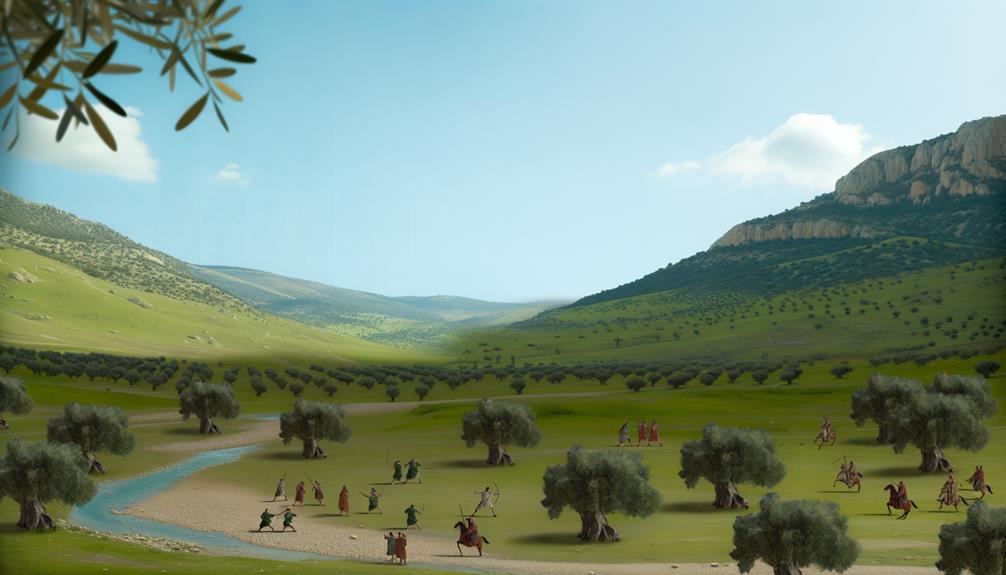
The Valley of Elah holds significant historical and theological importance, most prominently as the site of the biblical confrontation between David and Goliath detailed in 1 Samuel 17.
This valley, situated between the Judaean and Philistine territories, served as a strategic battleground. The encounter epitomizes divine intervention, showcasing how faith and divine support can empower the seemingly weak to overcome formidable adversaries.
David’s victory, achieved through his trust in God rather than conventional weaponry, underscores the biblical theme of God’s sovereignty and power.
Theologically, the Valley of Elah symbolizes the triumph of faith over fear, reinforcing the scriptural belief that God’s providence guides and protects those who trust in Him.
Valley of Dry Bones

Shifting from the historical battlefield of the Valley of Elah to a prophetic vision, the Valley of Dry Bones in Ezekiel 37 presents a powerful image of resurrection and divine restoration. This vision, given to the prophet Ezekiel during the Babylonian exile, symbolizes the revival of Israel from a state of national death to renewed life through God’s intervention.
Theologically, this passage emphasizes God’s sovereignty and power to breathe life into the spiritually and physically desolate.
- Scattered bones: Representing the dismembered and hopeless state of Israel.
- Divine breath: Symbolizing the Holy Spirit’s power to revive and restore.
Scripturally, Ezekiel 37:1-14 offers profound insight into God’s promise of renewal and hope for His people.
Valleys as Places of Testing

Many biblical valleys serve as symbolic landscapes where both individuals and nations undergo trials that test their faith and character.
The Valley of Elah, for instance, is renowned as the site where David confronted Goliath, a trial that tested not only David’s bravery but also his reliance on God (1 Samuel 17).
Similarly, the Valley of Achor became a place of judgment and repentance for Israel after Achan’s sin (Joshua 7).
These valleys encapsulate moments of divine testing, where the faithful are purified and their devotion to God is affirmed.
Through these trials, the biblical narrative emphasizes the importance of steadfast faith and obedience in the face of adversity, underscoring the valleys as crucibles of spiritual integrity.
Spiritual Growth in Valleys

In addition to serving as arenas of testing, biblical valleys also function as profound settings for spiritual growth and transformation.
Valleys in scripture often symbolize the soul’s journey through trials that lead to deeper faith and reliance on God. For instance, Psalm 23:4 describes walking ‘through the valley of the shadow of death’ but fearing no evil due to God’s presence, highlighting spiritual resilience.
- Valley of Elah: Where David’s faith triumphed over Goliath, symbolizing divine strength in adversity.
- Valley of Achor: Known as a ‘door of hope’ in Hosea 2:15, illustrating redemption and new beginnings.
These valleys illustrate spiritual growth through divine intervention and unwavering faith.
Conclusion
Valleys in the Bible serve as profound symbols, embodying both desolation and divine encounters.
From the Valley of Elah’s battlefield to the resurrection imagery in the Valley of Dry Bones, these lowlands are crucibles where faith is tested and spiritual renewal is forged.
Each valley, with its unique narrative, weaves a tapestry of human struggle and divine intervention, offering a fertile ground for theological reflection and deeper scriptural understanding.
Consequently, valleys stand as emblematic landscapes of both trial and transcendence.