
Black Horse Meaning in Bible: Famine and Judgment
In the Bible, the black horse, one of the Four Horsemen of the Apocalypse described in Revelation 6:5-6, symbolizes profound economic hardship and societal distress. The rider, holding a pair of scales, signifies famine and scarcity, reflecting a precarious balance of essential resources during crises.
This imagery underscores the severe deprivation that follows conflict, illustrating the broader impacts of divine judgment on civilization. The black horse serves as a metaphor for pervasive deprivation, inviting an introspective look at societal values and priorities.
A deeper understanding of this symbolism provides critical insights into apocalyptic themes and their implications.

Key Takeaways
- The black horse in the Bible symbolizes famine and economic hardship, as depicted in Revelation 6:5-6.
- The rider of the black horse holds scales, indicating scarcity and inflated prices for essential goods.
- The black horse represents societal distress and the precarious balance of resources during crises.
- It emphasizes divine judgment and the severe consequences of human actions, leading to widespread deprivation.
The Four Horsemen Overview
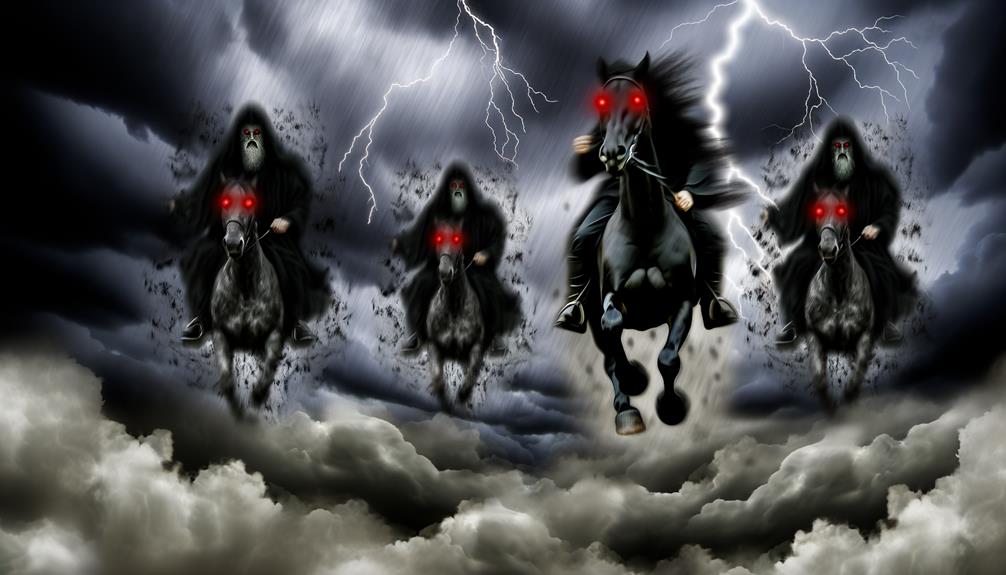
As part of the apocalyptic vision described in the Book of Revelation, the Four Horsemen serve as harbingers of divine judgment, each symbolizing a distinct form of catastrophe. These figures appear in Revelation 6:1-8, released upon breaking the first four of the seven seals.
They are traditionally interpreted as embodiments of conquest, war, famine, and death. The first horseman rides a white horse, often associated with conquest or pestilence. The second, on a red horse, represents war and bloodshed. The third, astride a black horse, signifies famine and economic disparity.
Symbolism in Revelation
The Book of Revelation’s depiction of the Black Horse under the Third Seal encompasses rich symbolism related to economic hardship and societal distress.
This imagery is often interpreted as representing famine and scarcity, where the rider’s scales signify the precarious balance of resources during times of crisis.
Such interpretations suggest a broader theological and historical context, underscoring the profound impact of divine judgment on human civilization.
The Third Seal
In the Book of Revelation, the opening of the Third Seal reveals a black horse, symbolizing economic hardship and famine. This vision, described in Revelation 6:5-6, portrays a rider holding scales, indicating a period of scarcity and inflated prices.
The imagery of the black horse and its rider underscores the severity of deprivation that follows wars and conflicts, resonating with historical contexts where such calamities often ensue. The scales, an emblem of commerce, suggest a disruption in equitable distribution of resources.
This symbolism is deeply rooted in the prophetic tradition, emphasizing the divine orchestration of judgment and the inevitable consequences of human actions. Understanding this vision requires contextual analysis within the broader narrative of Revelation’s apocalyptic revelations.
Economic Hardship Symbolism
Examining the black horse’s symbolism within Revelation reveals a profound depiction of economic hardship, reflecting the broader themes of scarcity and imbalance that permeate apocalyptic literature. This imagery is central to understanding the societal impacts of such adversity. The black horse, ridden by a figure holding scales, symbolizes a period where essential commodities become luxuries, highlighting economic disparities. This metaphor extends beyond mere famine, touching upon the ethical and moral consequences of inequitable distribution.
| Symbol | Interpretation | Biblical Reference |
|---|---|---|
| Black Horse | Economic Hardship | Revelation 6:5-6 |
| Scales | Measure and Inequality | Leviticus 19:35-36 |
| Rider | Harbinger of Despair | Revelation 6:5 |
These elements collectively underscore the severe economic distress illustrated in Revelation.
Famine and Scarcity
Revelation’s depiction of famine and scarcity, embodied by the black horse, serves as a poignant metaphor for the pervasive deprivation that characterizes apocalyptic prophecy. This vision is wrought with profound implications that resonate deeply within the human psyche.
The imagery of the black horse emphasizes not just physical hunger, but also a broader societal collapse. The rider, holding a pair of scales, symbolizes the dire economic measures and rationing that accompany such crises.
Key emotional triggers include:
- Desperation: The struggle for basic sustenance becomes a daily ordeal.
- Inequality: The rich remain unaffected while the poor suffer.
- Desolation: Communities face barren landscapes devoid of resources.
- Despair: Hope diminishes as survival becomes uncertain.
Understanding this symbolism provides insight into the stark warnings of Revelation.
Black Horse in Scripture

The black horse in Scripture, particularly in the Book of Revelation, carries profound symbolic weight, representing scarcity and economic hardship through its association with scales.
This imagery invites an in-depth interpretation within the broader theological and historical context of the Bible.
Symbolism and Interpretation
Within the context of biblical scripture, the black horse is often interpreted as a harbinger of economic disparity and famine, reflecting deeper themes of judgment and moral reckoning. This symbolism is multi-faceted, evoking a range of emotions and insights:
- Economic Hardship: The black horse signifies a time of scarcity, where basic necessities become luxuries.
- Divine Judgment: It serves as a reminder of the consequences of human actions and divine retribution.
- Moral Reflection: The black horse prompts introspection on societal values and priorities.
- Hope in Adversity: Despite its ominous presence, it also encourages faith and resilience in the face of trials.
Such interpretations enrich our understanding, urging readers to contemplate the profound implications of this biblical symbol.
Biblical References and Context
Positioned within the apocalyptic narrative of the Book of Revelation, the black horse emerges as a profound symbol laden with significant theological and eschatological implications.
Specifically, Revelation 6:5-6 depicts the black horse and its rider holding a pair of scales, heralding a period of severe economic distress and famine. The scales symbolize the meticulous measurement and scarcity of resources, reinforcing the themes of judgment and divine retribution.
Further, the pronouncement, ‘A quart of wheat for a denarius,’ underscores the dire economic conditions, where basic sustenance becomes prohibitively costly.
This vivid imagery not only conveys a historical context of hardship but also serves as a forewarning of future tribulations, thereby enriching the reader’s understanding of scriptural prophecy.
Historical Context
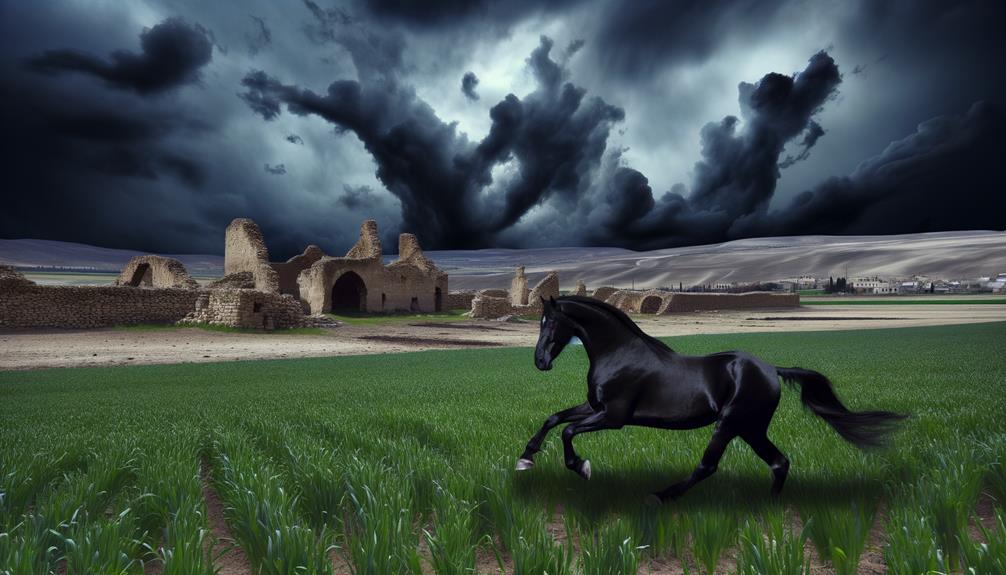
Examining the historical context surrounding the symbolism of the black horse in the Bible reveals its roots in ancient socio-economic conditions and prophetic literature. The imagery of the black horse, particularly in the Book of Revelation, is deeply intertwined with the societal realities and anxieties of early Christian communities.
The symbolism can be understood through:
- Economic Hardship: Reflecting periods of scarcity and oppression.
- Prophetic Writings: Drawing from Old Scriptures prophecies that conveyed divine judgment.
- Cultural Significance: Resonating with contemporary symbols of turmoil and adversity.
- Historical Events: Mirroring real historical crises that shaped collective memory.
These factors collectively illuminate the profound significance the black horse held for its original audience, embodying their struggles and divine expectations.
Associations With Famine

The depiction of the black horse in the Book of Revelation is inextricably linked to themes of famine and scarcity, reflecting a period of profound economic distress and societal upheaval.
In Revelation 6:5-6, the rider of the black horse holds a pair of scales, symbolizing the rationing of food amidst severe shortages. The passage specifies exorbitant prices for staple foods such as wheat and barley, indicating that essentials become luxuries in times of famine. This imagery evokes historical instances where scarcity resulted in inflated prices and widespread suffering.
Theologically, the black horse serves as a divine warning of the consequences of human actions, urging introspection and repentance in the face of potential divine judgment.
Economic Hardship Symbol
Building upon the association of the black horse with famine, this symbol extends to a broader representation of economic hardship, encapsulating the dire consequences of scarcity on societal structures and individual livelihoods.
The black horse signifies not just the absence of food, but the collapse of economic stability and the resulting human suffering. This is evident in:
- Widespread poverty – Families struggling to meet basic needs.
- Inflation – Drastic increases in the cost of essential goods.
- Unemployment – Loss of jobs leading to financial insecurity.
- Social unrest – Increased tension and conflict within communities.
In this context, the black horse serves as a poignant reminder of the profound vulnerability experienced during times of economic crisis, emphasizing the need for resilience and compassion.
Themes of Scarcity

Permeating the biblical narrative, themes of scarcity reveal the stark realities of human existence in the face of limited resources and the ensuing struggle for survival. The image of the black horse, as depicted in Revelation 6:5-6, symbolizes famine and economic distress, underscoring the dire consequences of scarcity. This horse’s rider, holding scales, emphasizes the meticulous measurement and rationing of food, reflecting a world where sustenance is precious and precarious. These themes are echoed throughout the Bible, offering a poignant reminder of the fragility of life and the dependence on divine providence.
| Theme | Biblical Reference |
|---|---|
| Famine | Genesis 41:30-31 |
| Economic Hardship | Revelation 6:5-6 |
| Dependence on God | Matthew 6:25-34 |
Justice and Retribution

Examining the symbolism of the black horse within the context of biblical justice and retribution reveals a profound connection between divine judgment and the moral order of the universe.
In the Book of Revelation, the black horse is often associated with scales, symbolizing the weighing of actions and the dispensing of justice. This imagery evokes a sense of:
- Inevitability: Divine justice is inescapable.
- Accountability: Each person’s deeds are meticulously evaluated.
- Equity: Punishments and rewards are meted out fairly.
- Sobriety: The serious consequences of moral failings.
These elements underscore the biblical belief that justice is not arbitrary but a fundamental aspect of God’s governance, ensuring that righteousness prevails and wrongdoings do not go unpunished.
Conclusion
In the biblical narrative, the black horse emerges as a harbinger of famine and economic hardship, painting a stark picture of scarcity and divine retribution.
Symbolizing the scales of justice, this figure underscores the inextricable link between human actions and their consequences.
The imagery of the black horse galloping through the annals of Revelation serves as a grim reminder of the cyclical nature of justice and the pervasive impact of moral and economic imbalance.