Blood in the Bible Meaning: Covenant and Redemption
In the Bible, blood is a potent symbol of life, atonement, and covenant. In the Old Scripture, blood sacrifices such as burnt and sin offerings (Leviticus) underscore the seriousness of sin and the need for purification.
The Passover lamb’s blood marks divine protection and covenant commitment (Exodus). Blood rituals in Israelite worship highlight life’s sacredness (Leviticus 17:11).
In the New Scripture, Jesus’ blood inaugurates a new covenant, offering redemption and unifying believers through the Eucharist. Prophets link blood to judgment and salvation, enriching its theological depth and historical resonance.
To fully grasp this, one must explore further facets of biblical narratives.

Key Takeaways
- Blood symbolizes atonement and purification, reflecting the gravity of sin and the necessity of a covenant relationship with God.
- The Passover lamb’s blood marks divine protection and foreshadows Jesus Christ’s redemptive sacrifice in the New Covenant.
- Jesus’ blood offers justification and righteousness through faith, contrasting with the repeated animal sacrifices of the Old Testament.
- The Eucharist represents Jesus’ blood, fostering unity among believers and commemorating His ultimate sacrifice.
Old Testament Sacrifices

The practice of blood sacrifices in the Old Scriptures serves as a foundational element of Israelite worship, symbolizing atonement, covenant relationships, and divine consecration.
Central to these rituals were offerings like the burnt offering (Leviticus 1), sin offering (Leviticus 4), and peace offering (Leviticus 3). Each type of sacrifice addressed different aspects of human-divine interaction, reflecting a theology deeply rooted in the concept of blood as life (Leviticus 17:11).
Historically, these sacrifices functioned within a structured priestly system, underscoring the gravity of sin and the necessity of purification. Theologically, they prefigured ultimate redemption, pointing to a future reconciliation between God and humanity.
Consequently, blood sacrifices were integral to Israel’s religious identity and spiritual praxis.
Passover and Blood

The significance of blood during Passover is rooted in the sacrificial lamb, whose blood marked the homes of the Israelites, signifying divine protection from the final plague in Egypt.
This act not only shielded them from death but also served as a profound symbol of the covenant between God and His people, epitomizing deliverance and the inauguration of a new spiritual and communal identity.
Consequently, the blood of the Passover lamb encapsulates themes of sacrifice, protection, and the foundational moment of Israel’s redemption.
Lamb’s Blood Significance
Integral to the theological and historical narrative of Passover, the sacrificial lamb’s blood symbolizes divine protection and covenantal faithfulness in the Hebrew Scriptures.
This act of marking doorposts with lamb’s blood, as described in Exodus 12:7, serves as a potent symbol of God’s deliverance from Egyptian bondage.
The lamb, without blemish, signifies purity and the necessity of an unblemished sacrifice to uphold the covenant.
Historically, this ritual underscores Israel’s obedience and trust in Yahweh’s redemptive promises.
Theologically, it prefigures the ultimate sacrificial act in Christian thought, linking the Old Covenant Passover lamb to the New Covenant’s portrayal of Jesus Christ as the Lamb of God.
Consequently, lamb’s blood weaves together themes of salvation, purity, and divine commitment.
Protection From Plagues
Marking a pivotal moment in the narrative of the Exodus, the application of lamb’s blood on the Israelites’ doorposts not only signified covenantal faithfulness but also served as a divine safeguard against the devastating plagues, particularly the death of the firstborn, as recounted in Exodus 12:12-13. This ritual established a profound theological framework where blood symbolizes both life and divine protection. The Lord’s passing over the marked homes underscored a divine selection and protection mechanism. Historically, this act was a turning point for the Israelites, emphasizing their unique relationship with God and their impending liberation from Egyptian bondage.
| Aspect | Description |
|---|---|
| Theological Symbol | Blood represents life and divine protection |
| Historical Context | Israelites in Egypt during the ten plagues |
| Scriptural Basis | Exodus 12:12-13 |
| Divine Action | Passing over marked homes, sparing the firstborn |
| Covenantal Significance | Signified Israel’s faithfulness and God’s protective promise |
Covenant and Deliverance
Frequently celebrated as a cornerstone of Jewish tradition, Passover encapsulates the covenantal relationship between God and the Israelites, epitomized through the sacrificial blood that facilitated their deliverance from Egyptian captivity.
This ritualistic use of blood, as instructed in Exodus 12:7, involved marking the doorposts with the blood of a lamb to signify divine protection.
Theologically, this act symbolizes the profound commitment of God to His people, reinforcing the covenant through a tangible, redemptive act.
Historically, it signifies the pivotal moment of liberation, where blood functioned as both a protective and a liberating force.
Consequently, the Passover underscores the dual themes of covenant and deliverance, intertwining divine promise with historical salvation through the symbolic power of blood.
Covenant Sealing

In the context of covenant sealing, blood serves as a profound symbol in biblical narratives, underpinning the gravity and sanctity of divine promises.
These rituals, evident in Old Covenant practices such as Abraham’s covenantal sacrificial acts, highlight blood’s role in binding agreements between God and humanity.
Understanding these historical practices offers insight into how blood functions as both a physical and spiritual seal, ensuring the fulfillment of divine commitments.
Symbolic Blood Rituals
Covenant sealing through symbolic blood rituals in the Bible represents a profound theological motif, deeply rooted in ancient Near Eastern customs and serving as a tangible manifestation of divine promises and relational commitments. These rituals encompass a spectrum of significant practices that underscore the sacredness of the covenants formed between God and humanity.
- Animal sacrifices: Often, animals were sacrificed to signify the seriousness of the covenant.
- Blood sprinkling: Blood was sprinkled on altars and participants to symbolize purification and commitment.
- Circumcision: As in Abraham’s covenant, this act marked a permanent physical reminder of divine promises.
- Passover: The lamb’s blood on doorposts protected Israelites, signifying deliverance and divine favor.
These rituals reflect the deep intertwining of theological and cultural elements in biblical covenantal traditions.
Divine Promises Confirmed
Building upon the significance of symbolic blood rituals, the confirmation of divine promises through covenant sealing underscores the irrevocable nature of God’s commitments to humanity.
In biblical theology, covenants sealed with blood represent a binding agreement between God and His people. The shedding of blood serves as a solemn guarantee that God’s promises will be fulfilled, demonstrating His unwavering faithfulness.
Historically, these covenants, such as those with Abraham and Moses, were pivotal in establishing a divine relationship and moral framework.
Theologically, the blood signifies life and sacrifice, reinforcing the sacredness and seriousness of the covenant.
Consequently, blood as a sealing agent in divine promises not only validates the covenant but also symbolizes the profound bond between the divine and the mortal.
Old Testament Practices
Ancient Israelite practices of covenant sealing frequently involved the ritualistic use of blood, symbolizing both the sanctity and the irrevocable nature of the agreements made between God and His people. This practice underscored the gravity and solemnity of divine covenants. For instance, in the Mosaic covenant, blood was sprinkled on both the altar and the people to signify mutual commitment.
Key elements of these rituals included:
- Sacrificial Offerings: Animals were sacrificed, and their blood was used as a binding agent.
- Altar Consecration: Blood was applied to altars, symbolizing purification and dedication.
- Covenant Renewal: Periodic ceremonies reaffirmed ongoing commitment through blood rites.
- Priestly Mediation: Priests played a central role in conducting these rituals.
Blood as Atonement
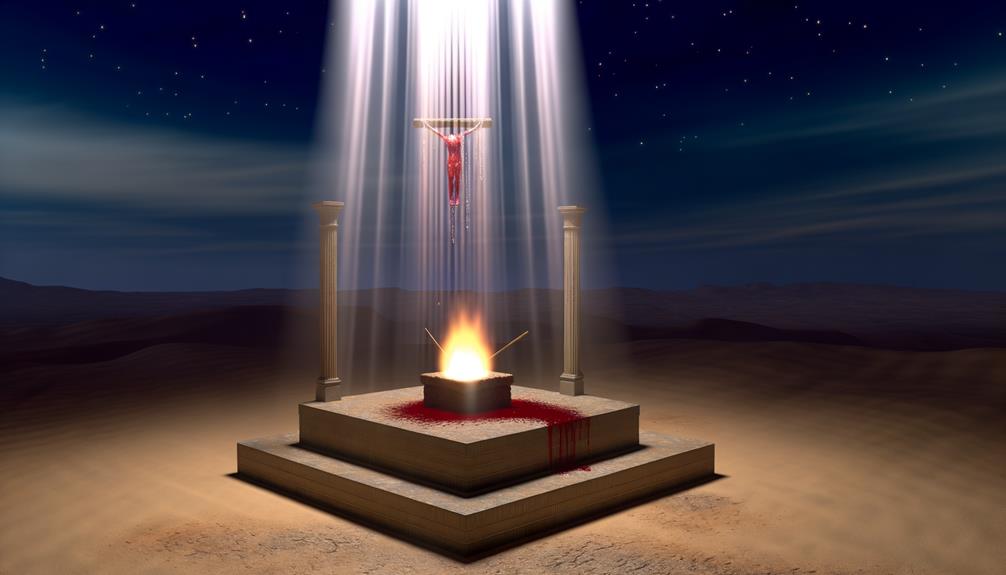
The concept of blood as atonement in the Bible intricately intertwines theological significance with historical sacrificial practices, underscoring its essential role in the reconciliation between humanity and the divine.
In the Old Covenant, the shedding of blood through animal sacrifices was deemed necessary to atone for sins, as vividly illustrated in Leviticus 17:11, which states, ‘For the life of the flesh is in the blood.’
This practice underscores a profound theological principle: the life force within the blood serves as a means of expiation, symbolizing the restoration of the covenantal relationship between God and His people.
Historically, these rituals were deeply embedded in Israelite worship, reflecting a sacred understanding that atonement required a life given in substitution for the sinner’s.
New Testament Significance

While the Old Covenant established the foundational role of blood in atonement, the New Scripture reinterprets and amplifies this concept through the sacrificial death of Jesus Christ, who is portrayed as the ultimate and final atonement for humanity’s sins. This theological shift highlights several key aspects:
New Covenant: Jesus’ blood inaugurates a new relationship between God and humanity.
Redemption: Christ’s sacrifice is seen as redeeming humanity from the bondage of sin.
Justification: Believers are justified, or made righteous, through faith in Jesus’ sacrificial blood.
Communion: The Eucharist symbolizes the sharing in Jesus’ blood, reinforcing communal and individual salvation.
Perpetual Efficacy: Unlike the repeated Old Scripture sacrifices, Jesus’ sacrifice is viewed as once and for all.
This reinterpretation underscores the transformative power of Christ’s atonement.
Blood of Jesus
Central to Christian theology, the blood of Jesus is perceived as the epitome of divine sacrifice and the fulcrum of the New Covenant, encompassing redemption, justification, and eternal salvation.
Historically contextualized, this belief stems from the crucifixion narrative where Jesus’ blood symbolizes atonement for humanity’s sins.
Biblically, Hebrews 9:22 asserts, ‘without the shedding of blood there is no forgiveness,’ underscoring its necessity in divine justice.
This notion is intricately woven into the fabric of early Christian doctrine, where the sacrificial blood is seen as a fulfillment of Old Scriptures prophecies and rituals.
Theologically, it signifies a transformative act that reconciles humanity with God, offering a pathway to spiritual regeneration and ultimate reconciliation.
This doctrine remains a cornerstone of Christian faith and practice.
Eucharistic Symbolism
Eucharistic symbolism in the Bible intricately intertwines with the themes of covenant and the New Agreement, prominently reflecting the sacrificial lamb imagery rooted in Jewish Passover traditions.
This symbolism underscores the theological significance of Jesus’ blood as a new covenant, establishing a profound unity among believers through the act of communion.
Historically, this sacrament has been a central tenet in Christian worship, embodying both remembrance and participation in the salvific sacrifice of Christ.
Covenant and New Testament
The symbolism of blood in the New Covenant is profoundly encapsulated in the concept of the Eucharist, representing the new covenant established through Christ’s sacrificial death. This sacred ritual, commemorating the Last Supper, integrates rich theological and historical dimensions:
- Covenantal Shift: The Eucharist marks the change from the Old Covenant, sealed with animal sacrifices, to the New Covenant in Christ’s blood.
- Redemptive Act: Christ’s blood signifies the ultimate sacrifice for humanity’s redemption.
- Communal Aspect: Participation in the Eucharist fosters a deep communal bond among believers.
- Divine Presence: The Eucharist symbolizes the real presence of Christ among his followers.
This elucidates the profound theological significance of the Eucharistic blood in the New Scriptures.
Sacrificial Lamb Imagery
Building on the Eucharist’s profound significance, the image of Christ as the sacrificial lamb emerges as a central theological motif that encapsulates the essence of divine sacrifice and redemption.
Historically, this symbolism is deeply rooted in Jewish Passover traditions, where a lamb’s blood signified deliverance from bondage in Egypt.
The New Covenant recontextualizes this imagery, presenting Jesus as the ultimate Passover lamb whose blood enables spiritual liberation from sin. This parallels the Eucharistic practice, where the bread and wine symbolize Christ’s body and blood, enacting a perpetual remembrance of his sacrificial act.
Consequently, the sacrificial lamb imagery intricately links Old Covenant rituals with New Covenant theology, highlighting the transformative power of Christ’s sacrifice in Christian faith.
Unity in Communion
In the act of Communion, the Eucharistic symbolism fosters a profound sense of unity among believers, intertwining theological depth with historical continuity. This ritual, rooted in the Last Supper, encapsulates the shared faith and communal bond within the Christian body.
Theologically, the Eucharist signifies Christ’s sacrificial blood, establishing a covenantal unity that transcends individualism.
- The Last Supper: Historical anchor for the Eucharistic practice.
- Covenantal Symbol: Represents the new covenant through Christ’s blood.
- Communal Participation: Unites the congregation in a singular act of worship.
- Liturgical Tradition: Maintains historical continuity across centuries.
This Eucharistic observance therefore becomes a living proof of the unity and continuity of the Christian faith.
Purification and Cleansing

Throughout biblical narratives, blood emerges as a profound symbol of purification and cleansing, intricately tied to ritual practices and theological doctrines.
Central to the Levitical system, blood sacrifices were mandated for atonement, signifying the removal of impurity and the restoration of holiness (Leviticus 16). The sprinkling of sacrificial blood on the altar and the tabernacle illustrated the cleansing of sin’s defilement (Hebrews 9:22).
Historically, these rites underscored a covenantal relationship where divine forgiveness was mediated through sacrificial blood. Theologically, it prefigured the ultimate sacrifice of Christ, whose blood, according to Christian doctrine, purifies believers from sin (1 John 1:7).
Consequently, blood’s purifying power is a cornerstone of biblical soteriology and ritual purity.
Life in the Blood

The biblical assertion that ‘the life of the flesh is in the blood’ (Leviticus 17:11) serves as a foundational principle underscoring the intrinsic value of blood in sustaining life and its sanctity within the theological and ritual framework of scripture.
This notion highlights blood’s essential role in:
- Sacrificial atonement: Blood offerings were central to Old Covenant sacrificial practices.
- Covenantal significance: Blood sealed covenants between God and His people.
- Ritual purity: Blood was used in rituals to purify and sanctify.
- Symbolism of life: Blood represented life itself, reinforcing its sacredness.
Theologically, these elements reflect the profound reverence and symbolic depth attributed to blood in biblical texts.
Prophetic Imagery

Prophetic imagery in the Bible frequently employs the motif of blood to convey themes of judgment, redemption, and divine intervention, offering a vivid and multifaceted symbol that intertwines with the broader narrative of salvation history. Blood in prophetic visions often signifies God’s judgment against sin, as seen in Isaiah’s portrayal of Edom’s destruction. Conversely, it symbolizes redemption through the suffering servant in Isaiah 53. Historical contexts bolster understanding, as these prophecies often correspond to specific events or divine promises.
| Theme | Scriptural Reference |
|---|---|
| Judgment | Isaiah 63:1-6 |
| Redemption | Isaiah 53:5 |
| Divine Wrath | Revelation 14:20 |
| Covenant Renewal | Zechariah 9:11 |
| Atonement | Hebrews 9:22 |
Such imagery deepens theological insights into God’s plans for humanity.
Conclusion
The multifaceted symbolism of blood in the Bible encapsulates its theological, historical, and sacrificial significance.
With over 400 references to blood in the scriptures, it is evident that blood functions as a vital element in covenants, atonement, and purification rituals.
The New Covenant reinterprets these motifs, especially through the Eucharist, underscoring the continuity and evolution of this powerful symbol.
This intricate tapestry of meanings highlights blood’s enduring role in the spiritual and communal life of biblical tradition.