
Contention Meaning in the Bible: Strife and Dispute
In biblical scripture, contention, captured by the Hebrew term ‘riv’ and the Greek term ‘eris’, signifies strife and disputes both in legal settings and personal relationships. Key passages like Proverbs 17:14 illustrate its destructive potential, while Romans 13:13 and James 4:1-2 caution against the divisiveness arising from strife and jealousy.
Old covenant narratives, such as Jacob and Esau’s rivalry, and New covenant exhortations, like 1 Corinthians 1:10-11, emphasize unity and divine justice. A deeper exploration of these themes illuminates the intricate balance of justice, reconciliation, and divine wisdom imbued within biblical teachings on contention.

Key Takeaways
- The Hebrew term ‘riv’ and Greek term ‘eris’ denote disputes and strife in the Bible.
- Proverbs 17:14 and Romans 13:13 warn against the destructive nature of contention.
- ‘Riv’ appears in legal and interpersonal conflicts, reflecting societal and judicial nuances.
- New Testament passages emphasize unity and avoiding divisions among believers.
Definitions and Contexts

In examining the concept of ‘contention‘ within the biblical canon, it is imperative to reflect on the original Hebrew and Greek terms, as well as their contextual applications in both the Old and New writings.
The Hebrew term ‘רִיב’ (riv) and the Greek term ‘ἔρις’ (eris) frequently denote disputes, strife, or quarrels.
For instance, Proverbs 17:14 cautions, ‘The beginning of strife is like letting out water,’ emphasizing the destructive potential of contention.
Similarly, in the New scriptures, Paul warns against ‘strife and jealousy’ in Romans 13:13, highlighting how contention disrupts communal harmony.
Understanding these terms within their scriptural contexts provides deeper insights into the theological implications and moral teachings surrounding human conflict and relational discord.
Old Testament Insights

In exploring the concept of contention within the Old Scriptures, one must first engage in a thorough analysis of the Hebrew terms such as ‘rib’ (רִיב), which frequently denote strife or dispute.
The historical context plays an essential role in understanding these terms, as the socio-political landscapes often influenced the nature of conflicts depicted in the writings.
Key biblical examples, such as the rivalry between Jacob and Esau (Genesis 25:22-34) and the disputes involving the Israelites and surrounding nations, provide profound insights into the pervasive nature of contention in ancient times.
Hebrew Word Analysis
The Hebrew term often translated as ‘contention‘ in the Old Scriptures is ‘רִיב’ (riv), which appears frequently in contexts of legal disputes and interpersonal conflicts.
This term is particularly found in Proverbs 17:14, ‘The beginning of strife is like letting out water; so abandon the quarrel before it breaks out,’ illustrating its use in denoting the onset of discord.
Additionally, ‘riv’ is employed in judicial settings, as seen in Isaiah 1:23, where corrupt leaders are chastised for their contentious behavior.
This word encompasses both the verbal and legal dimensions of conflict, demonstrating its multifaceted role in biblical narratives.
Understanding ‘riv’ provides a nuanced comprehension of how contention disrupts both personal relationships and societal harmony in the Old Covenant.
Historical Context Matters
Understanding the Hebrew word ‘riv’ within the broader historical and cultural context of the Old Scriptures reveals how contention shaped the judicial and social landscapes of ancient Israel.
The term ‘riv’ (רִיב) frequently appears in legal texts and prophetic literature, signifying disputes or legal cases (Deuteronomy 17:8).
In ancient Israel, resolving such disputes was vital to maintaining communal harmony and justice. Judges and elders would convene at city gates to adjudicate these contentions (Ruth 4:1-2), reflecting a society deeply invested in legal rectitude and covenantal fidelity.
Additionally, prophets often invoked ‘riv’ to articulate divine grievances against Israel’s infidelity (Micah 6:2), emphasizing contention’s role in divine-human relationships and covenantal discourse.
Consequently, ‘riv’ encapsulates multifaceted dimensions of ancient Israelite life.
Key Biblical Examples
Examining key biblical examples reveals how ‘riv’ functions not only as a term for dispute resolution but also as a profound theological motif illustrating divine justice and covenantal fidelity. In the Old Scriptures, ‘riv’ is employed to articulate significant confrontations and divine judgments.
- Isaiah 3:13-15: Here, God stands to ‘contend’ (riv) with the elders and princes of His people, showcasing His role as the ultimate judge who upholds justice against societal oppression.
- Micah 6:1-2: God initiates a ‘riv’ against Israel, calling the mountains and hills to witness His case, emphasizing the covenantal breach and divine expectations.
- Jeremiah 2:9: The Lord declares that He will ‘contend’ (riv) with Israel, emphasizing His unwavering commitment to covenantal fidelity despite Israel’s unfaithfulness.
These instances collectively underscore ‘riv’ as a central element in illustrating God’s engagement with His people.
New Testament Perspectives
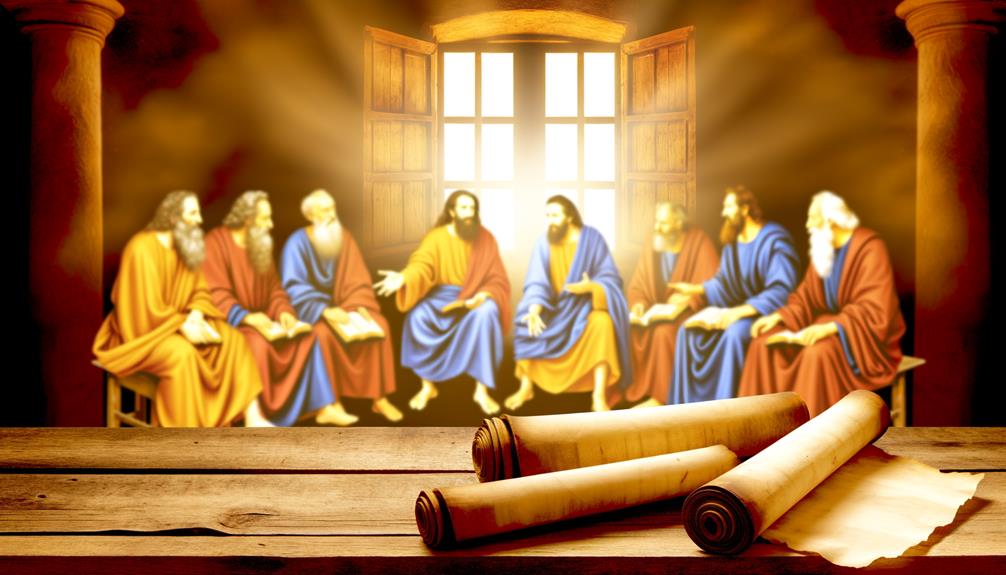
In the New Covenant, contention frequently emerges within the context of doctrinal disputes and community conflicts, underscoring its theological implications. The Apostle Paul addresses this in his epistles, particularly in 1 Corinthians 1:10-11, where he urges believers to avoid divisions. Similarly, James 4:1-2 identifies the root of quarrels as desires that battle within individuals. These scriptural insights highlight the importance of unity and the dangers of discord.
| Scripture Reference | Context | Key Message |
|---|---|---|
| 1 Corinthians 1:10 | Church Unity | Appeal for agreement and no divisions |
| James 4:1-2 | Community Conflicts | Conflicts arise from inner desires |
| Philippians 2:3-4 | Humility and Service | Encouragement to value others above self |
Understanding these passages helps illuminate the New Scripture’s stance on contention.
Spiritual Implications

The spiritual implications of contention in the Bible can be discerned through examining biblical conflict examples such as Cain and Abel (Genesis 4:1-16) and the disputes among the early Christians (1 Corinthians 1:10-13).
These instances illustrate divine methods for conflict resolution, emphasizing God’s call for reconciliation and peace (Matthew 5:9).
Additionally, they underscore the importance of faith and harmony within the community of believers, aligning with the scriptural mandate to ‘live in harmony with one another’ (Romans 12:16).
Biblical Conflict Examples
How do the spiritual implications of biblical conflicts, such as the strife between Cain and Abel or the discord between Saul and David, illuminate the deeper theological truths contained within Scripture? These narratives offer profound insights into human nature and divine expectations:
- Cain and Abel (Genesis 4:1-16): This conflict reveals the destructive power of envy and the consequences of disobedience to divine mandates.
- Saul and David (1 Samuel 18-31): Their discord underscores the perils of pride and the importance of humility and divine favor.
- Jacob and Esau (Genesis 25-33): The sibling rivalry illustrates themes of reconciliation and the sovereignty of God’s plan.
These stories highlight the necessity of aligning human actions with divine will, thereby underscoring the moral and spiritual lessons embedded in Scripture.
Divine Dispute Resolution
Divine dispute resolution within Scripture often reflects a celestial framework where divine justice and mercy converge to instruct humanity on the principles of righteousness and reconciliation. Biblical narratives such as Solomon’s wise judgment (1 Kings 3:16-28) and Jesus’ teachings on forgiveness (Matthew 18:21-22) exemplify God’s approach to resolving contentions with equity and compassion. These accounts highlight that divine intervention aims to restore relationships and uphold moral integrity.
| Scriptural Event | Principle Taught | Reference |
|---|---|---|
| Solomon’s Judgment | Wisdom in Justice | 1 Kings 3:16-28 |
| Jesus on Forgiveness | Boundless Mercy | Matthew 18:21-22 |
| Reconciliation of Jacob | Restorative Justice | Genesis 33:1-11 |
Thus, scriptural dispute resolution emphasizes reconciliation and moral rectitude as essential facets of divine justice.
Faith and Harmony
Building upon the principles of divine dispute resolution, faith and harmony emerge as fundamental spiritual virtues that undergird the pursuit of unity and peace within the Christian community. The Apostle Paul emphasizes this in Ephesians 4:3, urging believers to ‘make every effort to keep the unity of the Spirit through the bond of peace.’
Faith fosters trust in God’s sovereign plan, while harmony nurtures relationships among believers.
- Scriptural Foundation: Ephesians 4:3 underscores the importance of maintaining unity through peace.
- Faith’s Role: Trusting in God’s plan helps mitigate conflicts and promotes collective well-being.
- Harmony’s Influence: Nurtures interpersonal relationships, fostering a cohesive community.
Thus, faith and harmony are indispensable for overcoming contention and achieving spiritual unity.
Lessons for Modern Life

The biblical concept of contention offers profound insights into steering interpersonal conflicts and fostering harmonious relationships in contemporary society. Scriptures such as Proverbs 15:1 (“A gentle answer turns away wrath, but a harsh word stirs up anger”) exemplify the value of gentle communication. Likewise, James 1:19 (“Everyone should be quick to listen, slow to speak and slow to become angry”) underscores patience and active listening.
| Biblical Principle | Modern Application | Scriptural Reference |
|---|---|---|
| Gentle Communication | Reduces conflict | Proverbs 15:1 |
| Patience | Enhances understanding | James 1:19 |
| Humility | Encourages reconciliation | Philippians 2:3 |
| Forgiveness | Mends broken relationships | Colossians 3:13 |
These principles guide us towards a more peaceful existence, aligning our actions with divine wisdom.
Seeking Harmony and Wisdom

Frequently, the pursuit of harmony and wisdom in the biblical context necessitates a deliberate alignment with scriptural teachings and principles. Proverbs 3:13-18 underscores the value of wisdom, likening it to a tree of life for those who lay hold of it.
James 3:17 elucidates that wisdom from above is pure, peaceable, and gentle. Achieving harmony demands a commitment to these divine attributes, fostering unity in community and personal relationships.
To aid in this spiritual endeavor, consider the following:
- Study Scripture Regularly: Immersing oneself in the Bible nurtures wisdom and understanding (Psalm 119:105).
- Practice Humility: Philippians 2:3 advocates for humility, essential for maintaining harmony.
- Seek God’s Guidance in Prayer: James 1:5 encourages believers to ask God for wisdom, who gives generously.
Conclusion
In sum, the concept of contention within the biblical canon serves as a multifaceted mirror reflecting humanity’s struggles and divine expectations.
From the Old Scriptures’ historical narratives to the New Scriptures’ spiritual exhortations, the specter of discord underscores the perpetual tension between human frailty and divine guidance.
Embracing the scriptural wisdom on contention can illuminate pathways toward peace and understanding, urging a transcendence beyond mere conflict to a higher plane of spiritual harmony.