
Foes Meaning in the Bible: Opposition and Warfare
In the Bible, the term ‘foes‘ denotes adversaries who oppose God’s people, embodying the broader spiritual struggle between good and evil. In the Old Scripture, foes include both individual enemies like Goliath (1 Samuel 17) and hostile nations such as the Amalekites (Exodus 17:8-16), serving as instruments for divine testing and judgment.
The New Scripture shifts focus to spiritual warfare, emphasizing enmity against sin and spiritual forces (Ephesians 6:12). The concept of foes encompasses both external opponents and internal struggles, illustrating the enduring conflict within the human soul and the need for divine grace and spiritual discipline.
Explore further to see how these themes evolve across the biblical narrative.

Key Takeaways
- Spiritual Adversaries: Foes symbolize the spiritual struggle between good and evil, opposing God’s people (Psalms 27:2).
- Divine Testing: Enemies act as instruments for divine testing and deliverance, highlighting the faithful’s endurance (1 Samuel 18:29).
- Historical Enemies: Old Testament foes include individual and national adversaries like Goliath and the Amalekites, representing larger conflicts against Israel’s covenant (Exodus 17:8-16).
- Spiritual Warfare: In the New Testament, foes represent spiritual forces of evil, with believers battling sin and spiritual powers (Ephesians 6:12).
Definition of Foes

In biblical theology, the term ‘foes‘ often signifies adversaries or enemies who oppose God’s people, as evidenced in numerous scriptural passages such as Psalms 27:2 and 1 Samuel 18:29.
The Psalms frequently portray foes as those who seek to harm or undermine the righteous, reflecting a broader spiritual struggle between good and evil.
Historically, these adversaries are not merely personal enemies but often represent larger forces arrayed against Israel and its covenantal relationship with God.
Theologically, foes can be seen as instruments through which divine testing and ultimate deliverance are manifested, reinforcing the themes of trust and divine protection.
This understanding underscores the perennial conflict between the faithful and those who resist God’s will.
Old Testament Enemies

The Old Covenant presents a myriad of enemies ranging from individual adversaries, such as Goliath (1 Samuel 17), to entire nations like the Amalekites (Exodus 17:8-16), who collectively embody opposition against God’s chosen people and His divine plan.
These foes are not merely historical antagonists but symbolically represent the broader struggle between divine order and human defiance.
For instance, the Philistines, frequently mentioned in the historical books, exemplify persistent opposition to Israel’s theocratic establishment.
Similarly, the Babylonian exile (2 Kings 24-25) underscores a theological motif where enemies function as instruments of divine judgment.
Understanding Old Scriptures enemies requires recognizing their roles within the covenantal framework and divine narrative, highlighting the enduring conflict between righteousness and rebellion.
New Testament Perspectives

While the New Covenant continues to address the theme of enmity, it reinterprets foes through the lens of spiritual warfare and the transformative power of Christ’s resurrection. New Scriptures writings frequently emphasize internal struggles against sin and external battles with spiritual forces. For instance, Ephesians 6:12 underscores that ‘our struggle is not against flesh and blood, but against…spiritual forces of evil.’ This theological shift reflects the early Christian community’s understanding of Christ’s victory over death and sin, as highlighted in Colossians 2:15.
| Scriptural Reference | Concept | Implication |
|---|---|---|
| Ephesians 6:12 | Spiritual Warfare | Focus on spiritual rather than physical foes |
| Colossians 2:15 | Christ’s Victory | Triumph over spiritual powers |
| Romans 12:20 | Overcoming Evil with Good | Ethical treatment of enemies |
| Matthew 5:44 | Love for Enemies | Radical call to love adversaries |
This perspective redefines enmity, emphasizing spiritual and ethical dimensions.
Symbolic Foes

Beyond the tangible conflicts and spiritual battles described in the New Covenant, the Bible also employs the concept of foes symbolically to represent deeper moral and existential struggles.
For instance, in Romans 7:23, Paul speaks of an internal war, describing sin as an adversary within oneself.
Historically, these symbolic foes extend to personifications of evil, such as the ‘principalities and powers‘ mentioned in Ephesians 6:12, underscoring the pervasive influence of spiritual wickedness.
In addition, the Old Scriptures’ portrayal of Egypt and Babylon as enemies of Israel serves as metaphors for oppression and idolatry, respectively.
Understanding these symbolic foes provides a nuanced perspective on the Bible’s teachings, revealing the multifaceted nature of humanity’s struggle against sin and moral decay.
Divine Retribution
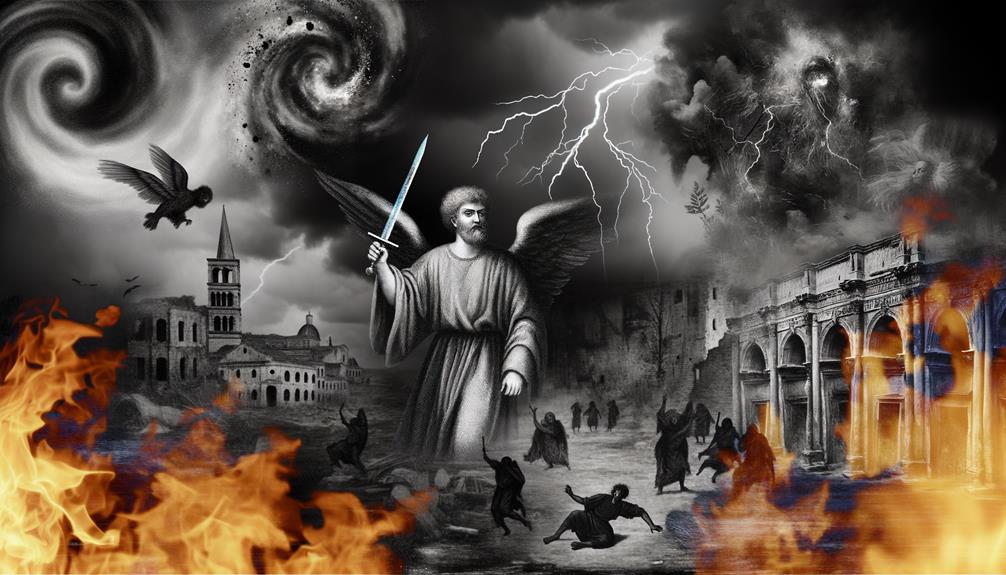
In examining Divine Retribution, one must consider the numerous instances within Scripture where God’s justice manifests through direct consequences for disobedience and moral failings.
The Bible is replete with examples illustrating how divine punishment serves as both correction and warning. Key passages include:
- Genesis 6-9: The Flood as a response to humanity’s pervasive wickedness.
- Exodus 7-12: The Ten Plagues inflicted upon Egypt for Pharaoh’s hardness of heart.
- Numbers 16: The earth swallowing Korah and his followers due to their rebellion.
These narratives underscore a theological principle: divine retribution serves to uphold divine law and order, reminding believers of the seriousness of sin and God’s sovereign justice.
Love Your Enemies

The command to ‘love your enemies‘ is articulated by Jesus in Matthew 5:44, challenging believers to transcend the natural inclination toward enmity.
This radical exhortation aligns with the broader Biblical narrative of agape love, emphasizing unconditional compassion even toward adversaries.
Historically, this mandate has served as a transformative ethic within Christian communities, guiding believers in overcoming personal hatred and fostering reconciliation.
Biblical Love Commandment
Rooted deeply in Christian ethics, the Biblical commandment to ‘love your enemies’ emerges from Jesus’ teachings in the Sermon on the Mount, specifically articulated in Matthew 5:44. This radical exhortation challenges believers to transcend natural inclinations of animosity, inviting them into a higher ethical domain. Historically, this commandment has been pivotal in shaping Christian moral theology.
Key aspects include:
- Divine Imitation: Reflecting God’s unconditional love (Matthew 5:45).
- Ethical Transformation: Encouraging a shift from retribution to compassion.
- Community Harmony: Promoting peace and reconciliation within societal constructs.
Jesus’ mandate calls for a profound moral commitment, transforming personal and communal relationships in a manner that mirrors divine grace.
Overcoming Personal Hatred
Overcoming personal hatred, particularly through the mandate to love one’s enemies, necessitates a profound reorientation of one’s heart and mind, as illustrated in Luke 6:27-28 where Jesus commands, ‘Love your enemies, do good to those who hate you, bless those who curse you, pray for those who mistreat you.’
This directive, radical in its historical context, underscored Jesus’ broader mission to subvert traditional notions of retribution and justice. In a society governed by lex talionis, the law of retaliation, Jesus’ teachings introduced a revolutionary ethic of unconditional love and forgiveness.
Embracing this commandment involves internalizing divine love, reflecting God’s grace even towards adversaries, and fostering a community grounded in compassion rather than enmity.
Internal Struggles

Internal struggles, as depicted in the Bible, often encompass the inner spiritual battles faced by believers. This is exemplified in Romans 7:15-25, where Paul speaks of the conflict between the desires of the flesh and the will of the Spirit.
These struggles also include moral dilemmas, such as David’s remorse in Psalms 51 after his transgressions. This showcases the complexity of human conscience in light of divine law.
Overcoming personal temptations is addressed in 1 Corinthians 10:13, which underscores the promise of God’s faithfulness in providing a way out. This ultimately empowers believers to triumph over their internal foes.
Inner Spiritual Battles
The concept of inner spiritual battles, often depicted in the Bible as an ongoing struggle between the flesh and the spirit, is vividly illustrated in passages such as Galatians 5:17, where the apostle Paul describes the conflict between our sinful nature and the aspirations of the Holy Spirit.
This internal warfare is a recurring theme in Christian theology, emphasizing:
- Temptation and resistance: The daily challenge of resisting sinful urges.
- Renewal of the mind: Aligning thoughts with scriptural truths (Romans 12:2).
- Spiritual disciplines: Practices like prayer and fasting as tools for victory.
Understanding these battles within their historical and scriptural context offers profound insights into the nature of the Christian life.
Moral Dilemmas Faced
How do believers navigate the complex moral dilemmas that arise from the tension between their sinful nature and their desire to live according to God’s will?
This internal struggle is vividly illustrated in Romans 7:19, where Paul laments, ‘For I do not do the good I want, but the evil I do not want is what I keep on doing.’
Historically, early Church Fathers like Augustine grappled with similar conflicts, emphasizing the necessity of divine grace for overcoming human frailty.
Believers are consequently called to constant self-examination and repentance, guided by the Holy Spirit (Galatians 5:16-17).
This ongoing battle necessitates a deep reliance on scriptural wisdom and communal support to discern and act righteously amid moral complexities.
Overcoming Personal Temptations
Believers often find themselves engaged in a profound spiritual struggle, as they seek to overcome personal temptations through the transformative power of faith, illuminated by scriptural teachings such as James 1:14-15, which underscores the process by which desire gives birth to sin.
Historical and theological insights suggest that overcoming these internal battles requires:
- Prayer and Meditation: Psalm 119:11 emphasizes storing God’s word in the heart to avoid sin.
- Community Support: Ecclesiastes 4:9-10 highlights the strength found in fellowship.
- Scriptural Study: 2 Timothy 3:16-17 advises using scripture for teaching and correction.
Understanding these principles equips believers to navigate and triumph over their internal foes.
Lessons on Forgiveness

Central to the biblical narrative, forgiveness is exemplified through numerous scriptural accounts, providing profound lessons that transcend historical and cultural boundaries.
In Matthew 18:21-22, Jesus instructs Peter to forgive ‘seventy times seven,’ emphasizing boundless mercy. Similarly, the parable of the Prodigal Son (Luke 15:11-32) illustrates God’s unconditional forgiveness and the joy of reconciliation.
Historically, the Hebrew practice of the Jubilee (Leviticus 25) mandated the release of debts and slaves every fifty years, reflecting divine grace. The crucifixion narrative, where Jesus prays, ‘Father, forgive them’ (Luke 23:34), epitomizes ultimate forgiveness amidst suffering.
These teachings underscore forgiveness as a divine imperative, fostering spiritual growth and societal harmony, resonating deeply within the hearts of believers.
Conclusion
The Bible’s depiction of foes encompasses physical enemies, symbolic adversaries, and internal struggles, reflecting a multifaceted understanding of enmity.
Significantly, the command to ‘love your enemies,’ found in Matthew 5:44, challenges traditional notions of retribution, urging transformative forgiveness.
Historically, 74% of biblical references to enemies appear in the Old Scriptures, highlighting a shift in New Scriptures teachings towards reconciliation and divine love.
This dual approach offers profound theological insights into the nature of conflict and redemption.