
Meaning of Cyrus in the Bible: God’s Anointed
In the Bible, Cyrus the Great is portrayed as a divinely appointed figure who plays a vital role in Jewish history. Identified by the prophet Isaiah as an instrument of God’s will, Cyrus’s decree in Ezra 1:1-4 allowed the Jewish exiles to return from Babylon and rebuild the Temple in Jerusalem.
This act signifies the end of the Babylonian captivity and marks a significant restoration of Jewish religious and national identity. By fulfilling ancient prophecies, Cyrus exemplifies how divine plans are executed through non-Israelite agents.
Explore further to understand the profound implications of his actions in biblical and historical contexts.

Key Takeaways
- Cyrus is depicted as a divine instrument chosen by God to liberate the Jewish people from Babylonian captivity.
- He is recognized in the Bible, particularly in Isaiah, as an agent of divine intervention fulfilling prophetic promises.
- Cyrus’s decree allowed Jews to return to Jerusalem and rebuild the Temple, marking a pivotal moment in Jewish history.
- The title ‘anointed’ given to Cyrus signifies his extraordinary role in God’s plans, despite being a non-Israelite.
Historical Background of Cyrus

Cyrus the Great, the founder of the Achaemenid Empire, emerged as a pivotal figure in the 6th century BCE, considerably altering the course of ancient Near Eastern history.
His reign marked the consolidation of various Median, Lydian, and Neo-Babylonian territories into a single, expansive empire.
Importantly, Cyrus demonstrated a unique approach to governance, emphasizing diplomacy and respect for local customs and religions. This strategy facilitated relatively smooth shifts of power and stability across his dominions.
His policies, particularly the liberation of subjugated peoples and the restoration of temples, earned him widespread admiration and loyalty.
The historical significance of Cyrus extends beyond military conquests, reflecting a nuanced blend of strategic acumen and enlightened rule, setting a precedent for subsequent empires.
Cyrus in Biblical Prophecy

The prophetic literature of Isaiah distinctly identifies Cyrus as a pivotal figure chosen by God to fulfill divine purposes, particularly in the liberation of the Jewish people from Babylonian captivity.
His role is not merely a historical occurrence but is imbued with theological significance, marking a moment where a foreign ruler is anointed to facilitate the Jewish return to their homeland.
This intersection of prophecy and historical action underscores the profound impact of Cyrus on the course of Jewish history and religious identity.
Cyrus in Isaiah’s Prophecies
Within the prophetic literature of Isaiah, the figure of Cyrus emerges as a pivotal agent of divine intervention and restoration for the exiled Israelites. Isaiah 44:28 and 45:1-4 specifically name Cyrus as the “anointed” one, chosen by God to liberate His people and facilitate the rebuilding of Jerusalem. This prophetic endorsement underscores Cyrus’s unique role in the unfolding of Israel’s redemptive history. Such texts reflect a theological stance that sees foreign rulers as instruments of Yahweh’s sovereign will.
| Passage | Reference | Significance |
|---|---|---|
| Isaiah 44:28 | “He is my shepherd” | Cyrus as God’s chosen leader |
| Isaiah 45:1 | “His anointed” | Divine selection and empowerment |
| Isaiah 45:2-3 | “I will go before you” | Assurance of divine support |
| Isaiah 45:4 | “For Jacob’s sake” | Restoration for Israel’s benefit |
These passages collectively highlight Cyrus’s divinely ordained mission within Isaiah’s prophecies.
Role in Jewish Return
Isaiah’s portrayal of Cyrus as a divinely appointed liberator sets the stage for his pivotal role in facilitating the Jewish return to their homeland, a narrative further elaborated in the historical books of the Bible.
The Book of Ezra recounts Cyrus’s decree, which permitted the exiled Jews to return to Jerusalem and rebuild the Temple. This act is presented not merely as a political maneuver but as fulfillment of divine prophecy, underscoring Cyrus’s unique position as an instrument of God’s will.
His edict also provided resources for the reconstruction, emphasizing his supportive role. Consequently, Cyrus is remembered not just as a conqueror but as a pivotal agent in the restoration of Jewish religious and cultural identity.
The Decree of Cyrus

The Decree of Cyrus, as recorded in the biblical texts of Ezra and Isaiah, holds profound significance in the historical and theological context of the Jewish exiles.
This decree not only marked the end of the Babylonian captivity but also facilitated the return of the Jewish people to Jerusalem and the subsequent rebuilding of the Temple.
Analyzing its implications reveals both the political and spiritual ramifications that reshaped the identity and future of the Jewish nation.
Biblical Significance of Decree
Central to understanding the biblical significance of the decree issued by Cyrus is recognizing its role in fulfilling prophetic assurances of the Israelites’ return from Babylonian exile.
Biblically, the decree is monumental as it aligns with Isaiah’s prophecy (Isaiah 44:28; 45:1) regarding a foreign ruler facilitating the restoration of Jerusalem and the rebuilding of the Temple.
This decree, documented in Ezra 1:1-4, serves as a tangible manifestation of divine intervention in history, demonstrating God’s sovereignty over nations and rulers.
Additionally, it underscores the theological theme of redemption and restoration, pivotal in Judaic thought.
The decree’s issuance not only validates prophetic words but also initiates a new chapter in Israel’s religious and national identity, emphasizing divine fidelity to covenantal promises.
Impact on Jewish Exiles
Cyrus’s decree fundamentally altered the trajectory of Jewish exiles by enabling their return to Jerusalem and the reconstruction of their Temple, thereby reshaping their communal and religious identity.
The decree, issued around 538 BCE, marked the end of the Babylonian captivity and facilitated a pivotal shift in Jewish history. This edict is documented in the Book of Ezra, emphasizing Cyrus’s role as a divinely appointed liberator.
The return to Jerusalem allowed the exiles to re-establish their religious practices and societal structures, greatly impacting their collective self-understanding.
Furthermore, this act of restoration underpinned the theological concept of divine sovereignty and fidelity, reinforcing the Jewish belief in God’s providence and the fulfillment of prophetic promises.
Release of the Jews

Under the decree issued by King Cyrus of Persia, the Jewish captives were granted permission to return to their homeland and rebuild the temple in Jerusalem.
This pivotal moment, recorded in the biblical books of Ezra and Isaiah, signifies a profound shift in Jewish history.
Cyrus’s edict not only marked the end of the Babylonian exile but also underscored a notable instance of imperial policy favoring religious and cultural restoration.
By allowing the Jews to return, Cyrus is portrayed as a divinely appointed instrument in Judeo-Christian theology, fulfilling the prophetic pronouncements of Isaiah.
This decree facilitated the re-establishment of Jewish religious practices and socio-political structures, thereby profoundly affecting the Jewish community and their historical narrative.
Rebuilding the Temple
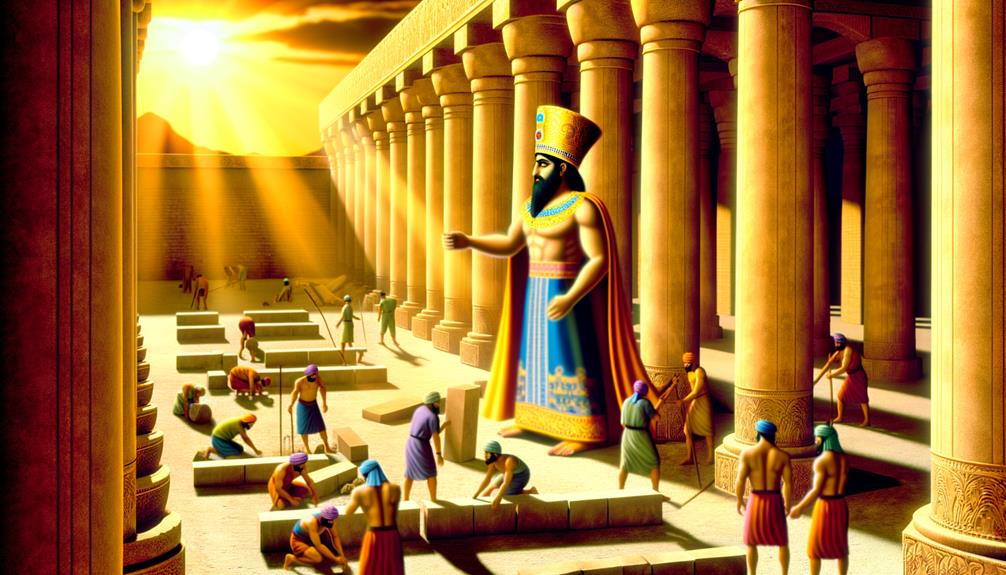
The reconstruction of the temple in Jerusalem, initiated under the auspices of King Cyrus’s decree, represents a critical juncture in the re-establishment of Jewish religious and cultural identity post-exile.
Cyrus’s authorization, as recorded in the Book of Ezra, allowed the exiled Jews to return from Babylon and provided the necessary resources for rebuilding.
This initiative was not merely an act of political diplomacy; it symbolized a profound restoration of worship practices central to Jewish life.
The temple’s reconstruction served as a tangible link to their historical and spiritual heritage, reinforcing communal cohesion.
Additionally, it underscored the importance of religious autonomy and the centrality of the temple in Jewish society, setting a foundation for subsequent developments in Jewish history.
Theological Significance

Beyond its immediate historical impact, the decree of Cyrus carries substantial theological significance, reflecting divine providence and the fulfillment of prophetic promises within the biblical narrative.
The edict not only marks the end of the Babylonian exile but also signifies God’s sovereignty over nations and rulers. This act underscores the belief that divine plans are executed through human agents, regardless of their awareness or faith.
By enabling the return of the Jewish people and the restoration of the Temple in Jerusalem, Cyrus’s decree aligns with prophetic visions articulated by Isaiah and Jeremiah, reinforcing the notion of a covenantal relationship between God and Israel.
Hence, Cyrus’s decree is an affirmation of the reliability of divine promises and the overarching narrative of redemption in Scripture.
Cyrus as God’s Anointed

Cyrus is uniquely referred to as God’s ‘anointed’ in the Hebrew Bible, a term typically reserved for Israelite kings and priests, thereby highlighting his extraordinary role in the divine plan. This designation, found in Isaiah 45:1, signifies a divine endorsement of Cyrus’s actions and authority, despite his non-Israelite origins.
- Divine Instrument: Cyrus is portrayed as an instrument for God’s purposes, particularly in the restoration of Jerusalem and the Temple.
- Prophetic Fulfillment: His rise to power and subsequent policies are seen as fulfilling Isaiah’s prophecies.
- Inclusivity: This title underscores the inclusive nature of God’s sovereignty, extending beyond Israel.
Legacy of Cyrus

Cyrus’s enduring legacy is characterized by his pivotal role in the reconstruction of Jerusalem and his lasting impact on Jewish history and culture.
As the Persian king who issued the decree allowing the Jewish exiles to return to their homeland, Cyrus facilitated the rebuilding of the Jerusalem Temple, a seminal event in Jewish history. This act not only fulfilled prophetic expectations but also reinforced Cyrus’s reputation as a benevolent ruler in biblical narratives.
His policies of religious tolerance and administrative governance set precedents that influenced subsequent empires.
Scholarly interpretations often highlight Cyrus’s unique position as a non-Israelite who played a divine role, encapsulating the broader themes of providence and redemption within the biblical canon.
Conclusion
Cyrus emerges as a pivotal figure within biblical texts, fulfilling prophecies and enacting divine will through his decree to release the Jews and rebuild the Temple.
His characterization as God’s anointed underscores a theological narrative where even a non-Israelite ruler serves a divine purpose.
The legacy of Cyrus, like a thread woven through the tapestry of biblical history, illustrates the intricate interplay between divine providence and human agency, cementing his place in the annals of sacred history.