
Meaning of Miriam in Bible: Prophetess and Strength
Miriam, a prominent figure in the Bible, is revered as a prophetess and leader among the Israelites. Her name, derived from the Hebrew ‘Miryam,’ holds complex meanings linked to bitterness and cherished status.
Miriam’s actions, such as watching over Moses in the Nile and leading women in worship post-Red Sea crossing, underscore her protective and inspirational roles. Theologically, she symbolizes divine guidance, feminine strength, and communal faith.
Her episode of leprosy and subsequent healing reflect divine justice and mercy, cementing her legacy in salvation history. Exploring Miriam further reveals her profound impact on biblical narratives and spiritual leadership.

Key Takeaways
- Miriam is recognized as a prophetess who led worship after the Red Sea crossing, symbolizing spiritual authority.
- Her name derives from Hebrew ‘Miryam,’ linked to ‘marar,’ meaning ‘bitterness,’ reflecting Israelite hardships in Egypt.
- Miriam watched over infant Moses in the Nile, showing protective instincts and early leadership qualities.
- She confronted Moses with Aaron, indicating her significant status and influence among Israelites.
Miriam’s Biblical Role

Miriam’s biblical role is multifaceted, encompassing her functions as a prophetess, leader, and sister within the Exodus narrative. As a prophetess, she is recognized in Exodus 15:20 for leading the Israelites in worship after crossing the Red Sea.
Her leadership is evident in Numbers 12, where she and Aaron confront Moses, highlighting her significant status among the Israelites. Additionally, Miriam’s protective instincts are showcased when she watches over her infant brother Moses in the Nile, ensuring his safety (Exodus 2:4-8).
Theologically, Miriam represents divine guidance and feminine strength in the deliverance story. Contextually, her actions underscore the importance of female figures in biblical history, shaping the narrative of Israel’s journey from slavery to freedom.
Etymology of Miriam

The etymology of Miriam’s name reveals profound theological and cultural dimensions, suggesting meanings that range from ‘rebellion’ to ‘beloved,’ reflecting her complex role in biblical narratives.
Linguistically, Miriam is derived from the Hebrew name ‘Miryam,’ which has been associated with the root ‘marar,’ meaning ‘to be bitter,’ potentially symbolizing the Israelites’ hardships in Egypt.
Alternatively, some scholars propose connections to the Egyptian ‘mry,’ meaning ‘beloved,’ emphasizing her cherished status.
The dual interpretations underscore her multifaceted identity, embodying both the struggles and the endearment of her people.
This etymological richness not only highlights Miriam’s significant presence in the scriptures but also underscores the broader historical and cultural contexts that shaped her character and her legacy.
Miriam as a Prophetess

As one of the few women explicitly identified as a prophetess in the Hebrew Bible, Miriam holds a unique and pivotal role in the spiritual and communal life of the Israelites.
Her prophetic status is established in Exodus 15:20, where she leads the women in song and dance after crossing the Red Sea, celebrating Yahweh’s deliverance. This act not only underscores her spiritual authority but also highlights the communal aspect of her role, as she mobilizes and inspires the women of Israel.
Miriam’s divine insight is further affirmed in Micah 6:4, where she is mentioned alongside Moses and Aaron as a leader sent by God.
Her prophetic identity thereby serves as a proof of her integral position within the narrative of Israel’s salvation history.
Miriam’s Leadership
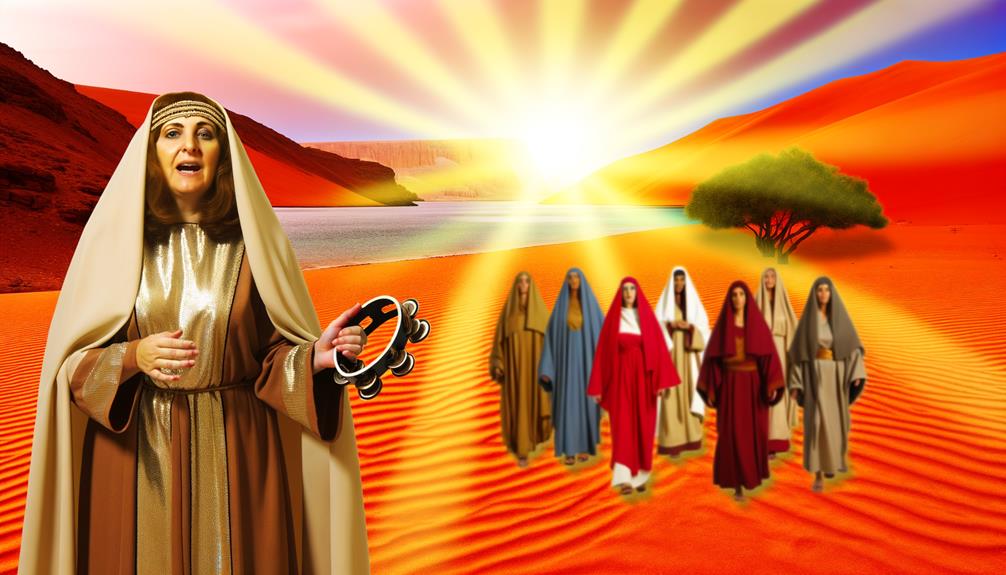
Miriam’s leadership is significantly exemplified in her prominent role during the Exodus narrative, where she emerges as a key figure among the Israelite women.
Her prophetic authority is further underscored by her leading the women in song and dance after the crossing of the Red Sea, symbolizing both spiritual and communal guidance.
Contextually, Miriam’s leadership not only affirms her as an essential component of the prophetic tradition but also highlights the significant yet often underappreciated contributions of women in biblical history.
Leading Women in Exodus
Exemplifying profound leadership, Miriam emerges as a pivotal figure in the Exodus narrative, guiding the Israelites through critical moments of their journey. Her leadership is multi-faceted, seen in her support role to Moses and Aaron and her direct actions influencing the community. Miriam’s role transcends mere familial loyalty; she becomes a symbol of strength and resilience.
| Aspect | Details |
|---|---|
| Leadership in Crisis | Led women in song and dance post-Red Sea |
| Community Influence | Instrumental in maintaining faith and morale |
| Family Contribution | Supported Moses and Aaron in leadership |
| Symbolic Importance | Represents female strength in biblical text |
Miriam’s contributions are critical in understanding the broader context of women’s roles in the biblical narrative and the Exodus story.
Miriam’s Prophetic Role
Building upon her role as a leader during the Exodus, Miriam’s prophetic contributions further solidify her significance within the biblical narrative.
Described as a prophetess in Exodus 15:20, Miriam’s leadership was not merely administrative but divinely inspired. Her role in the Song of the Sea, where she leads the women in song and dance celebrating God’s deliverance, exemplifies her prophetic function.
This act of worship and prophecy underscores her integral position in guiding and inspiring the Israelites. Contextually, Miriam’s prophetic role provided spiritual leadership at a vital time, reflecting the broader theological theme of God’s use of both men and women in His divine plan.
Consequently, Miriam’s prophetic voice reinforces her enduring legacy in biblical history.
Miriam’s Symbolism

As a pivotal figure in the Exodus narrative, Miriam embodies themes of leadership, faith, and divine intervention, serving as a multifaceted symbol within the biblical text. Her role as a prophetess underscores the importance of female leadership in a mainly patriarchal context.
Miriam’s actions, such as leading the women in song and dance after crossing the Red Sea, symbolize communal solidarity and unwavering faith in God’s deliverance. In addition, her experience of leprosy and subsequent healing highlights divine justice and mercy, reinforcing the theme of redemption.
Miriam’s presence signifies God’s inclusive vision, where both men and women are integral to the unfolding of His divine plan, emphasizing a holistic approach to spiritual leadership and community cohesion.
Legacy of Miriam
Miriam’s legacy in biblical history is underscored by her role as a prophetess and leader, whose actions and experiences continue to resonate within theological discussions on gender, faith, and divine justice.
Her leadership alongside Moses and Aaron during the Exodus situates her as a pivotal figure in the narrative of Israel’s deliverance.
The episode of her leprosy and subsequent healing (Numbers 12) exemplifies divine justice and mercy, while addressing themes of equality and authority.
In addition, her celebratory song after crossing the Red Sea (Exodus 15:20-21) highlights her spiritual and communal influence.
Miriam’s life and actions provide a complex and rich subject for examining the roles of women in scripture, as well as the nature of prophetic ministry.
Conclusion
Miriam’s presence in the biblical narrative unfolds a complex tapestry of leadership, prophecy, and symbolism. Her role, etched in the annals of theological history, transcends mere familial ties to Moses and Aaron.
As a prophetess and leader, Miriam’s actions resonate with profound implications, reflecting the divine orchestration of Israel’s journey. The etymological roots of her name add layers of meaning, while her legacy invites continuous exploration.
What ultimate insights might her story yet reveal?