
Meaning of Washing Feet in the Bible: Humility and Service
Washing feet in the Bible holds significant cultural and spiritual symbolism, reflecting ancient Near Eastern customs of hospitality and purification. In the Old Scriptures, it was a gesture of welcome and respect, often performed by servants.
At the Last Supper, Jesus transformed this act into a profound lesson on humility and selfless service, subverting hierarchical norms and promoting equality (John 13:1-17). The practice signifies humility, love, and the breaking of social barriers, encapsulating key theological virtues.
Understanding its multifaceted layers offers deeper insight into biblical teachings and communal principles in Christian faith. There is much more to explore.

Key Takeaways
- Foot washing symbolizes humility and selfless service, exemplified by Jesus at the Last Supper.
- It reflects ancient Near Eastern customs of hospitality and social hierarchy.
- The act emphasizes spiritual purification and readiness for religious participation.
- Jesus’ example challenges traditional hierarchies, promoting servant leadership and mutual care.
Ancient Cultural Context
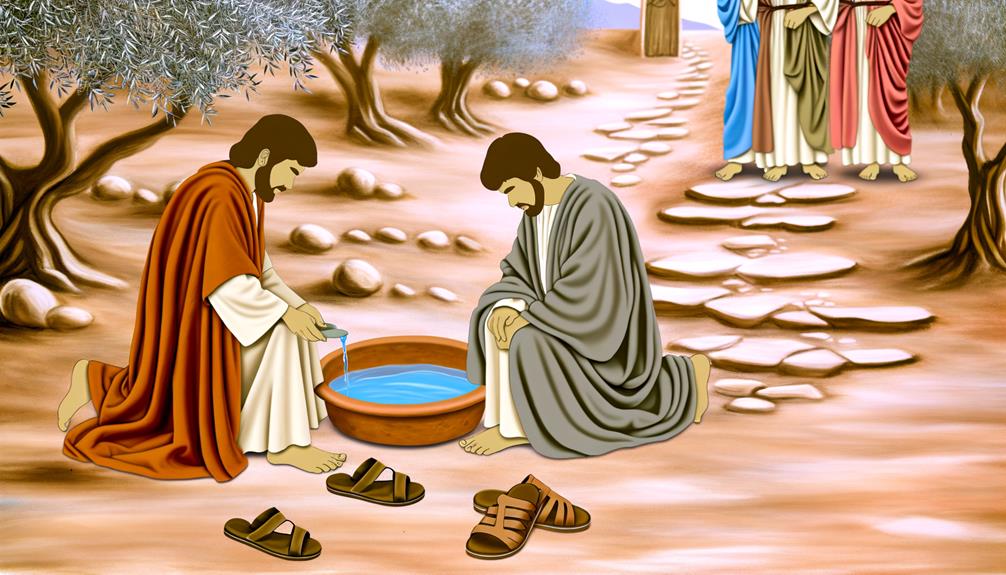
The practice of washing feet in ancient cultures, particularly within the Near Eastern context, was deeply embedded in the social customs and hospitality norms of the time. This ritual served both practical and symbolic purposes.
In a region characterized by arid climates and dusty roads, foot washing was a necessary act of cleanliness and comfort for travelers. Hosts offered this service to guests as a gesture of welcome and respect, often performed by servants or the hosts themselves.
This act of cleansing not only provided physical relief but also reinforced social hierarchies and relational bonds. The practice consequently held significant cultural weight, intertwining the mundane with the deeply ceremonial, reflecting the intricate social fabric of ancient Near Eastern societies.
Foot Washing in Old Testament

In the Old Scripture, foot washing emerges as a multifaceted practice that serves both hygienic and symbolic functions within the narratives and laws of ancient Israelite society. The act of washing feet is frequently mentioned in contexts that underscore its cultural importance and ritualistic connotations.
Foot washing was a gesture of welcome and respect extended to guests upon arrival.
It also played a role in purification rites, essential for participating in religious activities.
The task was often performed by servants, highlighting social hierarchies.
Additionally, it sometimes signified humility and dedication in religious contexts.
Understanding these facets illuminates the broader significance of foot washing in ancient Israelite life, providing a foundation for its later theological implications.
Jesus’ Example at Last Supper

Jesus’ act of washing His disciples’ feet during the Last Supper encapsulates a profound theological lesson on humility and servitude, reshaping traditional notions of leadership and fellowship.
By performing a task customarily reserved for the lowest servants, Jesus illustrated that true greatness in the Kingdom of God is found in selfless service.
This moment, documented in John 13:1-17, serves as a pivotal teaching moment where Jesus explicitly commands His followers to emulate His actions.
The ritual challenges hierarchical structures, emphasizing a servant-leader model.
Contextually, this act subverts existing social norms, promoting an ethic of mutual care and radical equality among Jesus’ followers, consequently redefining the essence of communal relationships within the early Christian community.
Symbolism of Humility

The act of washing feet in the Bible is a profound symbol of humility, exemplified by Jesus during the Last Supper.
This practice, rooted in cultural traditions of hospitality and servitude, underscores the virtues of selflessness and service to others.
Act of Servitude
Foot washing in biblical narratives serves as a profound illustration of humility and servitude, particularly within the context of ancient Near Eastern customs. This ritual act transcends mere physical cleansing to embody a deeper symbolic gesture of subservience and selflessness.
In an era where sandals and dusty roads were commonplace, washing another’s feet signified a willingness to perform menial tasks for the wellbeing of others. This act can be understood through several key dimensions:
- Cultural Significance: Essential in hospitality practices.
- Spiritual Implications: Reflects inner purity and humility.
- Social Hierarchies: Often performed by servants or those of lower status.
Analyzing these dimensions highlights the multifaceted importance of foot washing in biblical texts.
Jesus’ Example
In an exemplary demonstration of humility, Jesus’ act of washing His disciples’ feet during the Last Supper serves as a profound symbolic gesture that redefines notions of leadership and servitude within the Christian faith.
This act, recorded in the Gospel of John, underscores a radical inversion of societal hierarchies, wherein the Master serves the servants.
By performing a task typically reserved for the lowest household servant, Jesus illustrated that true greatness in God’s kingdom is measured by one’s willingness to serve others selflessly.
This ritualistic act of foot washing consequently embodies the essence of humility and sets a precedent for followers to emulate.
Jesus’ example urges believers to adopt servant leadership, prioritizing the needs of others above their own.
Cultural Context
Within the cultural milieu of ancient Near Eastern society, the act of washing another’s feet epitomized an unparalleled expression of humility and service. This practice, typically relegated to servants or the lowliest household members, held profound symbolic weight. It underscored the social hierarchy and the value placed on hospitality and care.
Servitude and Rank: The task often fell to the least esteemed members of the household, signifying their low rank.
Hospitality Norms: Washing guests’ feet was an essential part of welcoming them, reflecting the host’s honor.
Religious Significance: Ritual purification in religious contexts often included foot washing.
Symbol of Cleansing: Beyond physical cleanliness, it symbolized spiritual purification and renewal.
Thus, foot washing functioned as a potent metaphor within biblical narratives.
Act of Service and Love
The act of washing feet in the Bible signifies a profound demonstration of humility in action and compassionate leadership.
This ritual, performed by Jesus, underscores the importance of serving others selflessly, irrespective of social status or hierarchy.
Humility in Action
Washing feet in the biblical context exemplifies a profound gesture of humility, service, and love, as demonstrated by Jesus in John 13:1-17. This act is rich with theological significance, revealing the essence of servant leadership and the inversion of societal norms.
By washing His disciples’ feet, Jesus illustrated:
- Humility: Lowering oneself to perform a menial task typically assigned to servants.
- Service: Fulfilling the needs of others selflessly.
- Love: Demonstrating unconditional care and compassion.
In this context, the act of washing feet is not merely a ritual but a symbolic action that calls believers to emulate Jesus’ example of humility and selfless love, fostering a community grounded in mutual respect and service.
Compassionate Leadership
Compassionate leadership, as demonstrated through Jesus’ act of washing His disciples’ feet, encapsulates a profound model of service rooted in love and empathy. This act transcends mere ritual, illustrating the essence of servant leadership within a biblical context. Jesus’ actions challenge traditional hierarchies, inviting leaders to prioritize the well-being and dignity of those they serve. By washing the feet of His followers, Jesus redefined greatness as the capacity to serve selflessly.
| Element | Significance |
|---|---|
| Humility | Breaking social norms |
| Empathy | Understanding disciples’ needs |
| Service | Prioritizing others’ well-being |
| Leadership | Redefining authority through service |
| Love | Central motive behind the actions |
This teaching underscores that true leadership is marked by compassion and self-giving love.
Spiritual Lessons for Believers

Symbolically rich and deeply instructive, the act of washing feet in biblical narratives offers profound spiritual lessons for believers, emphasizing humility, service, and the transformative power of selfless love. This ritual, most significantly performed by Jesus in the Gospel of John, underscores the call to embody Christ-like virtues.
Analyzing its significance reveals:
- Humility: Jesus’ act of washing His disciples’ feet is an ultimate demonstration of humility, challenging believers to forsake pride.
- Service: The ritual teaches the importance of serving others, regardless of social status.
- Forgiveness: It symbolizes spiritual cleansing, reminding believers of the necessity of forgiveness.
Through these lessons, believers are guided towards a deeper, more committed spiritual walk.
Modern Interpretations and Practices

Contemporary Christian communities have adapted the ancient practice of foot washing to reflect modern understandings of humility, service, and communal bonds. This rite is often incorporated into Maundy Thursday services, symbolizing Jesus’ act of washing His disciples’ feet as an expression of selfless love.
In various denominations, foot washing has expanded beyond its traditional context to serve as a tangible reminder of spiritual equality and fellowship. Some congregations use it to address social justice concerns, promoting inclusivity and empathy.
Analytically, this practice underscores a theological commitment to embodying Christ’s teachings in everyday life, consequently fostering a collective identity rooted in compassion. Modern interpretations thereby maintain the ritual’s profound symbolism while adapting it to contemporary societal and ecclesiastical needs.
Conclusion
The practice of washing feet in the Bible, akin to a thread weaving through a rich tapestry, encapsulates ancient cultural customs, Old Covenant rituals, and Jesus’ profound demonstration of humility and service.
Symbolizing humility and love, it offers enduring spiritual lessons for believers, emphasizing selflessness and devotion.
Modern interpretations continue to draw from these timeless principles, ensuring the act remains a significant and meaningful practice within contemporary faith communities.