
Sanhedrin Meaning in the Bible: Jewish Council Authority
The Sanhedrin in the Bible was the paramount judicial and legislative institution in ancient Jewish society, fundamentally anchored in Mosaic law. Established during the post-exilic period, it comprised 71 members, including elders, scribes, and a High Priest.
This body adjudicated legal disputes, enforced religious laws, and maintained Jewish continuity under foreign dominance. Key scriptural references, such as Matthew 26:59-66 and Acts 23:1-10, highlight the Sanhedrin’s critical role in high-stake trials, including those of Jesus and Apostle Paul.
Its profound influence on modern Jewish legal practices underscores its integral role in the religious and social life of the time. Discover more about its enduring legacy.

Key Takeaways
- The Sanhedrin was a Jewish supreme court and legislative body, adjudicating legal and religious matters.
- Comprised of 71 members, including the High Priest, elders, scribes, and scholars.
- Originated post-Babylonian exile to maintain Jewish law and governance.
- Played a crucial role in trials, such as those of Jesus (Matthew 26:59-66) and the apostles (Acts 5:27-32).
Origin and Historical Background
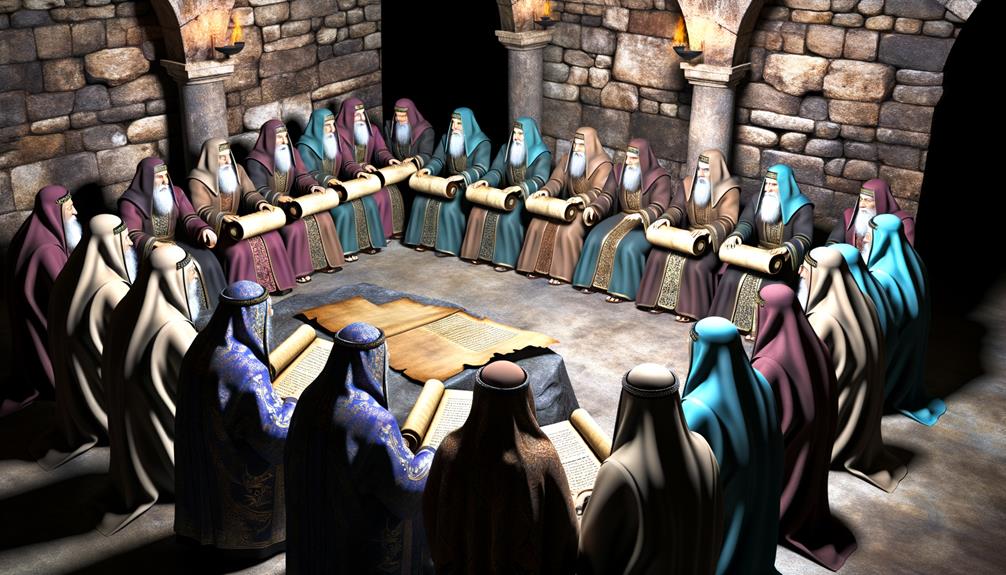
The origin of the Sanhedrin, a central judicial and legislative body in ancient Jewish society, can be traced back to the post-exilic period when Jewish leaders sought to establish a structured governance system based on Torah principles.
During this era, following the Babylonian exile, the need for a cohesive legal and religious framework became paramount.
Influenced by the prophetic and priestly traditions, the Sanhedrin evolved to adjudicate legal disputes, guarantee religious adherence, and navigate political complexities.
Historical evidence suggests that its establishment was pivotal in maintaining Jewish identity and legal continuity amidst foreign dominion.
The Sanhedrin’s foundation was rooted in scriptural mandates, particularly the Mosaic laws, which provided a robust basis for its authoritative role in Jewish life.
Structure and Membership
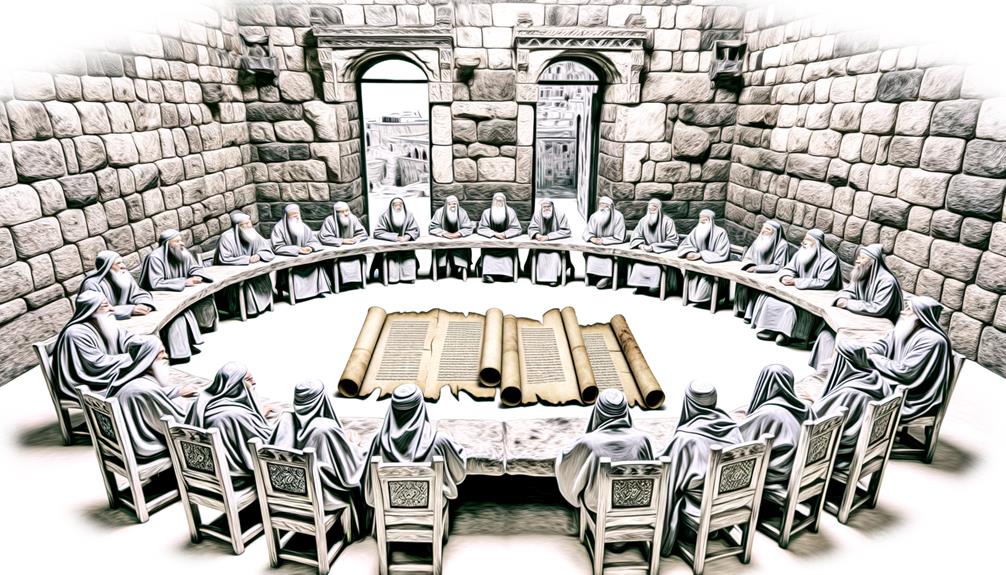
Building upon its foundational role in Jewish society, the Sanhedrin’s structure and membership were meticulously designed to reflect the diverse yet cohesive representation of various segments within the community.
Comprised of 71 members, it included:
- The High Priest – serving as the presiding officer, symbolizing religious authority.
- Elders – representing tribal and familial leadership, guaranteeing generational wisdom.
- Scribes and Scholars – embodying legal and scriptural expertise, facilitating informed decision-making.
This configuration guaranteed a balanced integration of religious, social, and intellectual elements, fostering thorough deliberation.
Members were selected based on their scholarly achievements, moral integrity, and communal standing, reinforcing the institution’s legitimacy and the community’s trust.
This multifaceted representation underscored the Sanhedrin’s pivotal role in upholding Jewish traditions and laws.
Judicial and Legislative Functions
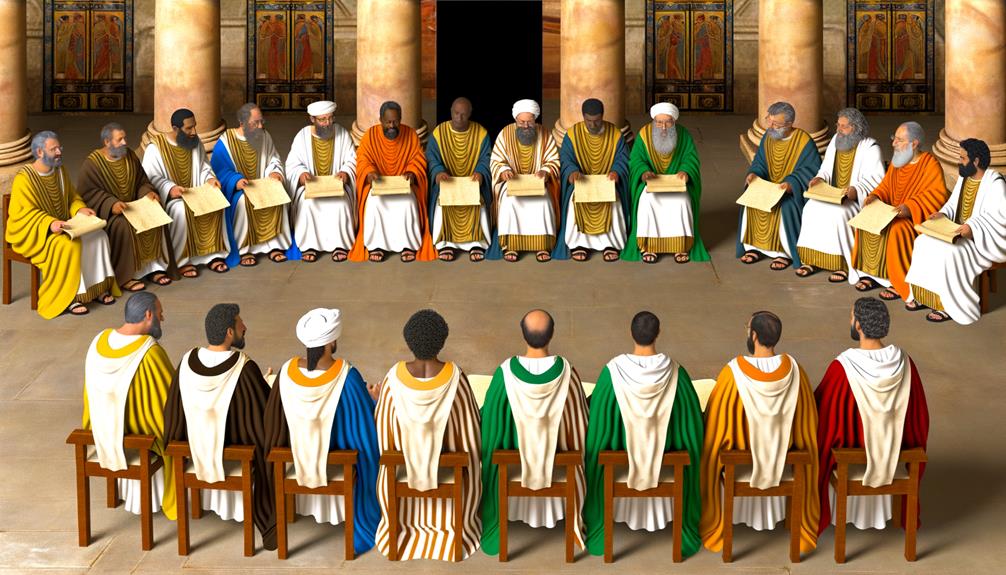
Functioning as both a supreme court and a legislative body, the Sanhedrin wielded extensive authority in interpreting and enforcing Jewish law.
This dual role enabled the Sanhedrin to adjudicate complex legal disputes, from civil cases to matters of religious observance. The legislative aspect involved creating and amending laws that aligned with Torah principles, ensuring their relevance to contemporary societal issues.
Their judicial responsibilities encompassed trials, including capital cases, where they meticulously examined evidence and testimony. This body also had the authority to issue decrees that shaped communal life and religious practice.
The Sanhedrin’s decisions were binding, reflecting a profound influence on the spiritual and social fabric of Jewish society during the Second Temple period.
Key Biblical References
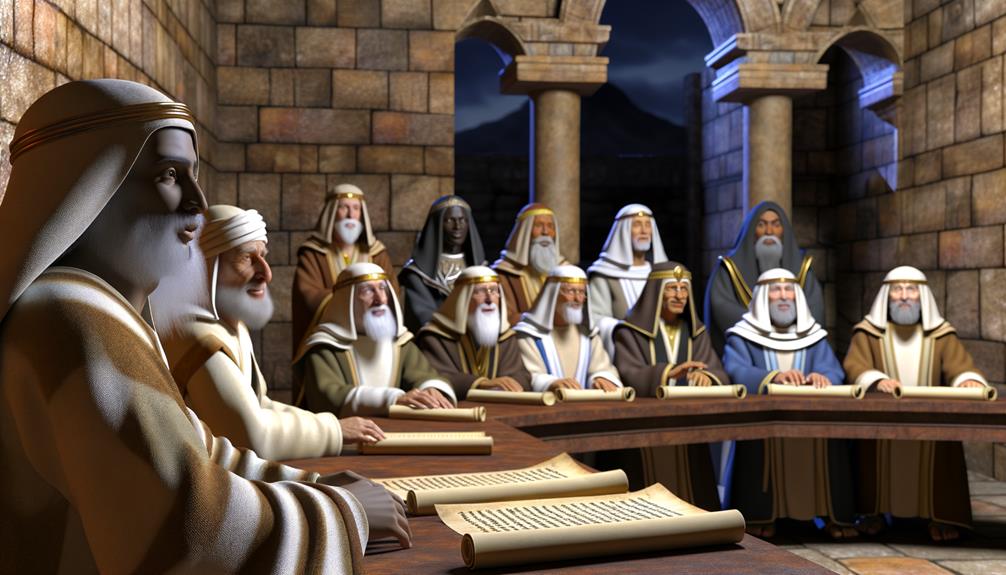
How is the Sanhedrin depicted in key biblical texts, and what insights do these references provide about its role and significance within ancient Jewish society?
The Sanhedrin, a prominent judicial body, is referenced in several New Covenant passages.
Specifically:
- Matthew 26:59-66: Details the trial of Jesus, demonstrating the Sanhedrin’s authority in religious and legal matters.
- Acts 5:27-32: Chronicles the apostles’ trial, highlighting the Sanhedrin’s power to enforce Jewish law.
- Acts 23:1-10: Describes Paul’s appearance before the Sanhedrin, illustrating its role in adjudicating major disputes.
These references underscore the Sanhedrin’s central function in maintaining religious orthodoxy and legal order, reflecting its profound influence within the socio-religious fabric of ancient Judaism.
Influence on Modern Judaism
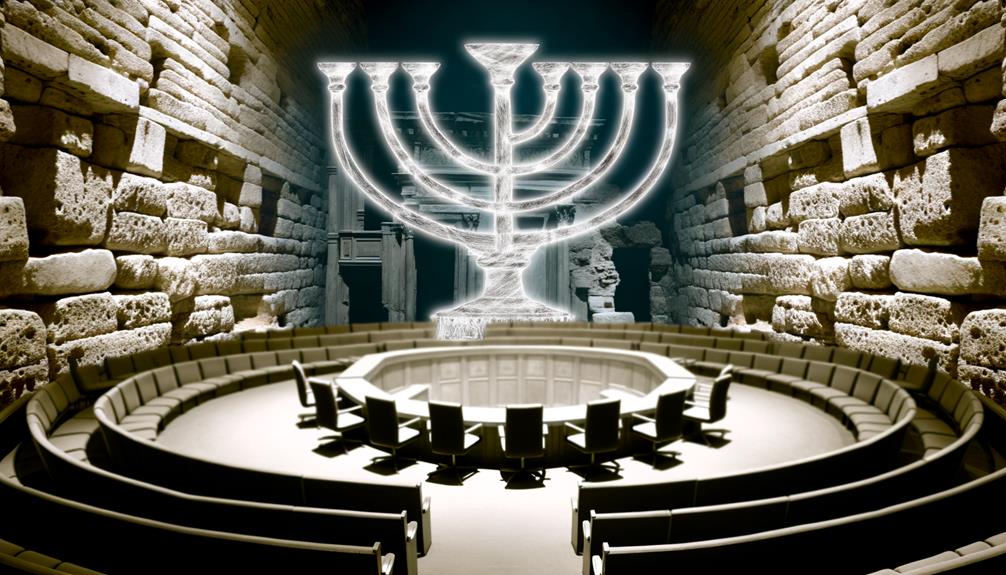
Although the Sanhedrin as an institution ceased to exist after the destruction of the Second Temple in 70 CE, its legacy continues to exert a profound influence on modern Jewish legal and religious practices. The structure and procedures of the Sanhedrin have informed rabbinic courts (Beth Din), which adjudicate matters of Jewish law today. In addition, the Sanhedrin’s emphasis on scholarly debate and consensus is echoed in contemporary Talmudic studies and halakhic decision-making.
| Aspect | Influence on Modern Judaism |
|---|---|
| Legal Structure | Basis for Rabbinic Courts (Beth Din) |
| Decision-Making | Scholarly Debate and Consensus |
| Religious Authority | Framework for Halakhic Interpretation |
| Educational Methods | Model for Talmudic and Rabbinic Study |
This enduring impact underscores the Sanhedrin’s pivotal role in shaping Jewish jurisprudence.
Conclusion
The Sanhedrin, rooted in ancient Judaic tradition, epitomizes the convergence of judicial and legislative authority within Biblical Israel.
Through its intricate structure and diverse membership, it wielded significant influence over both religious and civil matters.
Key Biblical references underscore its pivotal role in governance and legal adjudication.
‘The devil is in the details,’ and an analytical examination of the Sanhedrin reveals its profound impact on the development of modern Jewish legal and religious practices.