
Sebastian Meaning in the Bible: Name Interpretation
The name Sebastian is derived from the Greek word ‘sebastos,’ which translates to ‘venerable’ or ‘revered,’ originating from the verb ‘sebomai,’ meaning ‘to worship.’ This name gained prominence in early Christian communities due to Saint Sebastian, a Roman martyr celebrated for his steadfast faith. Known for aiding persecuted Christians and his own subsequent martyrdom, Saint Sebastian embodies resilience and divine protection.
The name’s etymological journey from an honorific Greek title to a popular Christian name highlights its deep cultural and spiritual significance within the historical context of Christianity. To explore further, one can uncover more about its historical and theological impact.

Key Takeaways
- Etymology: ‘Sebastian’ originates from Greek ‘sebastos,’ meaning ‘venerable’ or ‘revered.’
- Saint Sebastian: He was a Christian martyr known for his unwavering faith during the Roman Empire.
- Symbolism: Saint Sebastian’s story symbolizes resilience, faith, and divine protection in early Christianity.
- Cultural Impact: The name has significant cultural resonance, inspiring art, literature, and religious practices over centuries.
Etymology of Sebastian

The name Sebastian is etymologically derived from the Greek word ‘sebastos,’ which means ‘venerable‘ or ‘revered.’ This etymological root reflects a historical context where names were often imbued with significant cultural and societal values.
The term ‘sebastos’ itself is indicative of respect and honor, qualities that were highly esteemed in ancient societies. Understanding this derivation is essential for comprehending the broader implications of the name within various historical and religious frameworks.
In the Bible, names often encapsulate deeper meanings and intentions, serving as more than mere identifiers. Consequently, the etymology provides a foundational layer for interpreting the name’s biblical significance, aligning it with themes of reverence and esteem that are prevalent throughout scripture.
Greek Origins

The name Sebastian finds its roots in the ancient Greek word ‘Sebastos,’ which translates to ‘venerable‘ or ‘revered.’
This etymology not only underscores the name’s linguistic heritage but also reveals its historical and cultural significance within the Hellenistic world.
The reverence associated with the term reflects its usage in contexts of honor and respect, indicating a deeper societal value placed on individuals bearing this name.
Name’s Ancient Greek Roots
Tracing its etymology back to ancient Greece, the name Sebastian derives from the Greek word ‘Sebastos,’ which means ‘venerable’ or ‘revered.’ This term was often used as an honorific in the Hellenistic world, connoting respect and high status. The root ‘Sebastos’ aligns closely with the Latin ‘Augustus,’ which also carries a sense of being revered or majestic. Understanding the Greek origins of Sebastian provides valuable context for its subsequent cultural and religious significance, particularly in Christian contexts where the name gained prominence.
| Greek Term | Meaning | Usage Context |
|---|---|---|
| Sebastos | Venerable | Honorific Title |
| Augustus | Revered | Roman Emperors |
| Hagios | Holy | Religious Texts |
| Basileus | King | Political Title |
This table elucidates the semantic fields surrounding ‘Sebastos,’ shedding light on its esteemed connotations.
Etymology and Translation
Delving into the etymology and translation of ‘Sebastos‘ reveals a rich tapestry of linguistic and cultural evolution that underscores its revered status in ancient Greek society.
The term ‘Sebastos’ is derived from the Greek verb ‘sebomai,’ meaning ‘to revere‘ or ‘to worship.’ This etymological root highlights a sense of profound respect and veneration.
The adjective ‘Sebastos’ was often used as an honorific title, akin to the Latin ‘Augustus,’ and denoted a person of high status and dignity.
When translated into English, ‘Sebastos’ becomes ‘Sebastian,’ retaining the connotations of honor and reverence. This linguistic journey from ancient Greek to modern usage demonstrates the enduring legacy of the name and its embedded cultural significance.
Historical and Cultural Significance
Building on the etymological roots of ‘Sebastos,’ its historical and cultural significance in Greek society is profoundly linked to the social and political landscape of ancient Greece.
‘Sebastos’ was originally a Greek honorific meaning ‘venerable’ or ‘revered,’ often used to denote individuals of high status, most importantly emperors. This term mirrored the Latin ‘Augustus,’ a title conferred upon Roman emperors, thereby highlighting its connotations of augustness and respect.
In Greek culture, attributing ‘Sebastos’ to someone signified not merely a recognition of their power but also an acknowledgment of their sacrosanct qualities. Consequently, the name ‘Sebastian’ carries with it the weight of historical reverence, reflecting the societal values and hierarchical structures that were pivotal in shaping ancient Greek civilization.
Early Christian Adoption

The early Christian adoption of the name Sebastian can be traced to the veneration of Saint Sebastian, whose martyrdom under Emperor Diocletian became emblematic of steadfast faith.
His story and subsequent symbolism in early Christianity not only fortified the resolve of persecuted believers but also influenced the popularity of the name among Christian communities.
This adoption underscores the interplay between hagiography and the perpetuation of religious identities through naming conventions.
Saint Sebastian’s Martyrdom
Saint Sebastian’s martyrdom, which symbolizes unwavering faith and steadfast courage, became a pivotal narrative in early Christian adoption and veneration. His story, marked by his refusal to renounce his faith despite severe persecution, resonated deeply within the burgeoning Christian community.
The depiction of Sebastian, tied to a tree and shot with arrows, served as a profound illustration of his resilience and dedication.
Key aspects of his martyrdom include:
- Perseverance: His refusal to abandon his faith, even under the threat of death.
- Symbolic Imagery: The arrows piercing his body became a powerful symbol of faith.
- Veneration: His story fostered widespread reverence among early Christians.
This narrative illustrates the transformative power of steadfast faith in the face of adversity.
Symbolism in Early Christianity
Early Christian adoption of symbolism played an essential role in conveying complex theological concepts and fostering a sense of communal identity among believers. Symbols offered a clandestine means of communication, particularly during periods of persecution. They encapsulated intricate doctrines in simple, recognizable forms, such as the ichthys (fish) or the chi-rho, enabling believers to express and share their faith covertly. Symbolism also bridged cultural gaps, integrating diverse traditions into a unified Christian ethos.
| Symbol | Meaning |
|---|---|
| Ichthys (Fish) | Jesus Christ, Son of God, Savior |
| Chi-Rho | Christ (first two letters in Greek) |
| Anchor | Hope and steadfastness |
| Dove | Holy Spirit and peace |
| Lamb | Jesus, the sacrificial lamb |
These symbols remain central to understanding early Christian identity and theology.
Influence on Christian Names
Drawing from a profound intertwining of religious reverence and cultural tradition, early Christian communities often selected names for their children that bore significant theological and symbolic meanings, reflecting virtues, biblical figures, and martyrs revered within their faith.
The name Sebastian, for instance, gained popularity due to its association with Saint Sebastian, a martyr known for his unwavering faith and courage under persecution.
This practice of name selection was driven by several factors:
- Spiritual Significance: Names were chosen to invoke divine protection and blessings.
- Commemoration: Honoring saints and martyrs who exemplified Christian virtues.
- Symbolism: Reflecting core religious values such as faith, strength, and purity.
This deliberate naming tradition underscores the deep connection between personal identity and faith.
Saint Sebastian’s Life
Despite the lack of extensive historical records, the narrative of Saint Sebastian‘s life is pieced together through various hagiographies and traditional accounts, which depict him as a steadfast Christian martyr during the Roman Empire.
Born in Gaul, he served as a captain in the Praetorian Guard under emperors Diocletian and Maximian. His covert Christian faith came to light when he was discovered aiding persecuted Christians.
Consequently, he was ordered to be executed by being tied to a stake and shot with arrows. Left for dead, he miraculously survived and confronted Diocletian, who then had him clubbed to death.
Saint Sebastian’s enduring legacy is enshrined in his unwavering faith and courage amidst persecution and suffering.
Symbolism of Saint Sebastian
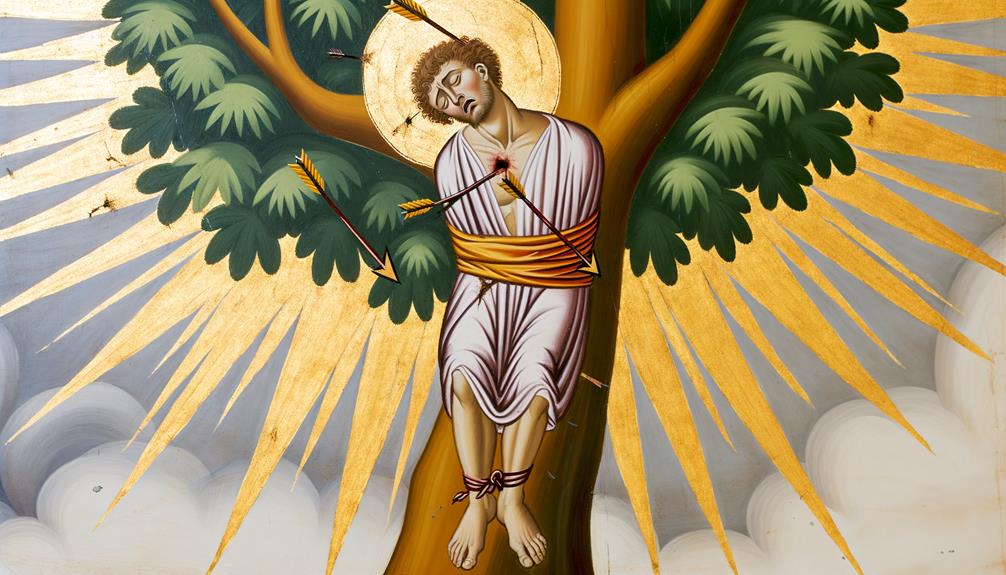
Saint Sebastian’s narrative not only highlights his personal valor but also imbues him with rich symbolic significance, representing resilience, faith, and the triumph of spirit over physical suffering in Christian iconography. His depiction, often pierced by arrows yet serene, transcends his martyrdom to embody enduring spiritual fortitude.
This symbolism is multifaceted:
- Resilience: His survival from the initial execution attempt signifies undying hope.
- Faith: His unwavering commitment to Christianity amidst persecution highlights devout belief.
- Triumph over Suffering: His calm demeanor in art underscores an inner peace surpassing physical anguish.
These elements collectively elevate Saint Sebastian as a profound emblem of Christian perseverance.
Biblical References

Although the name Sebastian is not explicitly mentioned in the Bible, its etymological roots and historical associations provide a rich context for understanding its significance within Christian tradition.
Originating from the Greek word ‘sebastos,’ meaning venerable or revered, the name aligns with the biblical emphasis on moral and spiritual honor.
In early Christian history, Saint Sebastian, a Roman martyr, became emblematic of steadfast faith and resilience under persecution. This symbolic association underscores the broader biblical theme of unwavering devotion to God.
Additionally, the reverence implied by ‘sebastos’ can be paralleled with various biblical figures who, through their actions and faith, embody the principles of respect and holiness central to Christian teachings.
Cultural Impact

The name Sebastian has experienced significant cultural impact, manifesting through its evolving artistic representations and fluctuating popularity trends over centuries.
Artistic depictions, from Renaissance paintings to contemporary cinema, have consistently reinforced and reinterpreted the name’s biblical and historical connotations.
Additionally, its enduring popularity across various cultures underscores a dynamic interplay between religious heritage and modern societal influences.
Artistic Representations Evolving
Artistic representations of Sebastian have evolved considerably over the centuries, reflecting the shifting cultural, religious, and societal contexts in which they were created.
Initially depicted as a martyrdom icon in early Christian art, Sebastian’s image changed to embody broader themes of human suffering and resilience in the Renaissance. By the Baroque period, his portrayal often emphasized emotional intensity and dramatic expressions of faith. Modern interpretations continue to adapt his image, incorporating contemporary themes and aesthetics.
- Early Christian Art: Focused on martyrdom and piety.
- Renaissance: Highlighted humanistic elements and anatomical precision.
- Baroque Period: Emphasized emotional depth and dramatic lighting.
These evolving representations reveal the dynamic interplay between art and societal values.
Name’s Popularity Trends
As artistic representations of Sebastian evolved, so did the cultural significance of his name, reflecting its enduring popularity and diverse impact across different eras and societies.
Historically, the name Sebastian gained prominence due to Saint Sebastian, a Christian martyr whose legacy influenced naming trends.
Over centuries, the name traversed continents, becoming a favorite in Europe, especially in Spain and France.
By the 20th century, its appeal broadened globally, bolstered by literary works and media portrayals.
In contemporary times, Sebastian ranks high in name popularity charts across various countries, signifying its timeless allure.
Its resonance is not merely historical but is continually reinforced by modern culture, from classical music to animated films, ensuring its enduring relevance.
Popularity Over Time

Evaluating the popularity of the name Sebastian over time necessitates an examination of historical records, cultural influences, and religious contexts. Initially emerging during the Roman era, the name gained prominence through St. Sebastian, a Christian martyr whose story captivated many.
Its use fluctuated through the centuries, often influenced by:
- Religious Revival: Increased interest during periods of Christian revival and saintly veneration.
- Literary Works: Appearances in literature, such as Shakespeare’s “Twelfth Night.”
- Royal Usage: Adoption by European aristocracy, enhancing its prestige.
These factors collectively reflect the dynamic trajectory of the name’s popularity, underscoring its enduring appeal across different epochs and cultures.
Modern Interpretations

In contemporary society, the name Sebastian is often perceived through a multifaceted lens that encompasses its historical roots, cultural resonance, and evolving significance in modern contexts.
Renowned for its association with Saint Sebastian, a Christian martyr, the name carries a legacy of resilience and faith.
Today, Sebastian is frequently seen in literature, film, and popular culture, adding layers of modernity to its ancient origins.
Its phonetic elegance and cross-cultural appeal have made it a favored choice among parents globally.
Additionally, the name’s adaptability across various languages underscores its timeless nature.
Consequently, while retaining its historical connotations, Sebastian has seamlessly integrated into contemporary settings, symbolizing both tradition and modernity.
Spiritual Significance

The name Sebastian holds profound spiritual significance, deeply rooted in its association with Saint Sebastian, whose martyrdom symbolizes unwavering faith and divine protection.
Saint Sebastian, a revered Christian martyr, was known for his steadfastness in the face of persecution, embodying the virtues of courage and resilience. His story serves as an emblem of spiritual fortitude, inspiring believers to uphold their faith despite adversities.
- Unwavering Faith: Saint Sebastian’s martyrdom underscores the importance of maintaining faith in challenging times.
- Divine Protection: His survival from initial execution attempts is viewed as a demonstration of divine intervention.
- Courage and Resilience: Demonstrates the strength to face persecution for one’s beliefs.
This profound symbolism enriches the name’s spiritual connotation.
Conclusion
The name Sebastian, steeped in rich etymology and profound historical significance, transcends its Greek origins through early Christian adoption and the life of Saint Sebastian.
Symbolizing resilience and faith, Saint Sebastian’s cultural impact is nothing short of monumental.
The name’s popularity has ebbed and flowed over centuries, reflecting diverse modern interpretations and deep spiritual significance.
In sum, the legacy of Sebastian is an indomitable proof to the enduring power of faith and cultural evolution in the annals of history.