
White Bird Meaning in Bible: Purity and Peace
In the Bible, white birds, especially doves, are potent symbols representing purity, divine presence, peace, and spiritual communication. They often symbolize the Holy Spirit, as seen during Jesus’ baptism where the Holy Spirit descends in the form of a dove (Matthew 3:16).
Additionally, in the story of Noah’s Ark, a dove returns with an olive leaf, signifying God’s covenant of peace (Genesis 8:11). White birds appear in the Psalms and prophetic visions as metaphors for divine protection and transformation, underscoring their theological significance across both Testaments.
To uncover deeper insights into these symbolic interpretations, explore further biblical narratives and art depictions.

Key Takeaways
- White birds signify spiritual purity and moral integrity in biblical texts, reflecting a sinless existence.
- They symbolize divine presence and communication, often depicted as messengers of God, like the dove at Jesus’ baptism.
- White birds represent peace and divine assurance, as illustrated by the dove returning to Noah with an olive branch.
- In Psalms and prophetic visions, white birds metaphorically express divine protection and spiritual transcendence.
Symbolism of White Birds

The symbolism of white birds in the Bible is often associated with purity, divine presence, and spiritual transcendence. These avian symbols serve as metaphors for holiness and celestial intervention, frequently appearing in scriptural narratives to signify God’s sanctified will.
For instance, in the Old Covenant, the white bird is emblematic of cleanliness and moral integrity, often linked to sacrificial rites and divine communication.
In the New Testament, such symbolism extends to represent the Holy Spirit, particularly during the baptism of Jesus, where the Spirit descends ‘like a dove’ (Matthew 3:16).
This recurrent imagery underscores the birds as messengers of divine grace and agents of spiritual elevation, reflecting a broader theological motif of sanctity and divine interaction in biblical exegesis.
The Peaceful Dove

In biblical scripture, the peaceful dove frequently emerges as a potent symbol of the Holy Spirit, particularly evident in the New Covenant during Jesus’ baptism.
This avian figure also embodies purity, underscoring its integral role in theological narratives concerning innocence and divine presence.
Analyzing these dimensions reveals the dove’s profound significance within Christian iconography and doctrine.
Symbol of Holy Spirit
As a prominent emblem in Christian iconography, the peaceful dove represents the Holy Spirit, signifying purity, peace, and divine presence. This symbolism is deeply rooted in biblical narratives, particularly in the New Covenant.
At Jesus’ baptism, the Holy Spirit is described as descending ‘like a dove’ (Matthew 3:16, Mark 1:10, Luke 3:22, John 1:32), underscoring its role as a harbinger of divine approval and sanctification.
The dove’s serene nature aligns with the Holy Spirit’s function as a comforter and guide, fostering spiritual tranquility and enlightenment.
This imagery not only reinforces doctrinal beliefs but also serves as a visual metaphor for the transformative and gentle influence of the Holy Spirit in the lives of the faithful.
Representation of Purity
Among the myriad of symbols associated with purity in biblical texts, the peaceful dove stands out as a poignant representation, often depicted in art and scripture to convey ideals of innocence and sanctity.
This emblematic bird is frequently linked to pivotal biblical narratives, such as Noah’s Ark, where a dove returns with an olive branch, symbolizing God’s covenant and the restoration of peace and purity.
In addition, in the New Covenant, the dove’s descent during Jesus’ baptism underscores its role as a divine messenger of purity and the Holy Spirit.
The dove’s consistent appearance across both Covenants underscores its profound theological significance, embodying a celestial purity that transcends human imperfection and offers a tangible reflection of divine grace.
Noah’s Ark and the Dove

How does the dove’s role in the narrative of Noah’s Ark elucidate its symbolic significance within the biblical context?
The dove in Genesis 8:8-12 serves as a pivotal figure in the story of Noah’s Ark, signifying the end of divine retribution and the dawn of a renewed covenant between God and humanity.
When Noah releases the dove, its return with an olive leaf in its beak symbolizes peace, restoration, and a new beginning.
This moment is emblematic of divine mercy and the restoration of order, aligning the dove with themes of hope and renewal.
Consequently, the dove’s role transcends mere narrative function, embodying profound theological concepts that resonate throughout biblical literature and tradition.
The Holy Spirit as a Dove
Building upon the dove’s emblematic function in the narrative of Noah’s Ark, its representation as the Holy Spirit in the New Covenant further accentuates its role as a symbol of divine presence and sanctification.
In the Gospels, particularly during the baptism of Jesus, the Holy Spirit’s descent as a dove signifies purity, peace, and the inauguration of Jesus’ ministry.
This iconography draws a profound connection between the Old and New Scriptures, portraying the dove as a harbinger of divine favor and renewal.
The dove’s presence in these pivotal moments underscores its theological significance, embodying attributes of gentleness and serenity that are integral to the Holy Spirit’s interaction with humanity.
Consequently, it encapsulates the transformative power of divine grace and guidance.
White Birds in Psalms

In the Psalms, white birds are frequently employed as metaphors for purity, divine protection, and spiritual transcendence. Their symbolic presence underscores themes of sanctity and the safeguarding influence of the Divine. Psalms often interweave these avian symbols to evoke a sense of tranquility and elevation of the soul. For instance, Psalm 55:6 speaks of the desire for wings “like a dove” to escape turmoil, suggesting a yearning for divine refuge and peace. The symbolism extends into broader theological contexts, emphasizing a divine connection and moral rectitude.
| Psalm Reference | Symbolism | Interpretation |
|---|---|---|
| Psalm 55:6 | Dove | Desire for peace and divine refuge |
| Psalm 68:13 | Silvered wings | Purity and divine favor |
| Psalm 84:3 | Sparrows | Divine protection and sanctuary |
| Psalm 91:4 | Feathers | God’s protective covering |
This nuanced use of imagery enriches the Psalms’ spiritual narrative.
Prophetic Visions of Birds

Prophetic visions of birds in biblical texts often serve as potent symbols, conveying divine messages and revelations that underscore significant spiritual truths.
In the Old Scripture, birds frequently appear in prophetic dreams and visions, such as in Zechariah 5:9, where two women with wings of a stork lift a basket containing iniquity, symbolizing the removal of sin.
Similarly, in the New Scripture, the Holy Spirit is depicted descending like a dove at Jesus’s baptism (Matthew 3:16), embodying purity and divine approval.
These avian symbols are not arbitrary; they are carefully chosen to communicate complex theological concepts.
Birds in prophetic visions often act as intermediaries between the divine and human domains, highlighting their integral role in biblical exegesis.
White Birds in Revelation
In the Book of Revelation, white birds are often interpreted as symbols of spiritual purity, reflecting the sanctity and divine grace bestowed upon the faithful.
Their presence is also seen as a representation of peace and the ultimate reconciliation of humanity with the divine order.
These symbolic interpretations underscore the broader theological themes of purity and peace that permeate the apocalyptic narrative.
Symbolic Spiritual Purity
The depiction of white birds in the Book of Revelation serves as a profound symbol of spiritual purity and divine presence within the biblical narrative. These symbols illuminate the eschatological themes that pervade the text, representing not only purity but also the unblemished nature of divine revelation. White birds, often associated with the Holy Spirit or angelic entities, underscore the ultimate triumph of good over evil and the sanctity of God’s kingdom.
| Symbol | Biblical Reference |
|---|---|
| White Dove | Revelation 19:11-14 |
| Angelic Birds | Revelation 4:6-8 |
| Purity | Revelation 3:4-5 |
| Divine Presence | Revelation 1:14; 14:14-16 |
In this context, white birds are not merely creatures but profound theological symbols, encapsulating the essence of divine purity and holiness.
Messenger of Peace
Within the apocalyptic visions of Revelation, white birds emerge as potent symbols of peace, heralding the ultimate harmony and reconciliation that will be established in the eschatological fulfillment of God’s promises. Their presence conveys profound theological insights into the divine assurance of peace amidst the chaos of end-times prophecy.
The imagery of white birds within Revelation underscores:
- Symbolic Assurance: White birds represent divine assurance of peace and God’s unwavering promise of ultimate harmony.
- Eschatological Fulfillment: They signify the culmination of God’s salvific plan, marking the advent of a new, peaceful era.
- Spiritual Reconciliation: These birds symbolize reconciliation between God and humanity, restoring spiritual order.
- Prophetic Revelation: Their appearance serves as a prophetic revelation of peace in the midst of apocalyptic visions, providing hope and solace.
Purity and Innocence

Symbolizing purity and innocence, the white bird frequently appears in biblical texts as an emblem of spiritual cleanliness and moral virtue.
This symbolism is most prominently exemplified in the depiction of the Holy Spirit as a white dove during the baptism of Jesus in the New Covenant (Matthew 3:16). The white bird embodies the essence of a sinless existence, aligning with the theological concept of sanctification.
Additionally, its presence in sacrificial rites, such as the offering of doves by the poor in Leviticus 12:8, underscores its role in purification rituals.
The recurring imagery of white birds consequently conveys a profound theological message, linking the avian purity to the aspirational human state of being free from sin and aligned with divine will.
Messengers of God
In biblical literature, white birds frequently symbolize messengers of God, often serving as conduits for angelic appearances and divine communication.
This symbolism is evident in numerous scriptural instances where white birds are depicted as harbingers of holy messages or divine will.
Angelic Appearances
Throughout the Bible, white birds, particularly doves, frequently serve as symbolic representations of angelic appearances and divine messengers. This symbolism is deeply rooted in various biblical narratives, where these birds are often depicted as harbingers of God’s will and presence.
The following points elucidate this symbolism:
- Noah’s Dove: In Genesis, a dove brings an olive branch to Noah, symbolizing peace and the end of divine judgment.
- Baptism of Jesus: The Holy Spirit descends like a dove during Jesus’ baptism (Matthew 3:16), signifying divine approval.
- Psalms Imagery: Doves in Psalms (55:6) metaphorically express a desire for divine intervention and deliverance.
- Song of Solomon: Doves symbolize purity and beauty, reflecting heavenly attributes (Song of Solomon 5:2).
These instances underscore the profound connection between white birds and angelic symbolism in biblical texts.
Divine Communication
Frequently depicted as divine emissaries, white birds in the Bible serve as profound symbols of God’s communication with humanity.
This is most prominently illustrated in the form of doves, which are often associated with the Holy Spirit. In the New Covenant, the descent of the Holy Spirit upon Jesus during His baptism is described as taking the form of a dove (Matthew 3:16). This event underscores the role of white birds as messengers conveying divine approval and blessing.
Furthermore, in the Old Testament, a dove returning to Noah with an olive leaf signifies God’s covenantal promise and the cessation of the flood (Genesis 8:11).
These instances highlight white birds as conduits of divine messages, embodying spiritual insight and assurance.
White Birds in Christian Art
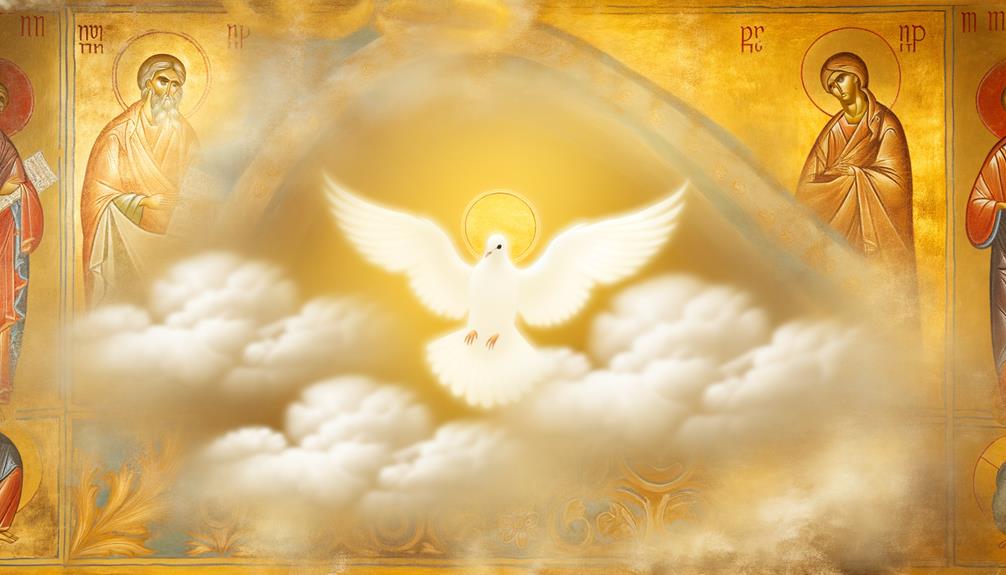
White birds, often depicted as doves, serve as profound symbols in Christian art, representing the Holy Spirit, peace, and divine presence. Their imagery is carefully integrated into various forms of sacred art to convey theological concepts and spiritual truths.
Key contexts where white birds appear include:
- Baptism of Christ: Doves are often shown descending upon Jesus, symbolizing the Holy Spirit during His baptism in the Jordan River.
- Annunciation: Art depicting the Virgin Mary often includes a white dove to signify the Holy Spirit’s role in the Incarnation.
- Peace Iconography: Doves carrying olive branches are emblematic of peace, harking back to Noah’s Ark.
- Resurrection: White birds are sometimes used to symbolize resurrection, purity, and new life in Christian tomb art.
This symbolism enriches the visual narrative of Christian theology.
Conclusion
In biblical literature, white birds, particularly doves, embody profound symbolism: peace, purity, and divine messengers.
The narrative of Noah’s Ark underscores the dove’s role in heralding hope and renewal. The representation of the Holy Spirit as a dove in the New Covenant further accentuates its sanctity.
Additionally, Psalms and Revelation utilize white birds to signify divine presence and purity. This perennial symbolism, akin to a timeless telegram from the heavens, continues to resonate in Christian art and theology.