
Tanzanite Meaning in the Bible: Hidden Symbolism
Tanzanite is not explicitly mentioned in the Bible, as it was only discovered in 1967. However, its deep blue-violet hue bears symbolic resemblance to biblically significant gemstones like sapphire and lapis lazuli.
These stones often represent divine favor, spiritual truths, and heavenly wisdom. In scripture, blue stones are linked to divine revelation and spiritual insight, while violet signifies transformation and penitence.
Though tanzanite itself is absent from ancient texts, its colors resonate deeply with biblical symbolism, illustrating potential theological insights on divine connections and spiritual enlightenment. Exploring its modern spiritual significance could reveal intriguing parallels.

Key Takeaways
- Tanzanite is not mentioned in the Bible, but shares symbolic similarities with biblically significant gemstones like sapphire and lapis lazuli.
- Blue-violet gemstones in the Bible symbolize divine favor, heavenly wisdom, and spiritual transformation.
- Tanzanite’s color evokes biblical themes of divine revelation and heavenly grace, akin to the deep blue of sapphire.
- Theological reflections suggest Tanzanite would resonate with biblical symbolism of divine beauty and spiritual enlightenment.
Historical Background of Tanzanite

Tanzanite, a relatively recent discovery in the gemological world, was first unearthed in 1967 in the Mererani Hills of northern Tanzania. This gemstone, characterized by its stunning blue-violet hue, quickly captivated the attention of gemologists and jewelers alike.
Its unique coloration, caused by trace amounts of vanadium, adds to its rarity and allure. Historically, Tanzanite‘s emergence coincided with a period of significant geopolitical changes in Africa, adding layers of cultural and economic significance to its narrative.
The gemstone’s discovery marked a pivotal moment, not just in geology, but also in the socio-economic fabric of Tanzania. For researchers and scholars, Tanzanite offers a compelling study of the interplay between natural beauty and historical context, enriching its contemporary significance.
Tanzanite in Biblical Times

In examining Tanzanite within the context of Biblical times, one must consider the historical references to gemstones and their theological symbolism in ancient scriptures.
Although Tanzanite was discovered in the 20th century, its potential representation through similar gemstones in the Bible reveals significant insights into its spiritual and cultural importance.
Analyzing these connections allows us to understand better the symbolic and historical value attributed to such precious stones in biblical narratives.
Historical Biblical References
Curiously, while tanzanite is a relatively modern discovery, its striking resemblance to biblically mentioned gemstones invites speculation about its possible historical references in ancient scriptures.
The Bible frequently refers to precious stones such as sapphire, lapis lazuli, and aquamarine, often symbolizing divine favor and spiritual truths.
Tanzanite’s deep blue and violet hues bear a remarkable similarity to these ancient gems, suggesting that it might have been among the stones known to biblical authors, albeit under a different name.
Despite no explicit mention of tanzanite in the Bible, its physical properties and vibrancy could align with descriptions of gemstones used in priestly garments and temple adornments, hinting at a deeper, though indirect, historical connection.
Symbolism and Significance
The deep symbolism and profound significance attributed to gemstones in biblical times often reflect the spiritual beliefs and cultural values of ancient societies.
While Tanzanite, discovered in the 20th century, is not directly mentioned in biblical texts, its striking blue and violet hues resonate with the symbolic meanings assigned to similar gemstones.
Biblically, blue stones like sapphire were emblematic of divine favor, heavenly domains, and spiritual insight. These associations suggest that Tanzanite, had it been known, might have been revered for its spiritual depth and connection to the divine.
Theologically, Tanzanite could be seen as a symbol of transformation and spiritual awakening, echoing the transformative experiences documented in scripture.
Consequently, Tanzanite’s symbolism aligns with biblical themes of divine revelation and inner enlightenment.
Symbolism of Blue-Violet Stones

The symbolism of blue-violet stones in biblical texts often conveys profound spiritual significance, reflecting themes of divine revelation and heavenly wisdom.
Historically, such stones were esteemed in ancient Israelite culture, frequently appearing in religious artifacts like the high priest’s breastplate.
These hues not only represent the transcendence of God but also carry connotations of spiritual insight and moral integrity.
Spiritual Significance Explained
In biblical narratives, blue-violet stones like tanzanite are often associated with divine revelation and spiritual insight, reflecting a profound symbolic meaning that transcends mere aesthetics. These stones are frequently interpreted as emblems of heavenly wisdom and divine communication, resonating with the themes of truth and divine presence. The color blue, symbolizing the heavens, and violet, representing spiritual transformation, together encapsulate the journey towards spiritual enlightenment.
| Symbolism | Blue-Violet Stones |
|---|---|
| Divine Revelation | Heavenly Wisdom |
| Spiritual Insight | Truth |
| Transformation | Divine Presence |
Historically, blue-violet stones were revered for their assumed ability to connect the earthly and the divine, serving as metaphors for spiritual clarity and guidance. This duality underscores their profound theological significance.
Historical Biblical Context
Biblical texts and historical records frequently highlight the prominence of blue-violet stones, underscoring their symbolic resonance within ancient spiritual and religious contexts.
In scripture, colors often hold deep theological significance. Blue, for instance, is associated with divine revelation and heavenly domains, as evidenced by the blue threads in the fringes of Hebrew garments (Numbers 15:38-39).
Similarly, violet hues often signify royalty, priestly authority, and spiritual wisdom. The high priest’s breastplate, described in Exodus 28, adorned with twelve precious stones, likely included blue and violet gems symbolizing divine connection and wisdom.
Consequently, the historical and spiritual connotations of blue-violet stones provide a rich tapestry of meaning that extends to contemporary interpretations of tanzanite within biblical symbolism.
Biblical References to Gemstones

How do the sacred scriptures illuminate the significance and symbolism of gemstones in biblical times?
In the Bible, gemstones frequently appear as symbols of divine beauty, authority, and spiritual truths.
The Book of Exodus (28:17-20) describes the High Priest’s breastplate adorned with twelve precious stones, each representing the twelve tribes of Israel.
Revelation (21:19-21) portrays the New Jerusalem’s foundations, adorned with various gemstones, symbolizing purity and divine glory.
Ezekiel (28:13) depicts Eden as being decorated with every precious stone, signifying perfection and divine craftsmanship.
These references underscore gemstones’ roles in conveying deeper theological meanings, reflecting God’s majesty and the spiritual heritage of His people.
The scriptures thereby elevate gemstones beyond mere adornments, imbuing them with sacred significance.
Tanzanite and Divine Connection

While the Bible richly details the significance of various gemstones, modern discoveries like tanzanite invite us to explore their potential spiritual connections and meanings within a contemporary theological framework.
Tanzanite, a relatively recent discovery, offers a fascinating juxtaposition to biblical gemstones, prompting inquiry into its possible divine associations. Found only in Tanzania, its unique blue-violet hue evokes imagery associated with divine revelation and celestial domains.
Historically, rare and precious stones have been linked to divine favor and spiritual insight. Consequently, tanzanite’s rarity and striking beauty may symbolize a modern manifestation of divine mystery.
Though not explicitly mentioned in scripture, tanzanite’s characteristics encourage a broadened contemplation of how contemporary finds can align with timeless spiritual themes.
Spiritual Significance in Scripture

In examining the spiritual significance of gemstones in scripture, it becomes evident that each stone mentioned carries profound symbolic and theological weight. Historically, gemstones in biblical texts often represent divine attributes, heavenly dimensions, and covenantal promises, offering a rich tapestry of meaning for believers.
| Gemstone | Spiritual Symbolism |
|---|---|
| Sapphire | Divine wisdom, purity |
| Emerald | Eternal life, resurrection |
| Ruby | Blood of Christ, sacrifice |
| Amethyst | Spiritual protection, piety |
These stones, embedded within scriptural narratives, serve as metaphors for spiritual truths and divine grace. Analyzing such symbolism provides deeper insights into the theological messages conveyed through scripture, enriching one’s faith journey. This intricate interplay between gemstones and spirituality underscores the sacred nature of biblical text, inviting contemplation and reverence.
Tanzanite in Christian Tradition
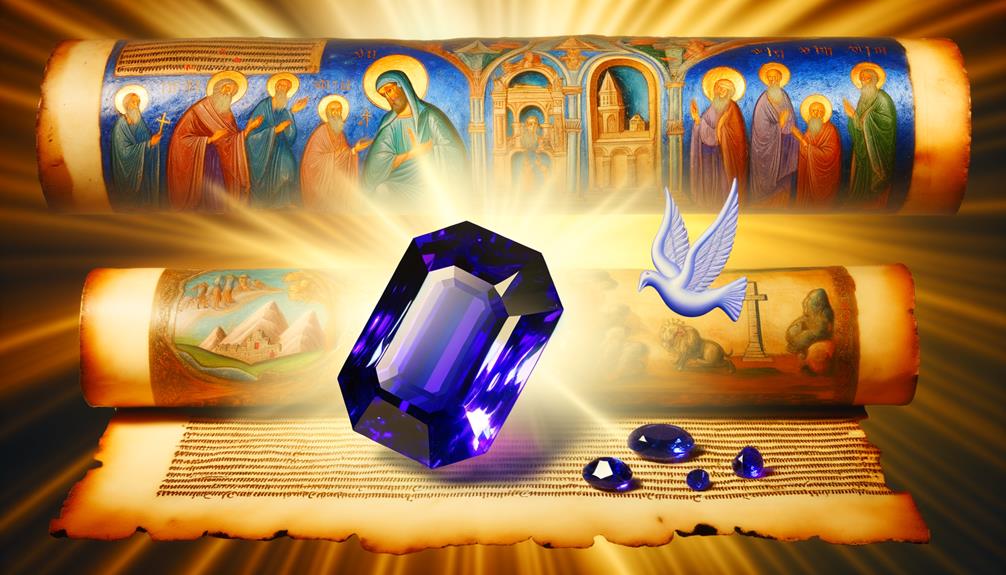
Tanzanite, a relatively modern addition to the pantheon of gemstones, has yet to be explicitly mentioned in biblical texts.
Yet its deep blue-violet hue invites theological reflection within the context of Christian tradition. Historically, the color blue has been associated with divine revelation and heavenly grace, echoing the Virgin Mary’s mantle and the sapphire foundations of the New Jerusalem described in Revelation.
The violet undertones of Tanzanite further evoke themes of penitence and spiritual transformation, aligning with the liturgical significance of Advent and Lent.
Consequently, while Tanzanite itself is not directly referenced in scripture, its enchanting coloration resonates with established Christian symbols, offering a contemporary gemstone that embodies timeless theological and spiritual meanings.
Interpretations by Biblical Scholars

Scholars have explored the symbolic resonance of Tanzanite through the lens of scriptural color symbolism and its theological implications.
The deep blue and violet hues of Tanzanite evoke the biblical imagery of the heavens and divine revelation, often associated with the throne of God as depicted in Ezekiel 1:26.
Some theologians draw parallels between Tanzanite and the ‘sapphire stone’ mentioned in Exodus 24:10, interpreting it as a symbol of divine clarity and spiritual insight.
Historically, colors in the Bible are rich in meaning, with blue signifying divine wisdom and violet representing royalty and priesthood.
Therefore, Tanzanite, with its unique blend of colors, is seen as a multifaceted stone symbolizing divine wisdom and spiritual enlightenment.
Modern Spiritual Insights on Tanzanite

Many contemporary spiritual practitioners regard Tanzanite as a stone of profound metaphysical significance, often associating it with heightened spiritual awareness and transformation.
Historically unearthed in 1967, Tanzanite’s relatively recent discovery contrasts with ancient biblical stones, yet its impact on modern spiritual practices is substantial.
Theologically, it is perceived to bridge the communication between the earthly and divine domains, fostering spiritual growth.
Analytical perspectives suggest Tanzanite’s deep blue and violet hues resonate with the third eye and crown chakras, enhancing intuition and transcendent experiences.
These insights echo historical beliefs that gemstones harbor divine energies, reiterating humanity’s enduring search for deeper spiritual connections, even with newly discovered stones like Tanzanite.
Conclusion
The historical and spiritual significance of Tanzanite in biblical contexts reveals a profound connection to divine symbolism.
Through examining the historical background, symbolism of blue-violet stones, and scriptural references, Tanzanite emerges as a gemstone of considerable importance.
The interpretations by biblical scholars and its place in Christian tradition further underscore its spiritual relevance.
Modern spiritual insights continue to affirm Tanzanite’s enduring significance, reflecting a timeless link between the divine and the material world.