
Amos in the Bible Meaning: Justice and Prophecy
Amos, an 8th-century BCE prophet, stands out for his critiques during Israel’s economically prosperous yet morally decayed period under Jeroboam II. Originating from Tekoa in Judah and initially a shepherd, Amos boldly condemned the social injustices perpetrated by the affluent against the marginalized.
His prophecies emphasized divine judgment for exploitation and insincerity in worship, advocating for ethical behavior aligned with true piety. Amos’s messages influenced subsequent prophets and remain relevant, challenging contemporary social injustices and emphasizing moral accountability.
To fully understand the depth and implications of Amos’s prophecies, one must explore the intricate socio-religious contexts he addressed.

Key Takeaways
- Prophet of Social Justice: Amos denounced the exploitation of the poor and called for equitable treatment and righteousness.
- Divine Judgment: He warned of impending destruction due to Israel’s social injustices and moral failings.
- Authentic Worship: Amos criticized superficial religious practices and urged a return to sincere worship aligned with ethical behavior.
- Visions of Destruction: His prophecies included vivid visions of calamities, symbolizing divine retribution for Israel’s transgressions.
Historical Context of Amos

The historical context of Amos is rooted in the 8th century BCE, during the reign of Jeroboam II in the northern kingdom of Israel. This period was marked by significant economic prosperity and territorial expansion.
However, this apparent prosperity masked underlying social inequities and moral decay. The affluent amassed wealth and power, often at the expense of the poor and marginalized.
Religious practices were frequently corrupted by syncretism and superficiality. The political stability under Jeroboam II fostered complacency, leading to a neglect of covenantal responsibilities.
In this milieu, Amos emerged as a prophetic voice, critiquing the societal injustices and calling for a return to genuine worship and social justice. His message was both a warning and a call for repentance.
Amos’s Background and Calling

Amos, a shepherd and sycamore fig farmer from Tekoa, was called by God to prophesy to the northern kingdom of Israel. His humble origins contrast sharply with the profoundness of his divine mission, emphasizing that prophetic authority is not confined to social status. Amos’s background is significant for understanding his message and approach.
| Aspect | Amos’s Background | Significance |
|---|---|---|
| Occupation | Shepherd, Sycamore Fig Farmer | Grounded in simplicity and labor |
| Hometown | Tekoa | A village in Judah |
| Prophetic Call | Direct divine intervention | Highlights divine selection |
| Audience | Northern Kingdom of Israel | Reflects cross-regional mission |
| Historical Period | 8th Century BCE | Era of social and religious issues |
This table underscores the dichotomy between Amos’s ordinary life and his extraordinary prophetic role, providing a richer context for his ministry.
Themes in Amos’s Prophecies
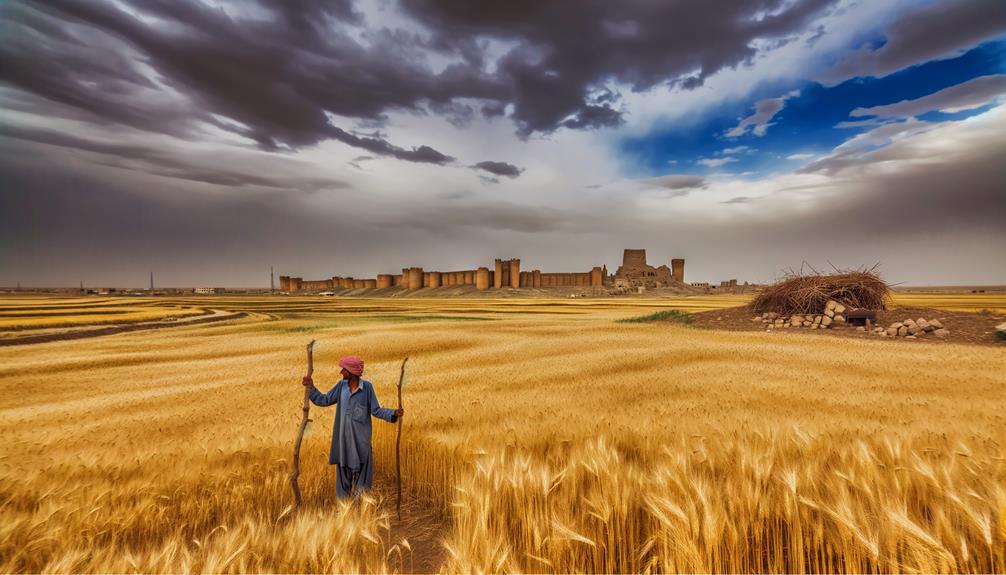
Central to the prophecies of Amos are themes of social justice, divine judgment, and the call for genuine worship. Amos’s messages are a direct response to the moral and spiritual decay he observed in Israel. His prophecies highlight:
- Social injustice: Amos condemns the exploitation and oppression of the poor by the wealthy elite, emphasizing that societal inequities are abhorrent to God.
- Divine judgment: He forewarns of impending divine retribution for Israel’s transgressions, underscoring the inevitability of God’s righteous judgment.
- Authentic worship: Amos criticizes the hollow religious rituals practiced by Israel, urging a return to sincere worship that aligns with ethical and moral behavior.
These themes form the core of Amos’s prophetic critique and provide a framework for understanding his overall message.
Social Justice in Amos
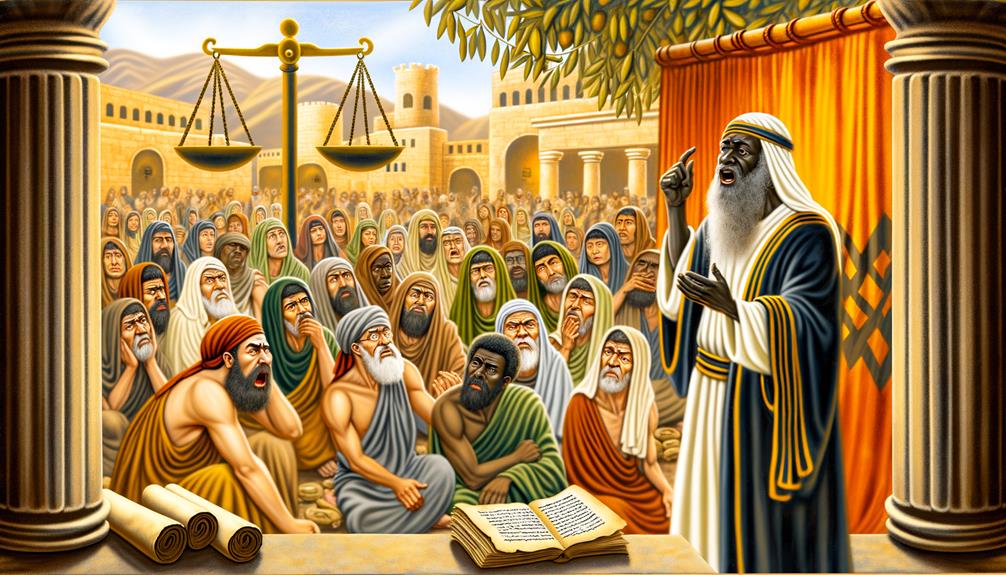
Addressing the theme of social justice, Amos’s prophecies vehemently denounce the systemic exploitation and marginalization of the vulnerable in Israelite society. Amos, a shepherd from Tekoa, emerges as a fervent advocate for the oppressed, condemning the affluent elite‘s transgressions.
His oracles highlight the stark disparity between the wealthy and the disenfranchised, where the rich accrue wealth at the expense of the poor. He castigates unethical practices, such as bribery and the perversion of justice, which perpetuate social inequities.
Divine Judgments Pronounced

The prophecies of Amos articulate a series of divine judgments that reflect the severity of Israel’s transgressions and the inevitable consequences of their actions. These judgments are meticulously detailed, underscoring the moral and ethical breaches committed by the people. Amos highlights the following key aspects:
- Condemnation of Social Injustice: The exploitation of the poor and the perversion of justice are central to the divine admonishments, indicating a society rife with inequality.
- Religious Hypocrisy: The people’s superficial religious observances are condemned, revealing a disparity between their rituals and their moral conduct.
- Impending Destruction: The prophetic declarations emphasize the certainty of divine retribution, portraying an unyielding divine response to their persistent disobedience.
These judgments serve as a sobering reminder of the covenantal obligations and the repercussions of neglecting them.
Visions of Destruction
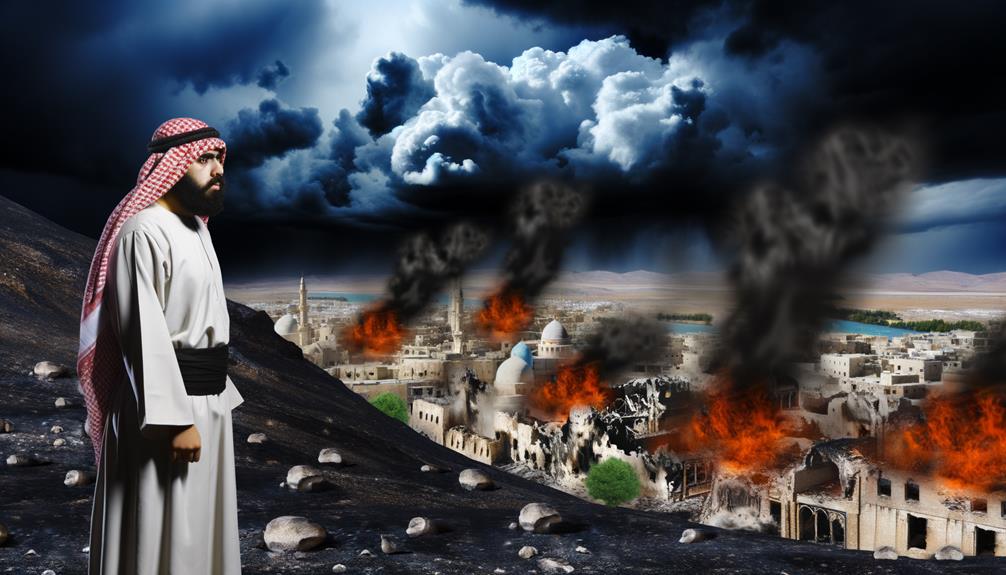
In the Book of Amos, the prophet’s visions of destruction serve as a grim forecast of impending calamities.
These prophetic warnings are meticulously detailed, portraying a series of divine retributions aimed at the nations for their transgressions.
Through these visions, Amos articulates the severity of judgments that await, underscoring the inescapable consequences of moral and social injustices.
Prophetic Warnings Detailed
Amos’ prophetic visions intricately depict impending destruction as a consequence of Israel’s social injustices and spiritual failures. The prophet’s detailed warnings are both vivid and dire, capturing the gravity of divine retribution.
These visions can be categorized as follows:
- Locust Swarm (Amos 7:1-3): Amos sees a devastating plague of locusts, symbolizing an overwhelming force that would consume the land’s resources.
- Fire (Amos 7:4-6): A vision of an all-consuming fire represents divine judgment that could obliterate both land and sea.
- Plumb Line (Amos 7:7-9): The image of a plumb line signifies God’s strict standard of justice, highlighting Israel’s deviation from righteousness.
These visions underscore the inevitability of judgment due to persistent transgressions.
Nations’ Judgments Foretold
Foretelling the judgments on surrounding nations, Amos’ prophetic messages extend beyond Israel, illustrating a broader scope of divine justice.
Amos vividly describes the forthcoming punishments for nations such as Damascus, Gaza, Tyre, Edom, Ammon, and Moab, highlighting their transgressions against humanity and divine law.
These judgments underscore the universal nature of God’s moral expectations, emphasizing that no nation is exempt from accountability.
Amos’ visions of destruction serve to remind both Israel and its neighbors of the serious repercussions of injustice and cruelty.
His prophecies are not merely regional admonishments but a declaration of a divine ethical standard that transcends national boundaries, reinforcing the notion that divine justice is both impartial and all-encompassing in its reach.
Amos’s Influence on Later Prophets
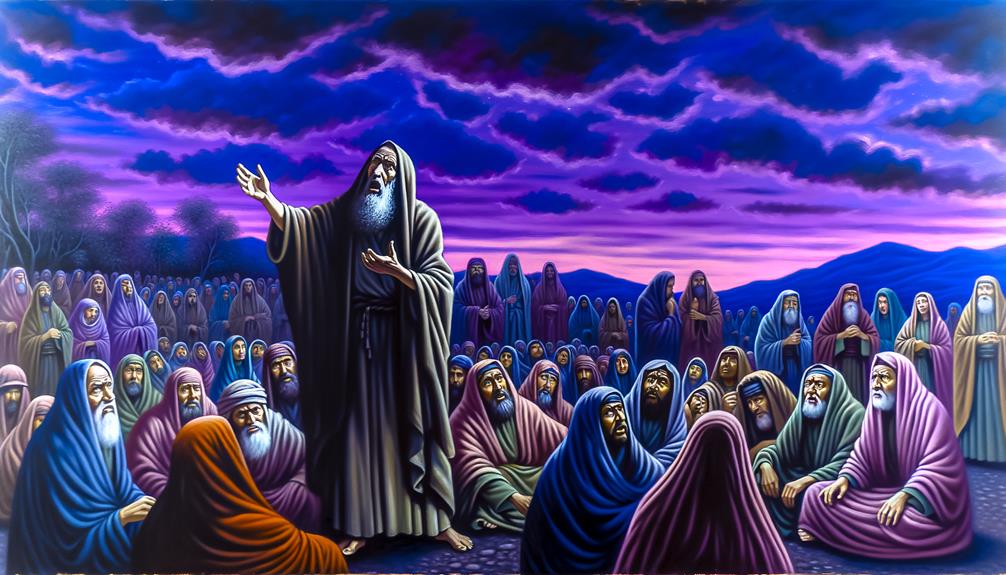
The prophetic ministry of Amos served as a paradigm that greatly shaped the messages and methodologies of later prophets. His emphasis on social justice, divine judgment, and the ethical demands of true worship resonated through subsequent prophetic literature.
Social Justice: Amos’s vehement critique of social inequalities set a foundational precedent for prophets like Isaiah and Micah, who similarly condemned societal injustices and called for righteousness.
Divine Judgment: His portrayal of inevitable divine judgment for moral and covenantal failures influenced prophets such as Jeremiah and Ezekiel, foregrounding the theme of accountability.
Ethical Worship: Amos’s insistence that religious rituals are meaningless without moral integrity echoed in the writings of Hosea and Zechariah, who emphasized the importance of ethical living over mere ceremonial observance.
Amos’s prophetic legacy consequently permeated and enriched the broader biblical prophetic tradition.
Modern Relevance of Amos

The prophetic messages of Amos hold significant modern relevance, particularly in the domains of social justice advocacy and moral accountability.
His critiques of societal inequities and the exploitation of the marginalized resonate strongly in contemporary discussions on ethical governance and social responsibility.
Social Justice Advocacy
Amos’s prophetic messages resonate strongly in contemporary discussions on social justice, underscoring the timeless necessity for equity and righteousness in societal structures. His call for justice and righteousness (Amos 5:24) serves as a guiding principle for modern advocacy, emphasizing the ethical obligations of societies.
The relevance of Amos’s teachings can be analyzed through:
- Economic Justice: Amos condemned the exploitation of the poor and called for fair treatment and equal opportunities.
- Legal Integrity: He denounced corrupt judicial practices, advocating for impartiality and fairness in legal systems.
- Moral Leadership: Amos urged leaders to embody ethical values, highlighting the role of moral integrity in governance.
Thus, Amos’s advocacy for social justice remains pertinent, providing a foundational framework for contemporary ethical discussions.
Moral Accountability Today
Examining the concept of moral accountability through the lens of Amos’s teachings reveals critical insights into the ethical responsibilities of modern leadership and governance.
Amos, an advocate for justice and righteousness, emphasized that leaders must uphold integrity and protect the marginalized. His call for ethical conduct transcends time, urging contemporary leaders to confront corruption, inequality, and social injustice.
In today’s global landscape, where ethical breaches and governance failures are rampant, Amos’s prophetic voice serves as a powerful reminder of the consequences of moral neglect.
The prophetic admonitions in Amos underscore the necessity for transparent, accountable, and compassionate governance, ensuring that justice is not merely an ideal but a lived reality.
This enduring relevance highlights the timeless call for moral integrity in leadership.
Conclusion
Amos’s prophecies transcend time, addressing historical injustices, social inequities, and divine judgments.
His unwavering call for righteousness and his vivid visions of destruction underscore the urgency of moral rectitude.
Influencing later prophets and remaining relevant in contemporary discourse, Amos’s message resonates with enduring significance.
Through a lens of justice, accountability, and divine expectation, the book of Amos serves as both a historical document and a timeless exhortation, urging societies to uphold ethical and spiritual integrity.