
Nicolaitans Meaning in the Bible: False Teachings Exposed
The Nicolaitans, referenced in Revelation 2:6 and 2:15, were an early Christian sect condemned for their syncretism with pagan practices and moral laxity. They advocated participation in idolatrous feasts and endorsed ethical relativism, promoting behaviors such as sexual immorality, which clashed with the strict moral codes of early Christianity.
Emerging amid cultural pressures of the Roman Empire, their teachings created significant tension within nascent Christian communities. The vehement opposition by the early church highlighted the threat they posed to doctrinal purity and ecclesiastical unity, making their story a pivotal study in the battle for early Christian orthodoxy.
Key Takeaways
- Nicolaitans are mentioned in Revelation 2:6 and 2:15 as a group whose practices are condemned by early Christian churches.
- They are associated with blending pagan rituals and Christian beliefs, promoting idolatry and moral laxity.
- Their teachings included permissive attitudes towards sexual immorality and participation in idolatrous feasts.
- The Nicolaitans’ practices were seen as a significant deviation from orthodox Christian teachings.
Biblical References
The term ‘Nicolaitans‘ appears in the biblical text primarily within the Book of Revelation, where it is mentioned in the context of early Christian communities.
Specifically, references to the Nicolaitans can be found in Revelation 2:6 and Revelation 2:15. In Revelation 2:6, the church in Ephesus is commended for hating the practices of the Nicolaitans, which are also hated by Christ.
Similarly, Revelation 2:15 addresses the church in Pergamum, criticizing it for tolerating those who hold to the teachings of the Nicolaitans.
The text does not provide explicit details regarding their doctrines or practices, yet it implies a significant deviation from orthodox Christian teachings, meriting strong condemnation from the early Christian leadership.
Historical Context
Understanding the historical context of the Nicolaitans necessitates an exploration of early Christian heresies and the socio-religious milieu of the first-century Roman Empire.
Emerging during a time when Christianity was still establishing its doctrinal boundaries, the Nicolaitans are often associated with heretical movements that blended pagan practices with Christian beliefs.
This syncretism is indicative of the broader cultural pressures faced by early Christians living under Roman rule, where the worship of multiple deities and emperor veneration were commonplace.
The Nicolaitans’ practices, as inferred from patristic writings, appear to challenge the nascent Christian orthodoxy by promoting lax moral standards and participating in idolatrous feasts, reflecting broader tensions between maintaining religious purity and conforming to dominant societal norms.
Theological Interpretations

To thoroughly understand the theological implications of the Nicolaitans, it is imperative to first examine their historical context and the socio-religious environment in which they emerged.
This analysis provides a foundation for exploring the doctrinal deviations attributed to the Nicolaitans, particularly their perceived antinomianism and potential influence on early Christian communities.
Historical Context Analysis
Historical records and theological exegesis provide compelling insights into the socio-religious dynamics that shaped the emergence and condemnation of the Nicolaitans in early Christian communities.
The Nicolaitans, mentioned in Revelation 2:6 and 2:15, are often interpreted as a sect promoting antinomianism, a doctrine which rejected traditional moral law. Their practices likely countered the apostolic teachings, leading to their denunciation.
Scholars suggest the Nicolaitans may have sought to harmonize Christian beliefs with prevailing pagan practices, thereby diluting doctrinal purity. This syncretism, combined with possible licentious behavior, positioned them as a theological and moral threat.
The early church’s stringent opposition underscores the significant tension between maintaining doctrinal integrity and steering through a pluralistic cultural milieu.
Doctrinal Implications Explained
The theological interpretations of the Nicolaitans‘ doctrines reveal significant concerns within early Christian thought regarding the preservation of moral and doctrinal purity amidst external and internal pressures.
The Nicolaitans are often associated with antinomianism, promoting a lifestyle perceived as contravening core Christian ethical teachings. This sect’s permissiveness threatened to erode the community’s adherence to apostolic doctrine and moral discipline.
Early church fathers, such as Irenaeus and Clement of Alexandria, condemned their practices, which they viewed as licentious and heretical.
The Book of Revelation explicitly denounces the Nicolaitans, underscoring the imperative to resist doctrinal deviations that could compromise the spiritual integrity of the Christian fellowship.
Therefore, the repudiation of Nicolaitanism underscores a broader theological commitment to uphold the sanctity and orthodoxy of early Christian teachings.
Practices and Beliefs
The practices and beliefs of the Nicolaitans, as referenced in the biblical texts, encompass a range of contentious behaviors and ideologies.
Central to their practices were acts of idol worship, which were explicitly condemned by early Christian teachings.
Additionally, the Nicolaitans were criticized for promoting moral laxity and advocating for a hierarchical church structure that was contrary to the egalitarian ethos of early Christian communities.
Idol Worship Practices
To understand the idol worship practices associated with the Nicolaitans, one must explore the syncretistic nature of their beliefs, which amalgamated elements of Christianity with pagan rituals.
This fusion often led to the acceptance of idol feasts and sacrifices, practices explicitly condemned in early Christian doctrine.
The Nicolaitans likely participated in banquets where food sacrificed to idols was consumed, a practice that blurred the lines between monotheistic worship and pagan idolatry.
By integrating these rituals, they undermined the exclusivity of Christian worship, fostering a theological compromise that was denounced by church leaders.
This hybridization of faiths eroded the doctrinal purity envisioned by early Christianity, contributing to the broader challenges faced by the nascent religious community.
Moral Laxity Concerns
Highlighting the moral laxity concerns surrounding the Nicolaitans, their practices and beliefs frequently strayed from established Christian ethics, particularly in their permissive attitudes towards sexual immorality and other behaviors considered sinful by orthodox standards. This group’s ethos often included a relaxed stance on moral issues, diverging from the stringent moral codes upheld by early Christian communities. Here is a comparative overview of their practices and beliefs:
| Nicolaitan Practices | Orthodox Christian Standards |
|---|---|
| Permissive sexual conduct | Sexual purity and chastity |
| Participation in pagan rituals | Strict monotheism |
| Ethical relativism | Absolute moral codes |
| Indulgence in hedonistic behaviors | Asceticism and self-control |
| Syncretism with local customs | Separation from non-Christian practices |
These discrepancies highlight the fundamental ethical divergences between the Nicolaitans and mainstream Christian doctrine.
Hierarchical Church Structure
While the moral laxity of the Nicolaitans contrasted sharply with the ethical rigidity of early Christian communities, it is equally important to examine how their views on hierarchical church structure further set them apart.
The Nicolaitans purportedly endorsed a more flexible and less centralized ecclesiastical framework. This deviated from the developing hierarchical norms established by early Christian leaders, who emphasized apostolic succession and centralized authority to maintain doctrinal purity and organizational cohesion.
The Nicolaitans’ approach potentially undermined the ecclesial unity and authoritative teaching, posing a threat to the nascent church’s stability. Their beliefs likely fostered an egalitarian ethos, which stood in opposition to the emerging clerical hierarchy aimed at preserving uniformity and orthodoxy within the broader Christian community.
Early Church Reactions
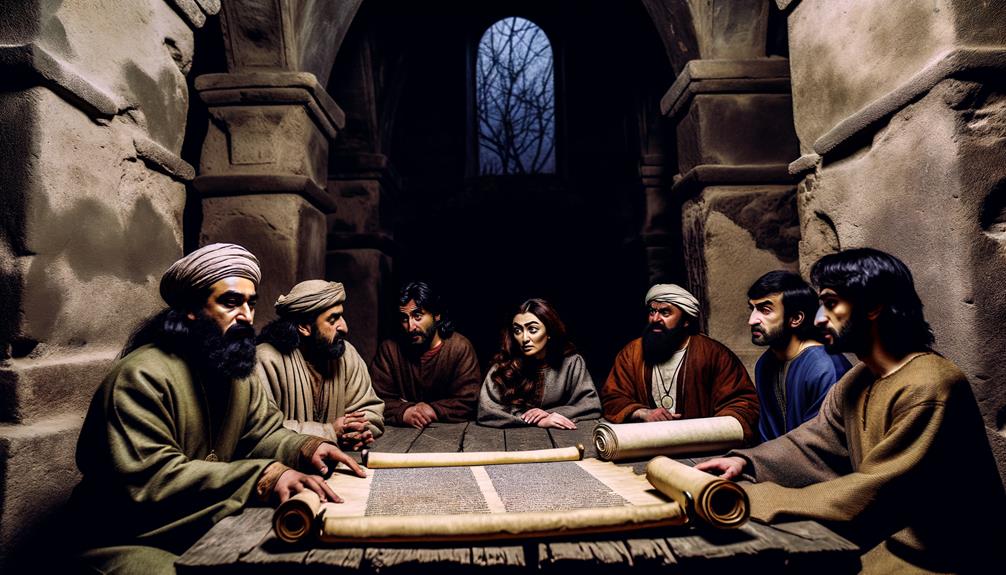
Examining the early church reactions to the Nicolaitans reveals a profound and vehement opposition, as evidenced by the denunciations found in the Book of Revelation.
The Nicolaitans’ practices and teachings were sternly condemned in Revelation 2:6 and 2:15, where their actions are described as detestable. This reaction underscores the early church’s commitment to doctrinal purity and moral integrity.
The Nicolaitans are depicted as propagators of licentiousness and idolatry, which starkly contradicted the Apostolic teachings.
The early church’s repudiation of the Nicolaitans signifies a broader resistance to heterodox influences that threatened ecclesiastical unity and ethical standards.
This vigorous opposition highlights the early Christians’ dedication to maintaining the sanctity of their burgeoning religious community.
Modern Perspectives

In contemporary theological discourse, interpretations of the Nicolaitans often reflect broader debates about heresy, ecclesiastical authority, and moral relativism within modern Christianity.
Scholars frequently analyze the Nicolaitans as a case study in early church conflicts over doctrinal purity versus inclusivity. Some argue that the Nicolaitans symbolize ongoing tensions between established religious norms and emergent, potentially heterodox beliefs. Others see them as indicative of power struggles within the early ecclesiastical hierarchy.
Moreover, moral relativism is a focal point, with the Nicolaitans’ alleged licentious practices prompting discussions on the boundaries of Christian ethical standards.
Consequently, modern perspectives on the Nicolaitans offer a rich field for examining how ancient controversies resonate within contemporary faith communities.
Conclusion
The term ‘Nicolaitans,’ as referenced in biblical texts, emerges as a symbol of divergent beliefs and practices that stood in contrast to early Christian orthodoxy.
Historical context and theological interpretations illuminate the complexities surrounding this group, whose practices were often condemned by early church leaders.
Modern perspectives continue to dissect the implications of the Nicolaitan doctrine, reflecting the ongoing struggle to maintain the purity of faith amidst the ever-evolving landscape of religious thought.