Footstool Meaning in the Bible: Submission and Authority
In biblical context, the footstool symbolizes God’s supreme dominion and authority, as well as humanity’s posture of humility and submission. Psalm 110:1 and Isaiah 66:1 utilize the footstool to depict the earth under God’s reign, emphasizing ultimate divine control and the subjugation of adversaries.
This imagery extends to Jesus’ teachings in the Gospels, illustrating the eschatological triumph of God’s kingdom. Additionally, it connects to the temple as a sacred space housing divine presence, illustrated in 1 Chronicles 28:2.
Understanding the multifaceted significance of the footstool in Scripture offers deeper insights into divine sovereignty and human subordination.

Key Takeaways
- Represents God’s supreme authority and dominion over all creation.
- Symbolizes submission to divine sovereignty and the humility of humanity.
- Depicts the earth as God’s footstool, highlighting His transcendence and immanence.
- Emphasizes divine presence in sacred spaces, notably the temple.
Footstool in Psalms

In the Psalms, the term ‘footstool‘ is frequently employed as a metaphor to signify the sovereign dominion and divine presence of God.
This metaphor elucidates a theological framework where the earth and all creation are under God’s supreme authority.
For instance, Psalm 99:5 exhorts worshipers to ‘exalt the LORD our God and worship at his footstool; he is holy,’ emphasizing reverence and submission to divine rule.
Similarly, Psalm 110:1 uses the imagery of a footstool to depict the subjugation of enemies, underscoring God’s omnipotence.
The recurrent use of ‘footstool’ in Psalms consequently serves to remind the faithful of the transcendent and immanent nature of God, reinforcing His ultimate power and sanctity in their spiritual lives.
Footstool in Isaiah

In the book of Isaiah, the concept of the footstool serves as a profound symbol of humility, illustrating humanity’s subservient relationship to divine authority.
This metaphor further encapsulates the representation of divine sovereignty, as God’s dominion encompasses the entire earth, which is depicted as His footstool.
Additionally, Isaiah employs the footstool imagery to convey an earthly throne, underscoring the tangible manifestation of God’s reign over creation.
Symbol of Humility
The metaphor of the footstool in the book of Isaiah profoundly illustrates the theme of humility by portraying humanity’s position in relation to God’s sovereignty.
Isaiah 66:1 states, ‘Heaven is my throne, and the earth is my footstool,’ highlighting the vast disparity between divine authority and human existence.
This doctrinal imagery serves to remind believers of their humble status before an omnipotent deity.
The footstool signifies submission and reverence, urging individuals to recognize their limitations and depend on God’s grace.
By employing such vivid symbolism, Isaiah effectively communicates the necessity of humility in the believer’s relationship with God, encouraging an attitude of worship and deference.
This theological concept is pivotal for understanding the human-divine dynamic in scriptural contexts.
Divine Sovereignty Representation
Isaiah’s depiction of the earth as God’s footstool not only underscores human humility but also emphatically asserts the absolute sovereignty of the divine. This metaphor highlights several significant theological points:
- Unparalleled Authority: God’s dominion over the earth is boundless and unchallenged, reinforcing His supreme rule.
- Cosmic Order: The imagery of a footstool brings forth the idea of an ordered universe, meticulously governed by divine will.
- Human Subordination: Humanity’s place within this divine hierarchy is unequivocally beneath God, emphasizing our dependence and finite nature.
Isaiah’s vivid portrayal serves as a doctrinal reminder of God’s omnipotence, beckoning believers to acknowledge their position within the grand divine scheme, fostering a sense of reverence and submission.
Earthly Throne Imagery
Analyzing the earthly throne imagery, Isaiah’s metaphor of the earth as God’s footstool conveys a profound theological assertion of divine kingship and authority over creation.
The prophet Isaiah articulates this in Isaiah 66:1, where God declares, ‘Heaven is my throne, and the earth is my footstool.’ This imagery underscores the transcendence and immanence of God, portraying His supreme rule and intimate involvement in the world.
It emphasizes the vastness of divine sovereignty, suggesting that all earthly domains are under His dominion. Additionally, it serves to remind believers of their place within the created order, encouraging humility and reverence.
Footstool in the Gospels

In the Gospels, Jesus’ reference to footstools is imbued with theological significance, often illustrating God’s dominion and the subjugation of earthly powers.
Through His teachings, Jesus employs the metaphor of a footstool to underscore the ultimate authority of the divine, as seen in Matthew 22:44 and Mark 12:36.
This symbolism consequently serves to reinforce the eschatological themes of subjection and the establishment of God’s kingdom.
Jesus’ Teaching on Footstools
Jesus’ teachings in the Gospels often use the metaphor of a footstool to illustrate the relationship between the divine and the earthly domains. This imagery emphasizes the sovereignty of God and the subservient role of creation. In Matthew 5:34-35, Jesus admonishes against swearing by heaven or earth, stating that earth is God’s footstool, underscoring divine authority and human humility.
This metaphor is rich with implications:
- Divine Authority: It evokes awe and reverence for God’s supreme power.
- Human Humility: It reminds believers of their place within the created order.
- Spiritual Perspective: It encourages a focus on heavenly rather than earthly things.
These teachings challenge believers to recognize their dependence on God and to live in a manner that honors divine authority.
Symbolism in Footstool References
Throughout the Gospels, the symbolism of the footstool serves as a profound representation of the relationship between the divine and the earthly, illustrating themes of divine authority, human humility, and spiritual perspective. This metaphor underscores the supremacy of God and the subservience of creation, aligning with the broader biblical narrative.
| Verse Reference | Context | Symbolic Implication |
|---|---|---|
| Matthew 5:35 | Jesus’ Sermon on the Mount | Earth as God’s footstool |
| Mark 12:36 | David’s Psalm quoted by Jesus | Enemies as a footstool |
| Luke 20:43 | Jesus’ teaching in the Temple | Divine victory over opposition |
| Acts 7:49 | Stephen’s speech | Heaven as God’s throne |
These references collectively enrich the theological understanding of God’s omnipotence and humanity’s place within divine order.
Symbol of Humility

The concept of a footstool in biblical texts often serves as a profound emblem of humility, illustrating human subservience to divine authority. This symbolism is deeply rooted in the following aspects:
- Recognition of God’s Sovereignty: The imagery of God’s throne and the earth as His footstool (Isaiah 66:1) underscores the vastness of divine supremacy over human existence.
- Human Acknowledgment of Limitations: By acknowledging oneself as a footstool, an individual accepts their finite nature and dependence on God’s infinite wisdom.
- Moral and Spiritual Reflection: The footstool metaphor calls believers to adopt a posture of humility, reflecting on their moral and spiritual duties in light of divine expectations.
These elements collectively evoke a heartfelt reverence for divine authority and promote an ethos of humility.
Sign of Submission
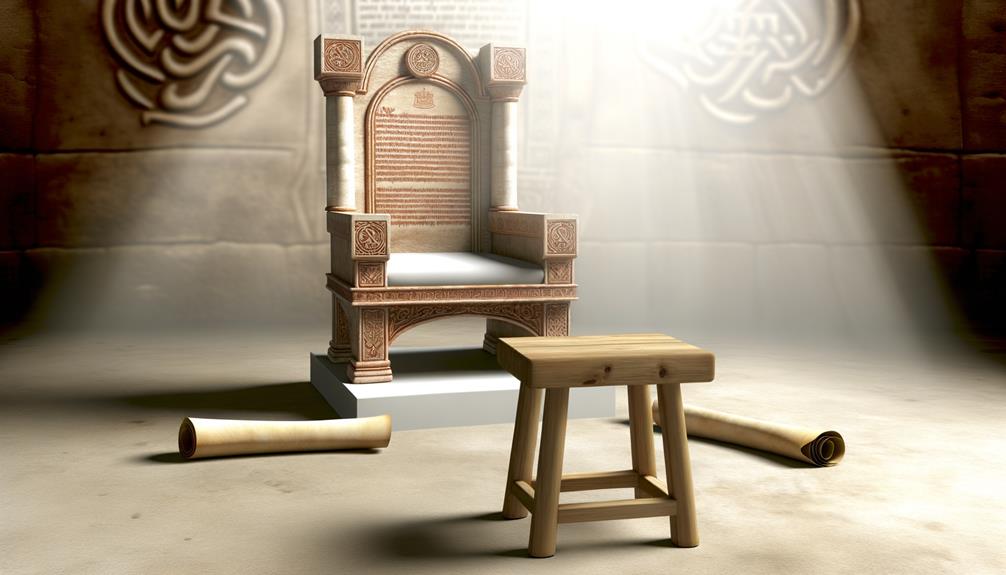
Building on the theme of humility, the footstool in biblical literature also serves as a potent symbol of submission to divine authority. The act of placing one’s feet on a footstool signifies subordination and acknowledgment of a higher power.
In Psalm 110:1, the phrase ‘until I make your enemies a footstool for your feet’ encapsulates this notion, implying the ultimate submission of adversaries under God’s dominion. Such imagery is recurrent in Scripture, illustrating a cosmic order where all creation is subject to the sovereignty of the Almighty.
The footstool, therefore, becomes a doctrinal emblem signifying not only humility but also the rightful place of humanity under God’s supreme rule, urging believers to recognize and accept their subordinate position.
Representation of Divine Authority

In biblical texts, the footstool frequently symbolizes the unparalleled dominion and authority of God over all creation. This imagery is employed to evoke a sense of divine supremacy and sovereignty, underscoring God’s ultimate control and governance. By depicting the earth as His footstool, the scriptures convey three profound truths:
- God’s Transcendence: Highlighting that God exists above and beyond the confines of the material world.
- Divine Kingship: Emphasizing God’s role as the eternal ruler and sovereign over all nations and beings.
- Judgment and Justice: Illustrating His authority to judge and administer justice throughout creation.
This doctrinal perspective reinforces the belief in God’s omnipotence and His rightful position as the supreme authority in the cosmos.
Connection to the Temple

Biblical references to the footstool frequently establish a symbolic link between God’s divine presence and the sanctity of the temple.
In 1 Chronicles 28:2, David refers to the Ark of the Covenant as God’s footstool, explicitly connecting it to the central place of worship in Jerusalem. This imagery underscores the temple as the earthly dwelling of God’s presence, where His authority and holiness are manifest.
Similarly, Psalm 132:7-8 emphasizes the temple as a locus for divine encounter, inviting worshippers to “worship at his footstool” and acknowledging the temple’s role in mediating divine-human interaction.
Consequently, the concept of the footstool serves as a profound theological metaphor, illustrating the intimate relationship between divine transcendence and the sacred space of the temple.
Footstool in Prophecy

The prophetic literature of the Bible frequently employs the imagery of the footstool to signify the ultimate subjugation of God’s enemies and the establishment of His sovereign reign. This powerful symbol is woven into numerous prophecies, underscoring a profound theological truth: God’s omnipotence and justice will prevail. In particular, the footstool imagery in Psalms and Isaiah crystallizes this divine promise.
- Psalm 110:1 – ‘The LORD says to my lord: ‘Sit at my right hand until I make your enemies a footstool for your feet.”
- Isaiah 66:1 – ‘Thus says the LORD: ‘Heaven is my throne, and the earth is my footstool.”
- Hebrews 1:13 – Reiterates the subjugation theme in the context of Christ’s preeminence.
These passages vividly project the eschatological victory of God.
Conclusion
In biblical literature, the term ‘footstool’ carries profound theological significance, symbolizing humility, submission, and divine authority.
Its appearances in Psalms, Isaiah, the Gospels, and prophetic texts highlight its multifaceted role in expressing humanity’s relationship to the divine.
Although some might argue that such symbolism is archaic, its continued relevance in religious discourse underscores enduring themes of reverence and divine sovereignty, making it a compelling subject for both scholarly analysis and doctrinal reflection.