
Sickle Meaning In The Bible: Judgment and Harvest
In biblical texts, the sickle is a profound symbol of divine judgment and the cyclical nature of life and spirituality. Rooted in the agrarian practices of ancient Israel, it represents both physical and eschatological harvests, often conveying themes of divine retribution and renewal.
In the Book of Joel, for instance, the sickle underscores the urgency of repentance amidst impending judgment, while Isaiah and Revelation utilize it to illustrate divine justice and the ultimate fate of souls. These layers of meaning reveal the deeply intertwined nature of agricultural rituals and spiritual metaphors in scripture, inviting further exploration of its symbolic richness.

Key Takeaways
- The sickle symbolizes divine judgment and the harvesting of souls in biblical eschatology.
- It represents the urgency and finality of God’s judgment, as depicted in Revelation 14:14-20.
- In the Book of Joel, the sickle underscores themes of repentance and impending divine retribution (Joel 3:13).
- It serves as a metaphor for separating the righteous from the wicked, emphasizing ultimate justice under divine sovereignty.
Historical Context of the Sickle

The historical context of the sickle in biblical times is intricately tied to the agrarian society of ancient Israel, where this tool was indispensable for the harvest.
This era, characterized by its reliance on agriculture for sustenance and economic stability, imbued the sickle with significant symbolic and practical value.
The sickle’s design—typically featuring a curved blade—was optimized for cutting grains, reflecting the technological advancements of the period.
References to the sickle in biblical texts often symbolize not only physical harvests but also divine judgment and providence.
Understanding the cultural and economic backdrop of ancient Israel enhances our grasp of why the sickle was prominent in biblical narratives, serving as a potent metaphor for reaping and moral reckoning.
The Sickle in Ancient Agriculture

In ancient agricultural societies, the sickle was an indispensable tool for harvesting crops, symbolizing both sustenance and the cyclical nature of life.
Its presence in biblical texts often carries metaphorical weight, reflecting themes of judgment and renewal.
Over time, the design and usage of the sickle evolved, mirroring advancements in agricultural practices and technological innovation.
Harvesting With Sickles
Integral to ancient agricultural practices, sickles were indispensable tools for harvesting crops, reflecting both the technological advancements and the cultural significance of agrarian societies in biblical times.
The design of the sickle, with its curved blade, allowed for efficient cutting of cereal grains like wheat and barley, essential staples in the biblical diet. This efficiency not only facilitated the gathering of food but also underscored the agrarian economy’s reliance on timely and effective harvests.
The labor-intensive process of using sickles required skill and coordination, often involving entire communities in collective effort.
Additionally, the sickle’s presence in agricultural rituals and festivals highlights its centrality in the socio-economic and religious life of ancient Israel, embodying the community’s dependence on the land.
Sickle’s Symbolic Meaning
Beyond its practical utility, the sickle in ancient agriculture also held profound symbolic meaning, reflecting deeper themes of life, death, and renewal within biblical narratives.
The act of harvesting with a sickle symbolized divine judgment and the shift from one season to another, often alluding to the end times and the gathering of souls. In prophetic scriptures, the sickle becomes a metaphor for God’s reaping of the earth, a vivid depiction of eschatological events.
Additionally, the cyclical nature of agriculture, mirrored in the sickle’s use, underscores themes of renewal and rebirth. This agricultural tool therefore transcends its physical purpose, embedding itself in the spiritual and eschatological framework of biblical literature, highlighting both divine justice and the promise of new beginnings.
Evolution of Sickle
As the symbolic significance of the sickle is deeply intertwined with its practical origins, understanding its evolution in ancient agriculture provides a foundational context for its multifaceted role in biblical texts.
The sickle, a simple yet revolutionary tool, emerged around 3000 BCE in the Fertile Crescent. Initially crafted from flint and later from bronze, it facilitated efficient harvesting, pivotal for agrarian societies. Its curved blade was designed to cut through cereal stalks, embodying the essence of sustenance and survival.
This utilitarian instrument not only shaped agricultural practices but also influenced socio-economic structures, as communities evolved from nomadic lifestyles to settled farming.
In biblical narratives, the sickle’s agricultural significance amplifies its metaphorical and eschatological connotations, enriching its scriptural symbolism.
Symbolism in the Book of Joel
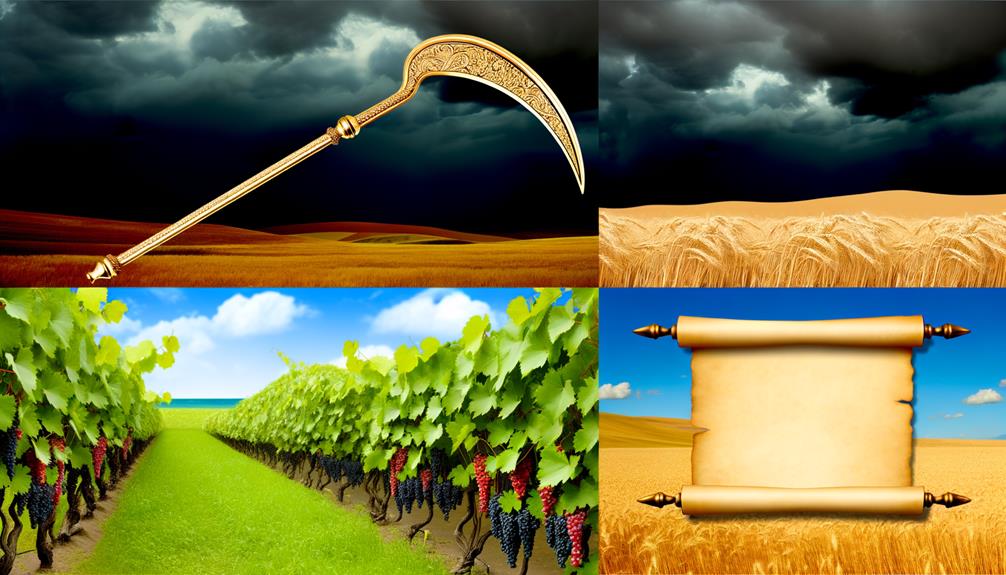
Joel’s prophetic visions employ rich agricultural imagery, with the sickle symbolizing divine judgment and the impending harvest of nations. This metaphor conveys the urgency and severity of God’s retributive justice. Joel 3:13 states, “Put in the sickle, for the harvest is ripe,” signifying the culmination of sin and the readiness for divine intervention. The sickle’s sharpness represents the swiftness of God’s judgment, cutting down those who oppose His will. This imagery underscores the themes of repentance and divine retribution, urging nations to turn back to righteousness before the inevitable harvest.
| Symbol | Meaning |
|---|---|
| Sickle | Divine judgment |
| Harvest | Culmination of sin |
| Sharpness | Swiftness of God’s judgment |
| Ripe | Readiness for divine action |
Such vivid symbolism invites readers to reflect on their moral standing and the consequences of their actions.
Harvest Imagery in Isaiah

Isaiah’s utilization of harvest imagery intricately intertwines themes of divine judgment, redemption, and the fulfillment of God’s promises to His people.
In Isaiah 17:5-6, the prophet depicts the judgment of nations through the metaphor of a reaper gathering grain, underscoring the inevitability of divine intervention.
Conversely, Isaiah 27:12-13 portrays the redemption and gathering of Israel, likened to a harvest, symbolizing the restoration and ingathering of God’s chosen.
This duality encapsulates both the severity of God’s judgment and the hope of renewal.
The harvest metaphor serves as a vivid reminder of the cyclical nature of divine justice and mercy, reflecting the broader covenantal themes prevalent throughout Isaiah’s prophecies.
Prophetic Visions in Revelation

The Book of Revelation employs vivid, often enigmatic imagery to convey prophetic visions that encapsulate the ultimate triumph of good over evil and the fulfillment of divine eschatological promises.
Central to these visions are symbolic representations, such as the sickle, which play a significant role in illustrating the divine harvesting of souls.
The vivid scenes described in Revelation, including the reaping of the earth (Revelation 14:14-19), emphasize the inevitability of divine judgment and the culmination of God’s plan for humanity.
This apocalyptic narrative uses the sickle as a potent symbol, intertwining it with themes of divine justice and cosmic renewal, thereby reinforcing the book’s overarching message of hope, judgment, and redemption within a divine framework.
Sickle as a Tool of Judgment

The sickle, often depicted in biblical texts, serves as a potent symbol of divine wrath and judgment, particularly in the context of eschatological events.
This imagery is vividly illustrated in the Book of Revelation, where the act of reaping with a sickle signifies the harvesting of the wicked at the culmination of the world.
Such depictions underscore the sickle’s role not merely as an agricultural implement but as an instrument of ultimate and irrevocable divine justice.
Symbolic Divine Wrath
In biblical texts, the sickle often emerges as a potent symbol of divine judgment, representing God’s decisive and unerring execution of justice. This imagery conveys a powerful message about the consequences of moral and spiritual failures.
The sickle, with its sharp, unwavering edge, symbolizes the following:
- Imminent judgment: A reminder of the urgent need for repentance.
- Unavoidable fate: Illustrating the inescapable outcome of divine scrutiny.
- Impartial justice: Reflecting God’s fair and unbiased assessment.
- Finality: Emphasizing the definitive nature of divine decrees.
This profound symbolism underscores the gravity of divine wrath, urging believers to align their lives with divine expectations to avoid severe repercussions.
Harvesting the Wicked
Eschatological imagery in biblical scripture frequently employs the sickle as a metaphorical instrument for harvesting the wicked, encapsulating the irrevocable nature of divine retribution.
This symbolism is vividly portrayed in Revelation 14:14-20, where an angel equipped with a sharp sickle reaps the earth’s harvest, symbolizing the final judgment.
The sickle’s association with farming underscores the inevitability of divine judgment, akin to the unavoidable harvest season.
This metaphor also draws on the agricultural practice of separating wheat from chaff, signifying the discernment between the righteous and the wicked.
Therefore, the sickle in this scenario is not merely a tool but a profound emblem of ultimate justice, where the wicked face their predetermined fate under divine sovereignty.
End Times Imagery
Replete with rich symbolism, the sickle in end-times imagery serves as a potent instrument of divine judgment, encapsulating the finality and inevitability of the eschaton. This powerful tool is often depicted in biblical texts as wielded by celestial figures, signifying the ultimate separation of the righteous from the wicked.
The vivid imagery of the sickle invokes a sense of:
- Unyielding justice: The inescapable reckoning that awaits humanity.
- Finality: The irreversible nature of divine judgment.
- Divine authority: The sovereign power of God over creation.
- Urgency: The impending and imminent nature of end-times.
These elements underscore the profound theological significance of the sickle in eschatological contexts.
Parables and the Sickle

The use of the sickle in biblical parables often serves as a potent symbol for divine judgment and the harvesting of souls at the end of the age. This imagery is prominently featured in the parables of Jesus, particularly in the New Covenant. The sickle represents the final gathering of humanity, separating the righteous from the wicked. Parables such as the Wheat and the Tares (Matthew 13:24-30) and the Harvest (Mark 4:26-29) employ the sickle to convey the urgency and inevitability of divine reckoning.
| Parable | Reference | Key Symbolism |
|---|---|---|
| Wheat and the Tares | Matthew 13:24-30 | Separation of righteous/wicked |
| Harvest | Mark 4:26-29 | Divine judgment |
| Vineyard Workers | Matthew 20:1-16 | Kingdom of Heaven |
Understanding these parables deepens our comprehension of eschatological themes in biblical literature.
Divine Intervention and the Sickle

Examining the role of the sickle within the context of divine intervention, we observe its profound significance as an instrument through which God’s direct engagement with humanity is symbolically depicted. The sickle often signifies both judgment and harvest, portraying a duality of divine action.
- Judgment Day: The sickle is wielded to separate the righteous from the wicked.
- Covenantal Fulfillment: Represents God’s promise to gather His people.
- Prophetic Imagery: Visualizes divine intervention in eschatological visions.
- Moral Reckoning: Symbolizes the ultimate accountability of humanity.
This multifaceted symbolism underscores the sickle’s role in conveying the gravity and hope inherent in divine intervention.
Conclusion
In the biblical narrative, the sickle emerges as a multifaceted symbol, intertwining the domains of agriculture, prophecy, and divine judgment.
Much like a reaper’s tool in the harvest fields, the sickle delineates the acts of separation and culmination, reflecting the divine intervention in human affairs.
Through allegorical lenses, it underscores the themes of readiness and accountability, reminding the faithful of the inevitable harvest where deeds are weighed, and destinies are sealed.