Ecclesia Meaning in the Bible: Church and Community
‘Ecclesia’ in the Bible, derived from the Greek word ‘ekklesia’, signifies the assembly of believers beloved by Christ. Originally a civic term in ancient Greece, it adopted profound theological meaning in the New Covenant, referring to the collective body of Christian followers.
This term echoes the Hebrew ‘qahal’, which described Israelite worship assemblies. Scriptural instances like Matthew 16:18 and Acts 2:42-47 highlight ecclesia’s foundational role in nurturing communal faith and spiritual unity.
Rooted in early Christian gatherings, modern interpretations of ecclesia emphasize its ongoing relevance in fostering community, worship, and mission. Explore further for deeper insights.
Key Takeaways
- ‘Ecclesia’ derives from the Greek ‘ekklesia’, meaning a civic assembly, later used in the New Testament to denote the Christian community.
- In the Old Testament, ‘qahal’ represents the assembly of Israelites for worship, influencing the concept of ‘ecclesia’.
- New Testament ‘ecclesia’ signifies the body of Christ’s followers, emphasizing spiritual unity and communal identity among believers.
- Early Christian gatherings, often in homes, focused on shared prayers, teachings, and breaking of bread, nurturing faith and community.
Origin of ‘Ecclesia’

The term ‘Ecclesia‘ originates from the Greek word ‘ekklesia,’ which historically referred to a civic assembly or gathering of citizens in ancient Greece. This concept was integral to Athenian democracy, where citizens convened to discuss and decide on public matters.
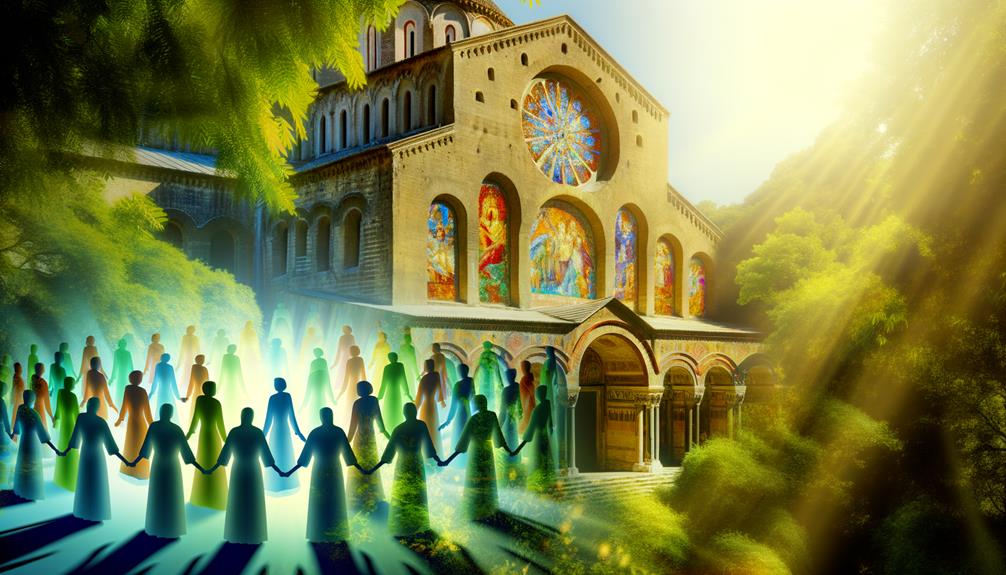
Theologically, the New Covenant writers adopted ‘ekklesia’ to describe the Christian community, reflecting a divinely called assembly rather than a mere social or political gathering. This linguistic shift emphasizes the communal and spiritual dimensions of the Church, encapsulating both the universality and the particular local assemblies of believers.
Scripturally, ‘ekklesia’ appears in contexts that underscore the spiritual unity and purpose of Christians, as seen in passages like Matthew 16:18 and Acts 2:42-47, where the term conveys a profound sense of divine mission and communal identity.
Old Testament Context
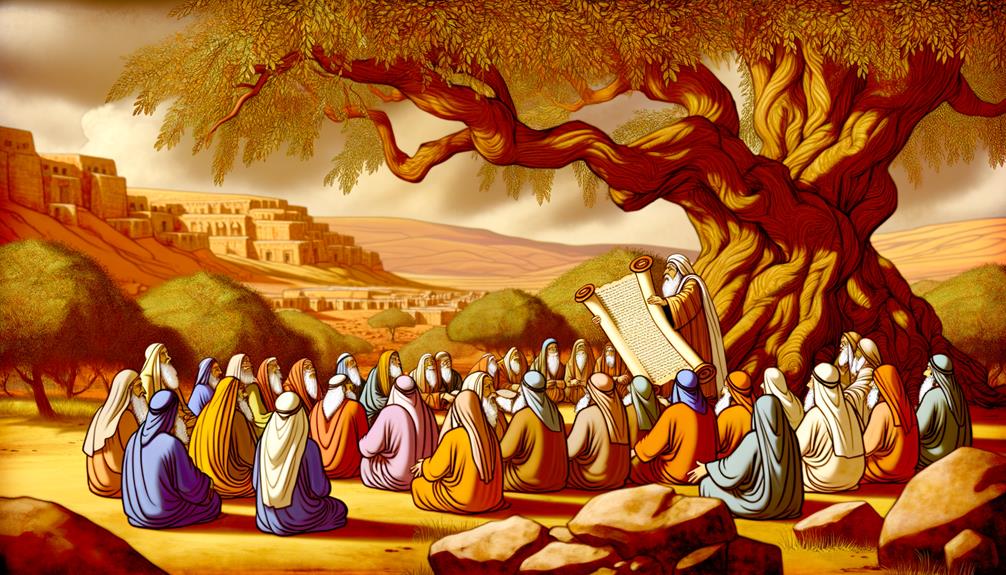
In the Old Scripture, the term ‘qahal‘ is pivotal, representing the assembly of Israelites gathered for worship and communal decision-making.
This Hebrew term, often translated as ‘assembly’ or ‘congregation,’ underscores the collective nature of Israelite worship and societal functions.
Examining the usage of ‘qahal’ provides foundational insights into the early conceptualizations of communal religious practice that later influenced the New Scripture understanding of ‘ecclesia.’
Hebrew Term “Qahal”
Rooted deeply in the Old Covenant, the Hebrew term ‘qahal’ refers to the assembly or congregation of the Israelites, often signifying a divinely ordained gathering of God’s chosen people. This term appears prolifically throughout the Old Scriptures, providing a foundational understanding of communal worship and covenantal relationships.
- Divine Assembly: ‘Qahal’ frequently denotes gatherings called by God, emphasizing a spiritual dimension.
- Covenantal Context: It underscores the communal aspect of the Israelites’ covenant with Yahweh.
- Scriptural References: Key passages include Deuteronomy 9:10 and 1 Samuel 17:47, illustrating its significance.
Understanding ‘qahal’ enriches our comprehension of biblical assembly and divine community.
Assembly of Israelites
Building on the understanding of ‘qahal’, the Assembly of Israelites in the Old Scripture context reflects a divinely orchestrated community bound by covenantal obligations and spiritual purpose.
This assembly, frequently mentioned in the Pentateuch and historical books, was convened for significant religious, judicial, and communal decisions.
For instance, Deuteronomy 9:10 and 18:16 highlight the assembly at Mount Sinai, where the Israelites received the Law.
This collective was not merely a social construct but a theological entity representing God’s chosen people, called to uphold His commandments.
The ‘qahal’ consequently served as a precursor to the New Covenant ‘ekklesia‘, embodying divine order, communal responsibility, and a covenant relationship with Yahweh, thereby underscoring the continuity of God’s redemptive plan.
Worship and Gatherings
Worship and gatherings in the Old scripture context were central to the religious life of the Israelites, serving as pivotal moments for communal prayer, sacrifice, and covenant reaffirmation. These gatherings were instrumental in fostering a collective identity rooted in their covenant with Yahweh.
Key aspects included:
- Tabernacle and Temple: Central places for worship where sacrifices and offerings were conducted.
- Feasts and Festivals: Annual events such as Passover and Yom Kippur that reinforced communal bonds and religious obligations.
- Sabbath Observance: Weekly day of rest and worship, emphasizing holiness and divine order.
These gatherings were not merely ritualistic but deeply spiritual, reinforcing the Israelites’ unique relationship with God.
New Testament Usage

In the New Scripture, the term ‘ecclesia‘ is primarily used to denote a gathering or assembly of believers, reflecting its evolution from a secular term for a civic assembly to a foundational concept in Christian theology.
Importantly, ecclesia appears in the Gospels and the Epistles, where it signifies the collective body of Christ’s followers. In Matthew 16:18, Jesus proclaims, ‘I will build my church [ecclesia],’ highlighting its divine origin and purpose.
Paul’s letters further elaborate on ecclesia as both local congregations (1 Corinthians 1:2) and the universal church (Ephesians 1:22-23). This dual usage underscores ecclesia’s role in fostering communal faith and spiritual unity, essential elements in the nascent Christian identity.
Early Christian Gatherings
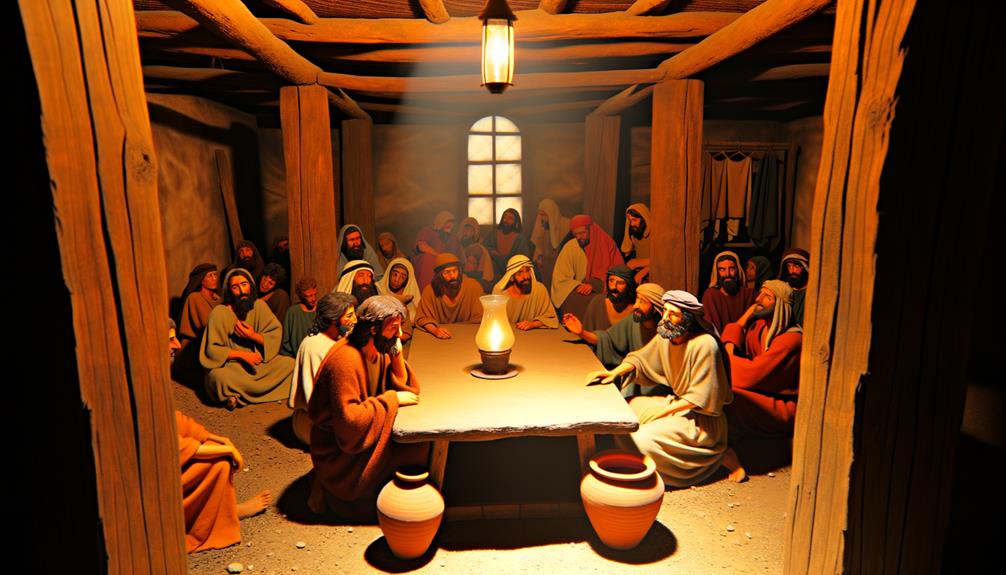
Early Christian gatherings, often held in private homes, were marked by a profound sense of worship and fellowship that fostered spiritual growth and community.
Scriptural accounts in Acts and Paul’s epistles highlight these house church meetings as foundational to the nascent Christian movement.
Through shared prayers, teachings, and the breaking of bread, these assemblies embodied the essence of ecclesia, nurturing the faith of early believers and expanding the reach of the Gospel.
House Church Meetings
House church meetings in the early Christian era were pivotal in fostering communal worship, doctrinal teaching, and the mutual support system that characterized the nascent Christian faith.
These gatherings, often held in private homes, provided an intimate setting for believers to grow in their faith and share in each other’s lives.
Key elements of these meetings included:
- Scriptural instruction: Teaching from the Hebrew Scriptures and apostolic letters.
- Prayer and praise: Collective expressions of worship and intercession.
- Breaking of bread: Commemorating the Lord’s Supper as a central act of devotion.
These house churches laid the foundational structure for Christian community life, deeply rooted in the principles of the early apostolic teachings.
Worship and Fellowship
Gathering for worship and fellowship among early Christians was a profound expression of their communal faith and theological convictions. These assemblies, often in private homes, were characterized by shared meals, prayers, hymns, and the reading of Scriptures (Acts 2:42).
Central to these gatherings was the Eucharist, or the Lord’s Supper, which signified unity and remembrance of Christ’s sacrifice (1 Corinthians 11:23-26). This practice of koinonia (fellowship) underscored mutual support and spiritual growth, as believers adhered to Christ’s command to love one another (John 13:34-35).
Theologically, these meetings were a microcosm of the Kingdom of God, reflecting early Christians’ understanding of being a distinct, sanctified community set apart from the world.
Community and Growth
The burgeoning sense of community among early Christians was instrumental in fostering spiritual growth and reinforcing their identity as a distinct and sanctified body of believers.
Early gatherings were not merely social; they were deeply spiritual assemblies rooted in the teachings of Christ and the apostles. These gatherings fostered:
- Mutual edification: Believers encouraged one another through shared testimonies and scriptural insights.
- Commitment to prayer: Collective prayers fortified their faith amidst persecution.
- Sacramental participation: Regular observance of the Eucharist reinforced their unity in Christ.
Acts 2:42-47 encapsulates this ethos, describing a community devoted to the apostles’ teaching, fellowship, breaking of bread, and prayers, thereby illustrating the early ecclesia’s holistic approach to growth.
Ecclesia and Community
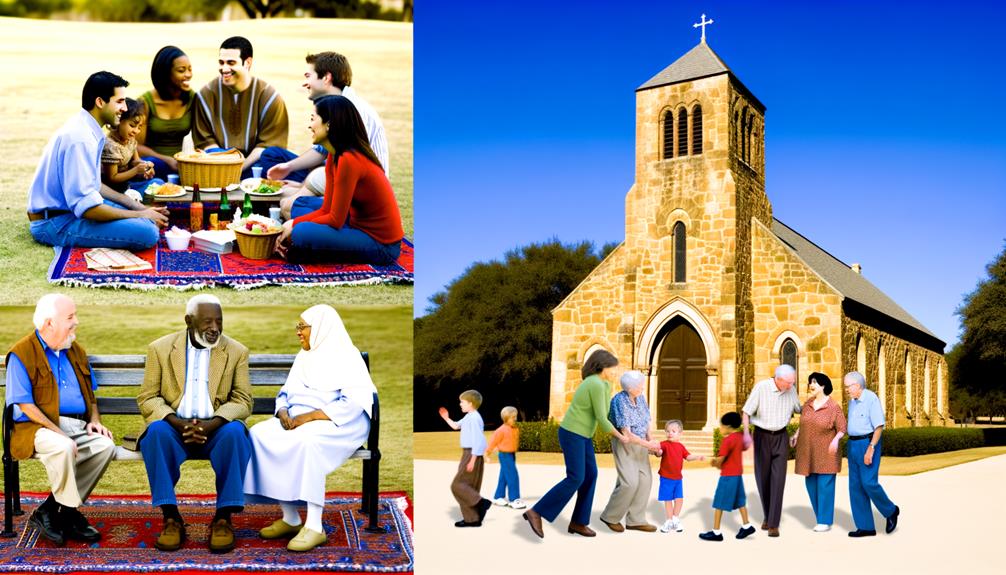
In the New Covenant, the term ‘ecclesia‘ not only refers to a gathering of believers but also emphasizes the profound sense of community and mutual support that characterized the early Christian assemblies.
Scripturally, this communal bond is evident in Acts 2:42-47, where believers devoted themselves to the apostles’ teaching, fellowship, breaking of bread, and prayers.
Historically, the ecclesia functioned as a tight-knit community, sharing resources to guarantee no member was in need (Acts 4:32-35). This collective identity fostered spiritual growth and resilience amid persecution.
Theologically, the concept underscores the unity of the Body of Christ, as articulated in 1 Corinthians 12:12-27, where individual members are interdependent, reflecting the interconnectedness and harmony intended by God.
Ecclesia in Worship

Central to the concept of ecclesia is the practice of worship, which historically and scripturally served as a focal point for communal expression of faith and devotion.
Worship within the ecclesia is not merely a ritual but a profound theological act that encapsulates the essence of Christian belief. The New Scriptures underscore this through various forms:
- Praise and Thanksgiving: Expressed in hymns and psalms, reflecting gratitude.
- Prayer: A direct communication with God, fostering spiritual intimacy.
- Sacraments: Baptism and Eucharist, symbolizing covenant and divine grace.
These elements collectively create a sacred space where believers can encounter the divine, reinforcing communal bonds and spiritual growth.
Ecclesia and Mission

Frequently rooted in the Great Commission, ecclesia’s mission encompasses proclaiming the gospel, fostering discipleship, and serving diverse communities in alignment with Christ’s teachings. This mission derives its theological foundation from passages such as Matthew 28:19-20, where Jesus instructs His followers to ‘make disciples of all nations.’
Historically, the early church, as depicted in the Acts of the Apostles, exemplified this mandate by engaging in apostolic preaching, communal living, and social outreach.
Scripturally, the ecclesia is seen as the body of Christ (1 Corinthians 12:27), tasked with embodying His love and grace. Hence, the mission of the ecclesia extends beyond mere evangelism, incorporating holistic care and the cultivation of a transformative, Christ-centered community.
Modern Interpretations

While the traditional understanding of ecclesia remains rooted in biblical mandates, contemporary interpretations often emphasize its role in addressing modern societal challenges through faith-based initiatives and community engagement. These interpretations draw on theological expertise and historical context to provide a more nuanced view of ecclesia’s evolving functions.
- Community Building: Ecclesia is seen as a hub for fostering social cohesion and mutual support.
- Social Justice: Many modern ecclesiae focus on advocating for marginalized groups, inspired by biblical teachings on justice.
- Education: Ecclesia serves as a center for moral and ethical education, guiding individuals in biblical principles.
This approach provides a dynamic and relevant application of ancient ecclesial principles.
Relevance Today

The relevance of ecclesia today lies in its persistent role as a transformative agent in society, guided by its scriptural foundation and historical evolution.
Rooted in the Greek term for ‘assembly’ and signifying the congregation of believers, ecclesia remains essential in fostering community, moral guidance, and social justice.
Scripturally, it embodies the collective body of Christ (1 Corinthians 12:27), tasked with manifesting divine principles in a secular world.
Historically, ecclesia has adapted to societal shifts, yet steadfastly upheld core Christian tenets.
In contemporary contexts, it addresses modern challenges such as technological advancement and ethical dilemmas, maintaining its crucial presence.
The ecclesia’s commitment to communal worship, service, and spiritual growth underscores its enduring significance.
Conclusion
The term ‘ecclesia‘ embodies a profound and evolving concept within the biblical tradition.
Originating in ancient Greek, its application spans from the Old Scripture to the New Scripture, representing the assembly of God’s people.
Early Christian gatherings further shaped its meaning, emphasizing community, worship, and mission.
Modern interpretations continue to explore its relevance, suggesting that ‘ecclesia’ remains an essential construct for understanding the nature of the Church and its role in contemporary society.