Meaning of Pillars in the Bible: Strength and Stability
In biblical literature, pillars are profound symbols representing God’s presence, guidance, and covenant with His people. They memorialize pivotal divine encounters, as seen with Jacob’s anointed stone at Bethel or the pillars of cloud and fire during the Israelites’ exodus.
In Solomon’s Temple, Jachin and Boaz stand as emblems of divine establishment and strength. Each pillar serves as a tangible reminder of the intersection between the sacred and earthly domains, illustrating themes of faith, stability, and divine assurance.
Exploring these symbols further reveals deeper theological insights and cultural messages embedded in biblical narratives.

Key Takeaways
- Pillars symbolize God’s presence, covenant, and guidance in biblical narratives.
- They mark significant divine-human encounters and serve as reminders of God’s promises.
- Pillars of Cloud and Fire provided physical and spiritual guidance for the Israelites during the Exodus.
- Jachin and Boaz in Solomon’s Temple signify strength, stability, and God’s enduring support.
Pillars as Divine Symbols

Pillars in the Bible frequently serve as divine symbols, representing God’s presence, covenant, and guidance throughout various narratives and theological constructs. These structures often mark significant encounters between the divine and humanity, accentuating their theological importance.
For instance, the pillar of cloud and fire in Exodus signifies God’s guidance and protection for the Israelites during their exodus from Egypt. Similarly, the pillars of the temple in Jerusalem epitomize God’s enduring covenant with His people.
These pillars are not merely architectural elements but are imbued with profound spiritual significance, embodying the intersection of the sacred and the earthly. Consequently, biblical pillars serve as tangible reminders of divine interaction, manifesting God’s will and reaffirming His promises to His followers.
Jacob’s Anointed Pillar

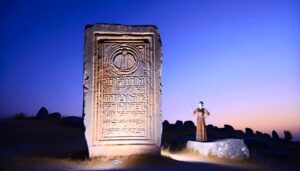
Jacob’s anointed pillar, as described in the Book of Genesis, serves as a significant witness to his divine encounter at Bethel, symbolizing both his covenant with God and the consecration of a sacred space. This event, recorded in Genesis 28:18-22, marks a pivotal moment in Jacob’s spiritual journey.
The anointed pillar represents:
- Divine Encounter: Jacob’s dream of a ladder reaching heaven, with angels ascending and descending, signifies God’s presence and promise.
- Covenant: The act of anointing the stone with oil solidifies Jacob’s vow to worship and serve God if He guarantees Jacob’s safety.
- Sacred Space: Naming the place Bethel, meaning ‘House of God,’ Jacob consecrates the location as holy ground for future generations.
Pillars of Cloud and Fire

The Pillars of Cloud and Fire serve as profound symbols of divine guidance, manifesting God’s presence and leadership during the Israelites’ exodus from Egypt.
These pillars provided not only physical direction and protection but also spiritual reassurance, underscoring the covenantal relationship between God and His people.
Their significance extends beyond mere historical narrative, embodying themes of faith, trust, and divine intervention in the journey of the Israelites.
Divine Guidance Symbols
Serving as profound symbols of divine guidance and protection, the pillars of cloud by day and fire by night in the biblical narrative of the Exodus represent God’s omnipresence and leadership for the Israelites during their journey from Egypt to the Promised Land.
These pillars serve several key purposes:
- Divine Presence: Signifying God’s constant presence, the pillars reassured the Israelites of His unceasing watchfulness.
- Guidance: Acting as navigational aids, these pillars directed the Israelites’ path, ensuring they traveled in the right direction.
- Protection: Providing safety from harsh desert conditions and potential enemies, the pillars underscored God’s protective nature.
Their dual function as symbols of both guidance and protection underscores the multifaceted role of divine intervention in the Israelites’ exodus.
Israelite Journey Significance
Integral to understanding the Israelite journey, the pillars of cloud and fire are emblematic of the multifaceted dimensions of faith, obedience, and divine interaction within the biblical narrative.
These pillars, described in Exodus 13:21-22, served as tangible manifestations of God’s presence and guidance, directing the Israelites through the wilderness.
The cloud by day provided shelter from the scorching desert sun, symbolizing protection and comfort. Conversely, the fire by night offered illumination and warmth, signifying divine vigilance and guidance in darkness.
The duality of these pillars underscores a continuous, unwavering divine accompaniment, reinforcing the notion of an ever-present God who actively participates in the faith journey of His people, ensuring their adherence to His covenant and leading them towards the Promised Land.
Pillars in Solomon’s Temple

The pillars in Solomon’s Temple, named Jachin and Boaz, are significant both in their intricate design and profound symbolism, encapsulating the theological and cultural ethos of ancient Israel.
Their historical significance is further underscored by the Temple’s role as a central place of worship and national identity.
Additionally, the architectural techniques employed in their construction showcase advanced craftsmanship and an understanding of structural engineering that was remarkable for the period.
Design and Symbolism
Within the architectural grandeur of Solomon’s Temple, the two bronze pillars, Jachin and Boaz, held profound symbolic significance and were meticulously designed to convey theological and cultural messages.
These pillars, standing at the temple’s entrance, were not mere structural elements but emblematic of divine presence and covenantal assurance.
- Names and Meanings: ‘Jachin’ means ‘He will establish,’ and ‘Boaz’ translates to ‘In Him is strength,’ reflecting God’s enduring support and strength.
- Height and Ornamentation: Each pillar stood approximately 27 feet tall, adorned with intricate capitals and pomegranates, symbolizing fertility and abundance.
- Position and Function: Positioned at the temple’s threshold, they served as a visual and spiritual gateway, demarcating the sacred space from the secular world.
These elements combined to elevate their symbolic stature within the temple.
Historical Significance
Emerging from the rich tapestry of Israelite history, the pillars Jachin and Boaz in Solomon’s Temple encapsulate a narrative of divine favor and cultural identity that shaped the religious consciousness of ancient Israel. These monumental structures, positioned at the temple’s entrance, symbolized stability and strength, reflecting God’s covenantal promises. Their names, Jachin meaning ‘He will establish’ and Boaz meaning ‘In Him is strength,’ denoted a theological affirmation of God’s enduring presence.
| Pillar | Meaning |
|---|---|
| Jachin | ‘He will establish’ |
| Boaz | ‘In Him is strength’ |
| Position | Temple Entrance |
| Symbolism | Divine Favor |
Jachin and Boaz consequently stood not just as architectural features but as profound emblems of faith, reinforcing Israel’s spiritual heritage.
Architectural Techniques
Understanding the historical significance of Jachin and Boaz brings us to an exploration of the sophisticated architectural techniques employed in their construction within Solomon’s Temple.
These pillars, crafted from cast bronze, demonstrate advanced metallurgical and construction skills. The techniques utilized can be summarized as follows:
- Casting and Molding: The bronze was cast in clay molds, likely in the Jordan Valley, requiring immense craftsmanship and precision.
- Transport and Assembly: Transporting these massive pillars to Jerusalem and erecting them involved complex logistics and engineering know-how.
- Ornamental Design: The capitals adorned with pomegranates and lilies illustrate intricate ornamental work, reflecting not only aesthetic considerations but also symbolic significance.
These elements collectively highlight the remarkable architectural ingenuity of the period.
Pillars of Strength and Stability

In biblical literature, pillars serve as potent symbols of strength and stability, often representing the enduring support provided by faith and divine presence. These structures frequently appear in narratives to denote God’s unwavering support and the resilience of faith. For instance, pillars in the Temple of Solomon—Jachin and Boaz—symbolize establishment and strength, underscoring the divine foundation and fortitude bestowed upon the faithful.
| Symbol | Representation | Biblical Reference |
|---|---|---|
| Jachin | Establishment | 1 Kings 7:21 |
| Boaz | Strength | 1 Kings 7:21 |
| Pillar of Cloud | Divine Guidance | Exodus 13:21 |
Through these powerful representations, pillars emphasize the critical role of divine support and spiritual steadfastness in the biblical narrative.
Pillars in Prophetic Visions

Throughout prophetic visions in the Bible, pillars often serve as profound metaphors for divine intervention and revelation, encapsulating the intersection of the heavenly domain with human experience. These symbolic structures frequently convey messages of support, judgment, and transformation.
Notable instances include:
- Jacob’s Ladder (Genesis 28:12): A heavenly pillar connecting earth and heaven, symbolizing divine communication and God’s promise.
- Pillar of Fire and Cloud (Exodus 13:21-22): Guiding the Israelites, signifying God’s presence and protection.
- Pillars of the Temple (Revelation 3:12): Representing the steadfast and eternal nature of the faithful in God’s kingdom.
These examples illustrate how pillars in prophetic visions are not merely physical structures, but profound theological symbols that convey deeper spiritual truths.
Pillars in the Early Church
Building on the rich symbolism of pillars in prophetic visions, the early Christian community also adopted the metaphor of pillars to describe foundational figures and elements within the nascent Church.
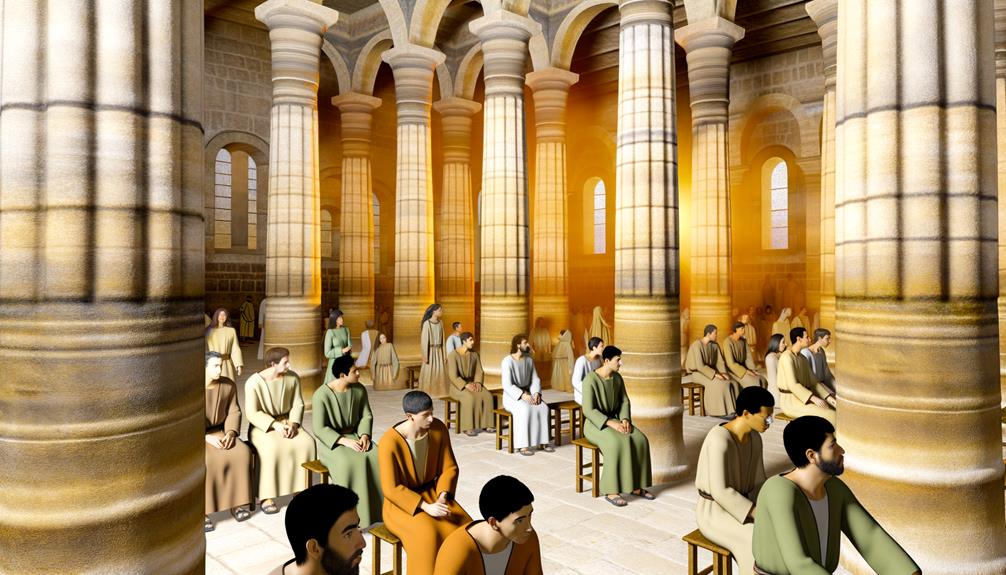
Key apostles, such as Peter, James, and John, were often referred to as ‘pillars’ (Galatians 2:9), signifying their roles as steadfast supports in the establishment and growth of the Christian faith.
This metaphor extended beyond individuals to include doctrinal truths and communal practices that provided structural integrity to the Church.
The use of ‘pillars’ emphasized the importance of stability, strength, and continuity in the face of external pressures and internal divisions, ensuring the Church’s resilience and unity during its formative years.
Modern Interpretations of Pillars

Examining contemporary theological scholarship reveals that the metaphor of pillars continues to hold significant interpretative value, symbolizing enduring principles and key figures that underpin modern Christian thought and practice.
The metaphorical use of pillars is frequently analyzed in the following contexts:
- Doctrinal Foundations: Pillars represent the core doctrines of Christianity, such as faith, grace, and salvation, which provide a stable framework for belief.
- Ecclesiastical Leadership: Pillars symbolize influential leaders and theologians whose teachings and leadership uphold the integrity and direction of the Church.
- Moral and Ethical Standards: Pillars are seen as embodiments of moral virtues and ethical standards that guide the behavior and practices of believers in contemporary society.
These interpretations underscore the enduring relevance of the pillar metaphor in guiding modern Christian thought.
Conclusion
In the biblical narrative, pillars emerge as profound symbols of divine presence, covenantal promises, and spiritual fortitude.
From Jacob’s anointed stone to the guiding pillars of cloud and fire, and the structural grandeur of Solomon’s Temple, these pillars embody strength, stability, and divine guidance.
Prophetic visions and early church references further underscore their significance.
Like steadfast sentinels, these pillars stand as timeless beacons, illuminating the enduring connection between the divine and the faithful across epochs.