
Meaning of Joaquin in the Bible: God Will Judge
The name Joaquin, rooted in the Hebrew Jehoiakim, translates to ‘God will establish,’ anchoring a significant theological sentiment in Biblical scripture. Jehoiakim, a recurring name in ancient Israel, highlights divine sovereignty and continuity within the Davidic lineage, especially emphasized through Jehoiachin’s narrative of captivity and survival.
The name’s evolution—from Hebrew to Greek, Latin, and into Spanish as Joaquin—illustrates its linguistic and cultural journey. Reflecting both historical and theological contexts, Joaquin encapsulates themes of divine promise and faithfulness.
Explore the broader implications of this name’s significance within cultural, religious, and historical domains.

Key Takeaways
- Joaquin is derived from Jehoiakim, meaning ‘God will establish’ or ‘Yahweh establishes.’
- Jehoiakim and Jehoiachin were significant figures in the Bible associated with divine sovereignty and the Davidic lineage.
- The name underscores themes of divine promise, establishment, and continuity of God’s covenant.
- Jehoiachin’s captivity in Babylon illustrated God’s judgment and the preservation of the Davidic line.
Origins and Etymology

Rooted in the Hebrew language, the name Joaquin originates from the Hebrew name Jehoiakim, which translates to ‘God will establish.’ This etymology reflects a profound theological assertion, encapsulating a divine promise and the establishment of God’s will.
Jehoiakim, a common name in ancient Israel, underscores a societal emphasis on divine sovereignty and providence. The name’s evolution from Jehoiakim to Joaquin illustrates linguistic evolution through cultural and geographical shifts, retaining its foundational meaning while adapting phonetically.
Understanding this etymological pathway offers insight into how names serve as vessels for cultural and religious values, embodying continuity and adaptation within the Judeo-Christian tradition. This contextual framework enriches our comprehension of the name’s enduring significance across different eras and locales.
Jehoiachin in Scripture
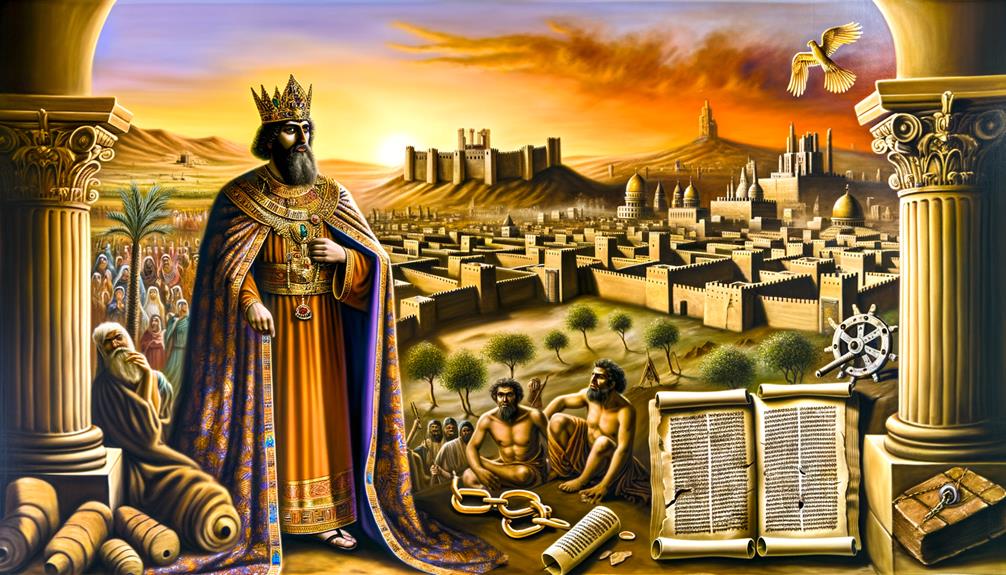
Jehoiachin’s narrative in Scripture is marked by his captivity in Babylon, which signifies an essential moment in the history of Judah’s monarchy.
This period of exile not only reflects the political turmoil of the era but also underscores the theological implications of divine judgment and mercy.
Furthermore, Jehoiachin’s lineage holds profound significance, as it connects to the Messianic prophecies and the Davidic line, consequently enriching the understanding of his role in biblical history.
Jehoiachin’s Captivity Explained
Frequently examined in biblical studies, the captivity of Jehoiachin is a pivotal event that provides insight into the political and theological dynamics of ancient Judah. His imprisonment by Nebuchadnezzar II of Babylon marked a significant shift, reflecting the geopolitical turmoil and divine retribution themes prevalent in the period’s prophetic literature. Jehoiachin’s captivity lasted 37 years, underscoring the severity of Babylonian control over Judah and the fulfillment of Jeremiah’s prophecies. The event is meticulously chronicled in 2 Kings 24:8-17 and 2 Chronicles 36:9-10, highlighting its importance in biblical history.
| Event | Biblical Reference | Duration |
|---|---|---|
| Jehoiachin’s Reign | 2 Kings 24:8 | 3 months |
| Captivity Begins | 2 Kings 24:12 | 597 BCE |
| Captivity Duration | 2 Kings 25:27-30 | 37 years |
| Release from Prison | 2 Kings 25:27 | 560 BCE |
Significance of Jehoiachin’s Lineage
The lineage of Jehoiachin holds considerable significance in biblical narratives, as it underscores the continuation of Davidic heritage despite the tribulations of exile and captivity.
Jehoiachin, also known as Jeconiah, was a descendant of King David, and his imprisonment in Babylon posed a threat to the Davidic line. However, his eventual release and the survival of his descendants, as chronicled in 2 Kings 25:27-30, affirm the persistence of God’s covenant with David.
This lineage is essential for understanding messianic prophecies, as it bridges the Old Covenant promises to the New Covenant realization in Jesus Christ, who is portrayed as a descendant of David through Jehoiachin.
This continuity emphasizes divine faithfulness and the fulfillment of scriptural prophecy.
Linguistic Evolution

Over centuries, the name Joaquin has undergone significant linguistic evolution, reflecting diverse cultural influences and historical contexts.
Originating from the Hebrew name Jehoiachin, meaning ‘Yahweh establishes,’ it transformed through languages and regions. In Hebrew, it was Yəhōiaḥin, which evolved into Ioakim in Greek, and Ioaquin in Latin.
The Spanish adaptation, Joaquin, emerged during the Reconquista, reflecting Iberian phonetic preferences. This progression illustrates the fluidity of names as they traverse linguistic boundaries, shaped by phonological, morphological, and sociolinguistic factors.
The shifts highlight the integration of religious and cultural narratives into vernacular languages, demonstrating how names serve as vessels for historical and theological continuity.
This linguistic journey underscores the dynamic interplay between language and cultural heritage.
Significance in Tradition

Rooted in deep historical and religious contexts, the name Joaquin holds profound significance in various traditions, embodying themes of divine establishment and continuity. Within Judeo-Christian traditions, this name is often associated with pivotal religious figures and sacred narratives.
- Biblical Lineage: Joaquin is derived from Jehoiakim, a king of Judah, symbolizing a connection to Biblical royalty.
- Meaning: The name translates to ‘Yahweh will establish,’ reflecting divine assurance and stability.
- Liturgical Context: In some Christian liturgies, Joaquin is honored as the father of the Virgin Mary, consequently linking it to the foundational narratives of Christianity.
- Symbolic Representation: The name embodies the idea of God’s enduring covenant with His people, signifying faith and fidelity across generations.
These elements highlight Joaquin’s enduring religious and cultural resonance.
Cultural Adaptations
Building upon its profound religious roots, the name Joaquin has seamlessly integrated into various cultural contexts, adapting unique nuances and significances across different societies.
In Spanish-speaking countries, Joaquin has become a commonplace name, often evoking a sense of tradition and familial heritage. The name’s phonetic appeal and historical resonance have also contributed to its popularity in Filipino culture, where it is frequently chosen for its strong, yet approachable sound.
In literature and the arts, Joaquin emerges as a powerful symbol, often associated with wisdom and resilience. This cross-cultural adoption underscores the name’s versatility, demonstrating how a biblically significant name can acquire diverse meanings and maintain relevance in varied cultural landscapes.
Modern Usage and Influence

In contemporary society, the name Joaquin continues to exert a significant influence, permeating various spheres such as media, politics, and popular culture, thereby reinforcing its enduring relevance. This can be observed in multiple contexts:
- Media: Renowned actor Joaquin Phoenix, known for his critically acclaimed roles, exemplifies the name’s prominence.
- Politics: Joaquin Castro, a prominent U.S. politician, underscores the name’s presence in governance.
- Literature: Joaquin Murrieta, a historical figure turned literary icon, highlights its narrative appeal.
- Global Reach: The name’s popularity in Spanish-speaking countries guarantees its widespread usage.
Such instances illustrate how the name Joaquin has transcended its biblical origins to become a significant cultural marker, reflecting diverse contemporary influences.
Conclusion
The name Joaquin, derived from Jehoiachin, manifests a rich tapestry of historical, linguistic, and cultural evolution.
Its scriptural origins imbue it with a profound significance, while its linguistic journey through time highlights the dynamic nature of language.
Tradition and modern usage further underscore its enduring resonance.
Consequently, Joaquin embodies a confluence of divine heritage and contemporary relevance, serving as a demonstration to the perpetual interplay between ancient texts and present-day identities.