
Minister Meaning in the Bible: Servant of God
In biblical terms, a minister derives from the Greek word ‘diakonos,’ meaning ‘servant’ or ‘attendant.’ This role, rooted in humility and divine commission, emphasizes service to the community and spiritual leadership. In the Old Scripture, roles like priests, prophets, and Levites illustrate various ministerial functions, from offering sacrifices to delivering God’s messages.
Jesus’ teachings redefined ministry through servant leadership, exemplified by humility and compassion (Mark 10:45). Early Christian apostles continued this tradition, establishing church doctrines and nurturing faith communities.
Understanding these roles within their theological and scriptural contexts reveals deeper insights into the essence of biblical ministry.

Key Takeaways
- The term ‘minister’ derives from the Greek ‘diakonos,’ meaning ‘servant’ or ‘attendant,’ emphasizing service and humility.
- Ministers in the Old Testament include priests, prophets, and Levites, each with distinct roles in worship and spiritual guidance.
- Jesus’ teachings on ministry highlight servant leadership, compassion, and service as central tenets, exemplified by His own life and sacrificial death.
- Apostolic ministry involved preaching the Gospel, establishing churches, and guiding early Christian communities with authoritative teaching and miracles.
Definition of Minister

In the biblical context, the term ‘minister‘ originates from the Greek word ‘diakonos,’ meaning servant or attendant, reflecting a role dedicated to serving others in accordance with divine directives. This term encapsulates the essence of Christian ministry, emphasizing service and humility.
In the New Covenant, ‘diakonos’ appears in various passages, particularly in Mark 10:43-45, where Jesus teaches that true greatness lies in being a servant to all.
The role of a minister transcends mere ecclesiastical duties; it embodies the spiritual mandate to care for the community, propagate faith, and exemplify Christ-like behavior.
Historical records and scriptural exegesis reveal that the concept of ministering is deeply embedded in the ethos of early Christian communities, highlighting its foundational significance.
Minister in the Old Testament

The concept of ministerial service in the Old Scripture is encapsulated through the roles of priests, prophets, and Levites, who were divinely appointed to mediate between God and the people, administer sacred rituals, and uphold the covenantal laws.
Priests, primarily from the tribe of Levi, performed sacrificial duties and maintained the Tabernacle and Temple.
Prophets, such as Isaiah and Jeremiah, conveyed divine messages and provided spiritual direction during pivotal periods.
Levites supported the priests in various capacities, ensuring the proper execution of worship practices.
These roles, deeply rooted in theocratic governance, underscored the centrality of divine instruction and communal holiness, reflecting a society where religious leaders guided both spiritual and societal norms through divinely mandated service.
Priestly Duties

Priestly duties in the Old Scriptures encompassed an array of sacred responsibilities, including offering sacrifices, maintaining the sanctity of the Tabernacle or Temple, and teaching the laws of God to the Israelite community.
These roles, primarily fulfilled by the descendants of Aaron, were integral to the spiritual and communal life of Israel.
Levitical priests performed daily sacrifices (Leviticus 1-7), guaranteed ritual purity (Leviticus 10:10-11), and acted as mediators between God and the people (Numbers 18:1-7).
The High Priest, in particular, held the unique duty of entering the Holy of Holies on the Day of Atonement (Yom Kippur) to offer sacrifices for the nation’s sins (Leviticus 16).
These duties highlighted the priests’ central role in upholding divine law and worship.
Prophets as Ministers

Unlike the priestly duties centered around ritual and temple service, prophetic ministry in the Bible emphasized conveying God’s messages and guiding the moral and spiritual direction of the Israelite people.
Prophets such as Isaiah, Jeremiah, and Ezekiel served as divine intermediaries, often calling the nation to repentance and adherence to God’s covenant. Their roles were not confined to foretelling future events but included addressing social injustices, idolatry, and apostasy.
Scripturally, prophets were chosen by God and endowed with the Holy Spirit to speak His words (2 Peter 1:21). Historically, their ministries were pivotal during periods of crisis, providing divine insight and guidance.
Consequently, prophetic ministry was integral to maintaining Israel’s covenant relationship with God, ensuring spiritual fidelity.
Jesus’ Teachings on Ministry

Consistently emphasizing servant leadership, Jesus’ teachings on ministry underscored humility, compassion, and the selfless service of others as foundational principles.
In Mark 10:45, Jesus proclaims, ‘For even the Son of Man did not come to be served, but to serve, and to give his life as a ransom for many.’ This profound declaration encapsulates His ministry’s essence, calling followers to emulate His example.
Historical context reveals a stark contrast to the prevailing hierarchical norms, where authority often equated to dominance. Jesus challenged this paradigm through acts of healing, teaching, and ultimately, His sacrificial death.
His parables, such as the Good Samaritan (Luke 10:25-37), further elucidate the call to compassionate action, central to His ministerial ethos.
Apostles and Early Church

The Apostles, as foundational figures in the early Church, undertook significant roles in establishing Christian doctrine and practice.
Their leadership was essential in guiding nascent Christian communities, as evidenced by scriptural accounts of their missionary journeys and epistolary teachings.
Through examining the Apostolic ministry roles, we gain insights into the broader framework of ecclesiastical authority and the propagation of the Gospel in the first century.
Apostolic Ministry Roles
In the context of the early church, apostolic ministry roles were foundational for establishing doctrinal purity and organizational structure.
Apostles, as seen in the New Covenant, were directly commissioned by Christ (Matthew 10:1-4; Acts 1:8). Their primary responsibilities included preaching the Gospel, planting churches, and providing authoritative teaching (Acts 2:42; Ephesians 2:20).
They performed miracles as divine validation of their message (2 Corinthians 12:12). Apostolic authority was essential in resolving theological disputes and guiding the nascent Christian community (Acts 15:6-29).
The epistles of Paul, Peter, and John further elucidate their role in nurturing believers and safeguarding the faith against heresies.
Therefore, apostolic ministry was instrumental in shaping the early church’s faith and practice.
Early Church Leadership
Building upon the foundational roles of the apostles, early church leadership emerged as a structured yet dynamic system designed to maintain doctrinal integrity and foster communal growth.
Central to this leadership were roles such as elders (presbyters) and deacons, as delineated in passages like Acts 14:23 and 1 Timothy 3:1-13.
Elders provided spiritual oversight, ensuring adherence to apostolic teaching, while deacons managed practical aspects, aiding in the equitable distribution of resources.
This dual structure is underscored in Acts 6:1-6, where the apostles delegated responsibilities to maintain focus on prayer and ministry of the word.
Such an organized framework was essential for the nascent Church’s resilience and expansion, balancing spiritual guidance with practical administration.
Apostles’ Missionary Journeys
Initiating extensive missionary journeys, the apostles played a significant role in spreading the Gospel and establishing early Christian communities across diverse regions. Their endeavors are richly documented in the Acts of the Apostles, revealing the theological foundation and historical context of their missions. Paul, Peter, and Barnabas, among others, set out on arduous travels to preach Christ’s message and nurture nascent congregations.
Key aspects of their journeys include:
- Paul’s Missionary Expeditions: Spanning Asia Minor, Greece, and Rome, Paul’s travels were instrumental in the proliferation of Gentile Christianity.
- Peter’s Ministry: Focused on the Jewish Diaspora, Peter’s journeying underscored the unity of Jewish and Gentile believers.
Through these efforts, the apostles laid the groundwork for the global Christian movement.
Ministerial Roles in Acts
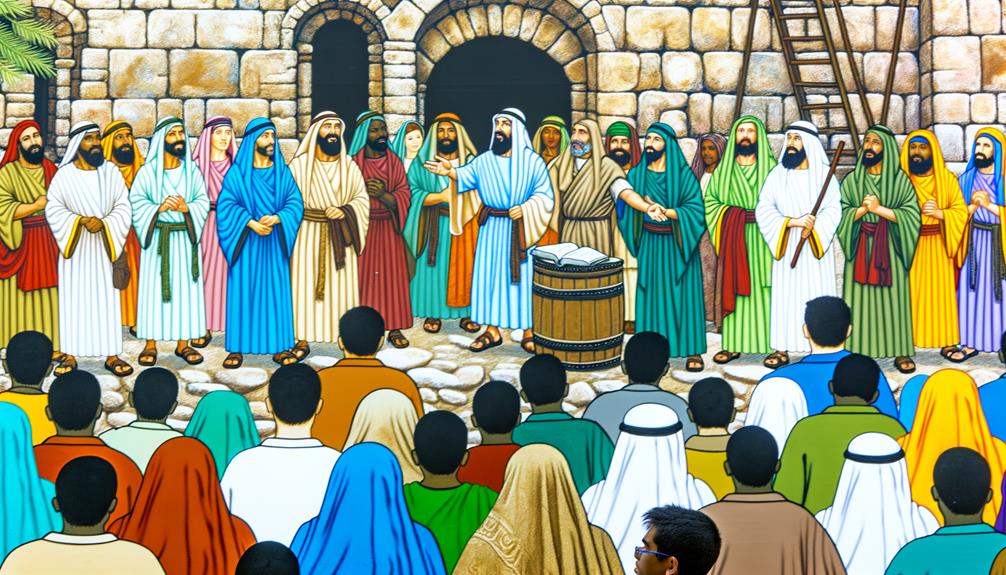
The Book of Acts delineates various ministerial roles that were essential for the early Christian community‘s growth and organization.
Apostles were primary leaders, entrusted with preaching, teaching, and establishing churches (Acts 2:42-47).
Deacons, as seen with Stephen and Philip, served by addressing practical needs, allowing apostles to focus on prayer and ministry (Acts 6:1-6).
Elders provided governance and pastoral care, maintaining doctrinal integrity (Acts 14:23).
Prophets and teachers, such as Agabus and Barnabas, played pivotal roles in guiding and edifying the church (Acts 13:1-3).
Collectively, these roles guaranteed the community’s spiritual and organizational health, demonstrating a divinely inspired structure for the nascent Church.
Their collaborative efforts were instrumental in spreading the Gospel throughout the Roman Empire.
Pastoral Epistles Insights

Drawing from the Pastoral Epistles, Paul’s letters to Timothy and Titus offer profound insights into the qualifications, responsibilities, and character of church leaders, underscoring the foundational principles for ecclesiastical governance and pastoral care.
These letters delineate essential guidelines for maintaining doctrinal purity and effective church administration while emphasizing moral integrity and spiritual maturity.
- Qualifications of Leaders: Emphasizes traits such as temperance, hospitality, and the ability to teach (1 Timothy 3:2).
- Responsibilities: Instructs on preaching the Word, sound doctrine, and reproving false teachings (2 Timothy 4:2-5).
These epistles provide a timeless blueprint for nurturing a faithful and effective church leadership.
Servanthood and Leadership

Servanthood in leadership, as exemplified by Jesus Christ, forms the cornerstone of biblical leadership paradigms, underscoring the necessity for humility and selfless service in ecclesiastical roles. The Gospels illustrate Christ’s model of leadership through servanthood, especially in John 13:1-17, where He washes His disciples’ feet, symbolizing the essential nature of humility. This approach contrasts with secular notions of power, promoting a leadership that prioritizes others’ needs. Historical ecclesiastical structures have mirrored this, fostering communities grounded in mutual respect and service.
| Aspect | Biblical Reference |
|---|---|
| Humility | John 13:1-17 |
| Selfless Service | Matthew 20:28 |
| Servant Leadership | Mark 10:42-45 |
This paradigm elevates leaders who serve, aligning with scriptural teachings.
Spiritual Gifts and Ministry

The New Scriptures emphasizes the diversity of spiritual gifts bestowed upon believers, each intended to serve and edify the body of Christ.
Rooted in passages such as 1 Corinthians 12 and Romans 12, these gifts highlight the communal aspect of ministry, wherein each member contributes according to their divine endowment.
Fundamentally, these gifts are imparted by the Holy Spirit, empowering individuals to fulfill their unique roles within the ecclesiastical structure.
Diverse Spiritual Gifts
Understanding the diverse spiritual gifts within the Christian ministry involves a thorough examination of scriptural passages, historical contexts, and theological interpretations that highlight the multifaceted nature of these divine endowments.
Scriptural references such as 1 Corinthians 12, Romans 12, and Ephesians 4 provide a foundational basis for recognizing the variety and purpose of spiritual gifts. These gifts serve to edify the body of Christ and manifest God’s presence in tangible ways.
- 1 Corinthians 12: Explores the unity and diversity of gifts within the church.
- Romans 12: Discusses the motivational gifts that inspire service and personal ministry.
This examination underscores how spiritual gifts are integral to Christian ministry, contributing to communal growth and divine mission fulfillment.
Serving the Church
In serving the church, spiritual gifts and ministry are crucial components that enable believers to fulfill their roles effectively within the body of Christ, as illustrated through scriptural teachings and historical ecclesiastical practices.
The Apostle Paul emphasizes in 1 Corinthians 12:4-7 that diverse gifts are distributed by the Spirit for the common good, creating a harmonious functioning of the church.
Historically, the early church fathers, such as Augustine, recognized the importance of these gifts in building a cohesive and spiritually robust community.
Ministries, ranging from teaching to administration, provide avenues for these gifts to manifest, ensuring that each member contributes to the church’s mission.
Accordingly, spiritual gifts and ministry are foundational in sustaining the church’s vitality and purpose.
Empowered by Holy Spirit
Empowerment by the Holy Spirit is evident through the distribution of spiritual gifts, enabling believers to effectively carry out their ministries as depicted in various New Covenant scriptures.
These gifts, referenced in passages such as 1 Corinthians 12 and Romans 12, are divinely bestowed to edify the church and manifest God’s presence.
Theologically, these gifts underscore the continuity of God’s work through His people, emphasizing the communal and interdependent nature of the Body of Christ.
Historically, the early church thrived through the active employment of these gifts, fostering growth and unity.
Scriptural analysis reveals that spiritual gifts include:
- Prophecy: Speaking God’s truth to others.
- Healing: Miraculous restoration of health.
Understanding these gifts enhances ministry efficacy and spiritual growth.
Modern Implications

Exploring the modern implications of the term ‘minister’ in the Bible reveals a dynamic interplay between historical context and contemporary applications, inviting a reevaluation of spiritual leadership and service in today’s world.
Historically, ‘minister’ encapsulated a servant-leader model, anchored in humility and divine commission (Mark 10:45). Today, this role extends beyond ecclesiastical boundaries, encompassing community service, social justice, and interfaith dialogue.
Scripturally, the Greek term ‘diakonos’ underscores a servant’s essence, urging modern ministers to embody Christ-like service (Matthew 20:26-28). This reevaluation challenges modern spiritual leaders to align with biblical principles of service, fostering holistic well-being and communal harmony.
Consequently, the biblical minister remains a timeless archetype, continually adapted to meet evolving societal needs.
Conclusion
The concept of the ministerial role in the Bible encompasses various dimensions, from Old Covenant priestly duties to New Covenant teachings of Jesus and the Apostles.
A remarkable statistic is that the term ‘minister’ (Greek: diakonos) appears over 30 times in the New Covenant, underscoring its significance in early Christian communities.
This multifaceted role, rooted in servanthood, spiritual gifts, and leadership, continues to inform contemporary Christian ministry and ecclesiastical structure.